
Compound interest is the engine behind nearly every long-term financial outcome: retirement balances, mortgage payoffs, credit card debt, and even the slow drag of inflation. Understanding it is less about memorizing a formula and more about seeing how three quiet variables (rate, frequency, and time) combine to produce results that feel disproportionately large.
This guide walks through what compound interest actually is, the formula that governs it, the difference between compounding daily and yearly, and the realistic scenarios where it helps or hurts you. By the end, you will be able to read a savings account disclosure, a loan amortization, or an investment projection and know exactly what is happening behind the number.
What Compound Interest Actually Is
Compound interest is interest calculated on both your original balance and the interest already earned. Each compounding period, the base used for the next interest calculation grows. That is the defining feature.
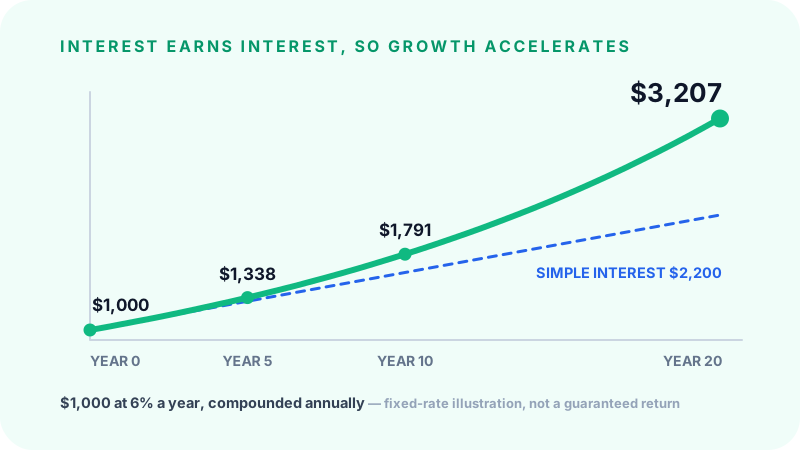
Simple interest, by contrast, only ever earns interest on the original principal. If you deposit $1,000 at 5% simple interest, you earn $50 every year forever, with no acceleration. With compound interest at the same 5%, year two earns interest on $1,050, year three on $1,102.50, and so on. The gap is small at first and then becomes the dominant force.
A helpful way to picture it: simple interest grows in a straight line, compound interest grows on a curve. The curve looks gentle for the first few years and then bends sharply upward. People often underestimate how dramatic that bend becomes, which is why compound interest gets called "the most powerful force in finance," not because the math is exotic, but because human intuition is bad at curves.
The Compound Interest Formula
The standard formula for compound interest is:
A = P (1 + r/n)^(nt)
Where:
- A is the final amount (principal plus accumulated interest)
- P is the principal, the starting amount
- r is the annual interest rate, expressed as a decimal (5% becomes 0.05)
- n is the number of compounding periods per year (12 for monthly, 365 for daily)
- t is the time in years
The interest earned alone is A − P.
A few things worth noticing. The rate r is the nominal annual rate, the headline number a bank or lender quotes. It is divided by n, so each period only gets a slice of it. But that slice is then applied n × t times. Higher n means smaller slices applied more often, which produces slightly more growth than fewer, larger slices, but only slightly, and never without limit, as we will see.
This formula applies to a single lump sum left alone to grow. If you are also adding money every month, the deposits each compound for a different length of time, so they need their own future-value calculation rather than this one.
Worked Example
Deposit $10,000 at a 6% annual rate, compounded monthly, for 10 years.
- P = 10,000
- r = 0.06
- n = 12
- t = 10
A = 10,000 × (1 + 0.06/12)^(12 × 10) A = 10,000 × (1.005)^120 A = 10,000 × 1.81940 A ≈ $18,194
Interest earned: about $8,194. At simple interest, the same deposit would have earned exactly $6,000. The extra $2,194 is the compounding effect.
Compounding Frequency: How Much Does It Really Matter?
This is one of the most misunderstood parts of compound interest. People often assume daily compounding will dramatically outperform annual compounding. The reality is more measured.
Using the same $10,000 at 6% for 10 years:
- Annually (n = 1): $17,908.48
- Quarterly (n = 4): $18,140.18
- Monthly (n = 12): $18,193.97
- Daily (n = 365): $18,220.29
- Continuously: $18,221.19 (the theoretical maximum, using A = Pe^(rt))
The difference between annual and daily compounding over a decade on $10,000 is about $312: not nothing, but far smaller than most people expect. The variable that genuinely moves results is time, followed by rate. Frequency is a distant third.
Notice too that frequency has a ceiling. Compounding every second, or every instant, does not run away to infinity: it converges on the continuous case, $18,221.19 here. Daily compounding already captures all but 90 cents of the maximum possible benefit at this rate. More frequent compounding cannot manufacture unlimited growth from the same nominal rate.
This matters when shopping for savings accounts: a bank advertising "daily compounding" at 4.0% APY is almost identical in outcome to one offering 4.0% APY compounded monthly. Focus on the APY (annual percentage yield), which already bakes in the compounding frequency. Two accounts with the same nominal rate but different frequencies will show different APYs; two accounts with the same APY are equivalent regardless of how often they compound.
Compound vs Simple Interest
| Feature | Simple Interest | Compound Interest |
|---|---|---|
| Interest base | Principal only | Principal + accumulated interest |
| Growth pattern | Linear | Exponential |
| Formula | I = P × r × t | A = P(1 + r/n)^(nt) |
| Common use | Short-term loans, most US auto loans, Treasury bills | Savings, investments, credit cards, long-term projections |
| Long-term advantage | Lower cost for borrowers | Higher returns for investors |
The takeaway: if you are saving or investing, you want compound interest. If you are borrowing, simple interest is usually friendlier. Credit cards genuinely compound, typically daily, on any balance you carry. Standard amortizing mortgages and student loans are different: as long as you make the scheduled payment, interest is charged on the outstanding balance each period and paid off, so it never gets added to principal. Compounding bites on those loans when unpaid interest is capitalized into the balance, which happens with deferred or forborne student loans and with negative-amortization mortgages.
Real-World Scenarios
Scenario 1: Starting Early Beats Starting Big
Two people each retire at 65. Anna invests $3,000 a year from age 25 to 35, then stops, for a total of $30,000 contributed. Ben invests $3,000 a year from age 35 to 65, for a total of $90,000 contributed. Both earn a steady 7% a year, with each contribution made at the start of the year.
At 65:
- Anna has roughly $338,000
- Ben has roughly $303,000
Anna contributed one-third as much and still ends with more. The reason is not magic; it is 30 extra years of compounding on her early dollars. Time in the market is the variable that compounded interest rewards most aggressively.
Two caveats, because this example is often quoted without them. First, a smooth 7% every year is a modelling assumption, not a promise: investment returns are not a contractual interest rate, and a real portfolio delivers that average, if at all, through years that are individually much better and much worse. Second, the result depends on when contributions land. The same schedule with contributions at the end of each year produces roughly $316,000 for Anna and $283,000 for Ben. The ranking does not change, but the numbers do, which is why it is worth stating the assumption rather than quoting a single figure as fact.
Scenario 2: Credit Card Debt Compounds Against You
Carry a $5,000 credit card balance at 22% APR, compounded daily, paying only the minimum each month. Take a common minimum formula: 1% of the balance plus that month's interest, with a $25 floor. Because the payment shrinks as the balance shrinks, payoff takes roughly 19 years and costs about $8,200 in interest.
Some cards instead set the minimum at a flat percentage of the balance. That is worse, not better. At a flat 2% of a $5,000 balance, the first payment is $100 while the first month's interest is about $92, so barely $8 goes to principal: the same debt runs past 70 years and well over $35,000 in interest before the $25 floor finally clears it. The exact figures depend on your card's minimum-payment formula, which is set out in your cardholder agreement.
The same balance attacked with $200 monthly payments clears in about 34 months with around $1,770 in interest. Compounding is neutral; it amplifies whatever direction you are pointing.
Scenario 3: The 30-Year Mortgage
On a $300,000 mortgage at 6.5% over 30 years, total interest paid is roughly $383,000, more than the loan itself. That is compounding from the lender's perspective. Even small rate differences (0.25% over 30 years on a large balance) translate into tens of thousands of dollars.
Common Mistakes and Misconceptions
Mistake 1: Confusing the nominal rate with the effective yield. A nominal annual rate is the headline number before compounding is accounted for. APY (or AER in some regions) is the effective annual rate after compounding. A 5% nominal rate compounded monthly is a 5.12% APY. The two are only equal when interest compounds exactly once a year. When comparing savings products, compare APYs. On the borrowing side, US APR bundles in most fees but is still quoted as a nominal rate, so a loan's effective annual cost is a little higher than its APR whenever it compounds more often than yearly.
Mistake 2: Assuming the curve is steep from day one. Compound interest looks underwhelming for the first 5–10 years. Many people give up on long-term saving because they cannot see the curve yet. The acceleration is real, but it lives in years 15 and beyond.
Mistake 3: Ignoring inflation. A 7% nominal return with 3% inflation is roughly a 4% real return. Compounding works on whichever number you choose, but the real number is what determines purchasing power.
Mistake 4: Treating contributions and growth interchangeably. Two portfolios can both reach $500,000, one funded mostly by contributions and one mostly by growth. The distinction matters for planning, because a balance built on contributions tells you what your savings rate can do, while a balance built on growth depends on returns repeating. Neither is inherently safer; past growth does not prove a rate is sustainable.
Mistake 5: Forgetting that fees compound too. A 1% annual expense ratio on an investment compounds against you the same way returns compound for you. On a 7% gross return, a 1% fee leaves about 24–25% less after 30 years and roughly 30% less after 40.
The Rule of 72: A Useful Shortcut
To estimate how long it takes for money to double at a given annual rate, divide 72 by the rate.
- At 6%: 72 / 6 = 12 years to double
- At 8%: 72 / 8 = 9 years to double
- At 12%: 72 / 12 = 6 years to double
It is an approximation (it works best for rates between 4% and 15%), but for back-of-envelope thinking it is hard to beat. Want to know what 25 years at 7% does to a balance? 72/7 ≈ 10.3 years per double, so 25 years is roughly 2.4 doublings, or about 5.4× the starting amount. (The exact figure, 1.07^25, is 5.43×.)
Step-by-Step: Calculating Compound Interest by Hand
- Convert the rate to a decimal. 4.5% becomes 0.045.
- Divide by compounding frequency. Monthly: 0.045 / 12 = 0.00375.
- Add 1. 1.00375.
- Raise to the power of total periods. 5 years monthly = 60 periods. 1.00375^60 ≈ 1.2518.
- Multiply by principal. $8,000 × 1.2518 ≈ $10,014.
- Subtract principal for interest earned. $10,014 − $8,000 = $2,014.
Most calculators with a y^x or x^y key can do this in under a minute. Spreadsheets handle it with =FV(rate/n, n*t, 0, -P).
When Compound Interest Is the Wrong Lens
Compounding assumes a constant rate. Real investments do not behave that way: markets fluctuate, dividends vary, and rates change. For volatile assets like stocks, the relevant compounding number is the geometric mean of returns, not the arithmetic average. A portfolio that gains 50% one year and loses 50% the next did not break even; it lost 25%. Compound thinking captures that; simple averaging hides it.
This is why long-term nominal return assumptions for diversified portfolios tend to land in the 5–8% range rather than at the higher single-year peaks, and why the corresponding real (after-inflation) assumption is several points lower again. Use realistic, geometric-mean-style numbers in projections, and keep nominal and real figures clearly labelled so you do not accidentally compound one and spend the other.
FAQ
What is compound interest in simple terms? Compound interest is interest earned on both the original amount and the interest already accumulated. Each period, the interest is added to the balance, and the next period's interest is calculated on the new, larger balance.
What is the compound interest formula? A = P(1 + r/n)^(nt), where A is the final amount, P is the starting principal, r is the annual rate as a decimal, n is the number of compounding periods per year, and t is the number of years.
How is compound interest different from simple interest? Simple interest only ever calculates interest on the original principal, producing linear growth. Compound interest calculates interest on principal plus prior interest, producing exponential growth.
Does daily compounding really make a big difference? Surprisingly little. At typical savings rates of around 4–6%, daily compounding adds under 0.2 percentage points of effective yield over annual compounding, and it can never add more than the continuous-compounding limit. The gap grows at high rates, which is why it matters much more on a 22% credit card than on a savings account. Time and rate matter far more than frequency.
Can compound interest work against you? Yes. Credit card balances, payday loans, and unpaid taxes all compound. The same exponential curve that grows savings can grow debt, which is why minimum payments on high-rate cards barely move the balance.
How do I calculate compound interest by hand? Convert the rate to a decimal, divide by the compounding frequency, add 1, raise to the power of total periods (frequency × years), multiply by principal, and subtract principal to get the interest portion.
What is the Rule of 72? A shortcut that estimates how many years it takes for money to double at a given annual rate: 72 divided by the rate. At 8%, money doubles in roughly 9 years. It is most accurate for rates between 4% and 15%.
Related Tools and Reading
For hands-on practice, use the Compound Interest Calculator to model scenarios with your own numbers, or compare against the Simple Interest Calculator to see the gap widen with time. If you are planning long-term savings, the Savings Goal Calculator builds monthly contributions into the projection. For debt-side compounding, the Loan Calculator shows how amortization handles compound interest in reverse.
Pair this article with our guides on APR vs APY and How to Calculate Percentages for a complete foundation in everyday financial math.
Conclusion
Compound interest is not a trick or a hidden feature. It is the default behavior of nearly every interest-bearing account, loan, and investment. The math is straightforward; the lesson is harder. Time matters more than rate, rate matters more than frequency, and consistency matters more than perfect optimization. Start early, contribute steadily, mind the fees, and let the curve do the work that intuition cannot.
The single most useful habit is running the numbers before making a financial decision rather than after. Whether you are evaluating a savings account, a loan, or a long-term investment, plug the inputs into the formula or a calculator and watch what time does to the result. That five-minute exercise is what separates people who understand compounding from people who merely have heard of it.