
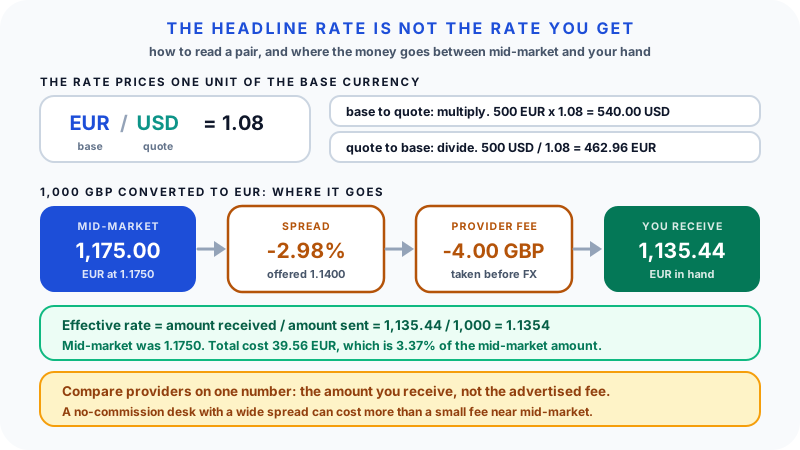
An exchange rate is the price of one currency measured in another. That is the whole idea. Everything else in this guide is about two things the headline number does not tell you: which direction to do the arithmetic in, and how much of your money disappears between the market rate you looked up and the amount that lands in your hand.
Those two things account for most real-world exchange rate mistakes. Multiplying when you should divide can be off by a factor of the rate squared. Ignoring the spread quietly costs 1 to 6 percent on a typical consumer transaction, and it never appears on the receipt as a fee.
The Short Version
- A pair is written BASE/QUOTE. The rate says how many units of the quote currency buy one unit of the base currency.
- Converting from the base currency, multiply. Converting into the base currency, divide.
- The rate you see quoted online is usually the mid-market rate, a wholesale midpoint. It is a benchmark, not an offer.
- Your actual cost is the spread (a worse rate) plus any fee. Compare providers on the amount you end up receiving, not on the advertised fee.
- Exchange rates tell you nothing about local prices. A high rate does not mean a cheap destination.
Reading a Currency Pair
Currency pairs are always written in a fixed order, and the order is what makes the arithmetic work.
EUR/USD = 1.08 means one euro costs 1.08 US dollars. EUR is the base currency, the one being priced. USD is the quote currency (also called the counter currency), the one doing the pricing.
USD/JPY = 155 means one US dollar costs 155 Japanese yen. Here the dollar is the base.
This is why "the rate went up" is ambiguous unless you know the pair. If EUR/USD rises from 1.08 to 1.12, the euro got stronger and the dollar got weaker, because it now takes more dollars to buy the same euro. If USD/JPY rises from 155 to 160, the dollar got stronger against the yen. The same currency can be the base in one quote and the quote in another.
Getting the Direction Right
The commonly repeated formula is:
converted amount = original amount x exchange rate
That is only correct when your original amount is in the base currency of the pair you are using. Written properly, for a rate quoted as BASE/QUOTE:
- Base to quote: amount in quote = amount in base x rate
- Quote to base: amount in base = amount in quote / rate
Worked both ways with EUR/USD = 1.08 (an illustrative rate, not a live one):
- You have 500 euros and want dollars. Euros are the base, so multiply: 500 x 1.08 = 540 US dollars.
- You have 500 dollars and want euros. Dollars are the quote, so divide: 500 / 1.08 = 462.96 euros.
If dividing feels awkward, invert the rate first. The inverse of 1.08 is 1 / 1.08 = 0.9259, so USD/EUR = 0.9259, and now you can multiply: 500 x 0.9259 = 462.96 euros. Same answer, and it is often easier to sanity-check because the multiplication direction is familiar.
The quick sanity check that catches almost every direction error: decide first whether you expect a bigger or smaller number. A euro is worth more than a dollar in this example, so converting euros into dollars must give a bigger number, and converting dollars into euros must give a smaller one. If your result moves the wrong way, you multiplied where you should have divided. The Currency Converter handles the direction for you, but knowing which way it should go is how you catch a rate entered backwards.
Why Rates Move
A currency is a claim on an economy, and its price reflects how much of that claim people want to hold. Demand comes from far more than tourism:
- Trade flows. Buying a country's exports means buying its currency to pay for them.
- Investment flows. Foreign money entering shares, bonds, property or businesses has to be converted first.
- Interest rate differences. Higher returns on deposits and government bonds attract capital, all else equal.
- Inflation expectations. A currency losing purchasing power at home tends to lose it abroad too.
- Growth and stability. Political, legal and fiscal credibility affects whether investors want to hold a currency at all.
- Safe-haven demand. In a crisis, money moves toward currencies perceived as liquid and low-risk regardless of yield.
- Commodity prices, for economies whose exports are concentrated in oil, metals or agriculture.
- Central bank operations, including reserve management and direct intervention.
Two points make currency news easier to follow.
Markets price expectations, not facts. If traders already expect a rate rise next month, much of the move happens before the announcement. A central bank that raises rates by less than expected can see its currency fall on the day it tightened policy. This is why exchange rates so often appear to react backwards to news: the comparison being made is against what was already priced in, not against yesterday.
Single-variable explanations are usually wrong. An oil exporter whose export revenue is climbing may still see its currency fall if investors are worried about inflation or debt. Any given day's move is a net result of several forces pulling in different directions.
Floating, Pegged, and Managed
Exchange rate regimes sit on a spectrum, and the IMF catalogues where every member country actually sits in its Annual Report on Exchange Arrangements and Exchange Restrictions.
Floating. The rate is set mainly by market trading. The US dollar, euro, pound, yen, Swiss franc, Canadian dollar and Australian dollar broadly work this way. Central banks still shape conditions through interest rates and communication, but they are not targeting a rate.
Fixed or pegged. Authorities commit to holding the currency at or near a set value against another currency or a basket. This buys predictability for trade and investment, which matters most for small or highly open economies. The cost is that defending the peg can require large foreign currency reserves, interest rates set for the peg rather than the domestic economy, or capital controls. A peg is only as strong as the reserves and the political will behind it.
Managed float. The rate moves, but authorities intervene to smooth sharp swings or hold a broad range. Most of the world sits somewhere in this middle ground rather than at either pole.
Neither end is better in the abstract. Fixed rates trade flexibility for certainty; floating rates trade certainty for the ability to absorb shocks through the exchange rate rather than through wages and employment.
Where the "Real" Rate Comes From
Foreign exchange is a decentralised global market rather than an exchange in one building. Trading follows the business day around Sydney, Tokyo, Singapore, London and New York, so the major pairs move almost continuously during the working week. It is also enormous: the Bank for International Settlements, which measures the market every three years, put average daily turnover in over-the-counter FX at 7.5 trillion US dollars in April 2022.
Because there is no single exchange, there is no single official price. What converters and news sites show is the mid-market rate: roughly the midpoint between the best wholesale bid and offer at that moment. Nobody actually transacts at the mid-market rate. It exists as a neutral reference point, which is exactly what makes it the right benchmark for comparing what you were offered.
Some central banks publish their own daily reference rates for accounting and reporting, such as the ECB's euro foreign exchange reference rates, fixed once each working day. These are reference values for statistics and contracts, not the rate a consumer is offered either.
The Spread and the Fee: Working Out What You Actually Paid
Providers make money two ways, and most use both:
- The spread: they give you a rate worse than mid-market. This is invisible unless you look up the mid-market rate yourself.
- The fee: an explicit charge, fixed or percentage.
"No commission" signage refers only to the second one. A zero-fee provider with a 5 percent spread is far more expensive than a provider charging a small flat fee at a near-mid-market rate.
Here is the arithmetic on a realistic transaction. Mid-market GBP/EUR is 1.1750. Your provider offers 1.1400 and charges a 4 pound fixed fee. You hand over 1,000 pounds.
| Step | Calculation | Result |
|---|---|---|
| At mid-market | 1,000 x 1.1750 | 1,175.00 EUR |
| Fee deducted first | 1,000 - 4 | 996.00 GBP converted |
| At the offered rate | 996 x 1.1400 | 1,135.44 EUR |
| Total shortfall | 1,175.00 - 1,135.44 | 39.56 EUR |
| Total cost as a percentage | 39.56 / 1,175.00 | 3.37% |
The spread alone accounts for most of it: (1.1750 - 1.1400) / 1.1750 = 2.98 percent. The fee adds the rest.
The single number worth comparing across providers is the effective rate:
effective rate = currency received / currency handed over
Here that is 1,135.44 / 1,000 = 1.1354, against a mid-market 1.1750. One division collapses the spread, the fee and any rounding into one figure you can put side by side with a competitor's quote. The Percentage Calculator is handy for turning that gap into a percentage when you want to compare across different transaction sizes.
Note also that fixed fees and percentage fees rank providers differently depending on the amount. A 4 pound fee is 0.4 percent on 1,000 pounds and 0.04 percent on 10,000. Always run the comparison at the size you are actually sending.
Dynamic Currency Conversion
Pay by card abroad and the terminal may offer to charge you in your home currency instead of the local one. The amount looks reassuring because it is in familiar money. It is usually the more expensive option.
Choosing your home currency hands the conversion to the merchant's payment processor, which sets its own rate and keeps the margin. Choosing the local currency leaves the conversion to your card network, whose wholesale rates are typically much closer to mid-market. Card networks and issuers may add their own foreign transaction fee on top, so the honest comparison is your card's total cost against the terminal's offer, but in most cases paying in the local currency wins.
In the US, providers of international money transfers must disclose the exchange rate and the amount that will be received before you pay, and again on the receipt; the CFPB's guidance on sending money internationally sets out what those disclosures should contain. Rules differ by country, but the underlying habit travels: get the received amount in writing before committing.
Where the Cost Sits, By Method
- Airport and hotel exchange desks. Usually the widest spreads. They sell convenience at the moment you have the least ability to shop around.
- High street banks. Better than airports, often still 2 to 4 percent away from mid-market on cash.
- Debit and credit cards abroad. Network rates are close to mid-market; the cost is the issuer's foreign transaction fee, which varies from zero to around 3 percent. Check yours once and the question is settled for years.
- Specialist transfer providers. Typically the narrowest spreads on larger transfers, but the fee structure matters and headline rates are sometimes promotional.
- ATMs abroad. Two costs stack: your issuer's fees, and the local machine's own charge and DCC prompt. Decline the machine's conversion offer and take the local currency amount.
What a Weak or Strong Currency Does to Prices
A weaker home currency makes imports more expensive in local terms: fuel, food, electronics, machinery, medicines, raw materials. That feeds into domestic inflation over months, not days. Exporters benefit, because their goods become cheaper abroad, but only to the extent their own inputs are not imported.
A stronger currency reverses both effects. Imports get cheaper, exporters get squeezed.
Neither effect is fast or complete. Firms hedge, absorb margin, switch suppliers, or invoice in a dominant currency such as the US dollar, all of which delay and dampen the pass-through. This is also why a business with foreign receipts due in six months has a real risk to manage: a forward contract locks in a rate for a future date, trading away favourable moves in exchange for protection against damaging ones. Smaller businesses without derivatives still make the same decision by pricing in their home currency, holding foreign balances, or building an exchange rate buffer into quotes.
Exchange Rates Are Not Prices
This is the single most common misreading. An exchange rate tells you how many units of another currency you receive. It says nothing about what those units buy.
Getting 90,000 units of some currency for 1,000 dollars does not make a country cheap. Getting 0.8 units per dollar does not make it expensive. The numeric size of a rate is an accident of history and redenomination, not a measure of national wealth or cost of living.
The concept that does compare costs is purchasing power parity, which asks what a comparable basket of goods costs in each place. It is useful for economic comparison and imperfect for travellers, because visitors buy a different basket from residents: tourist-district hotels and airport taxis may be expensive in a country with low average prices. For trip budgeting, convert the currency and then research the actual prices of the actual things you will buy.
Inflation is the same erosion seen from the inside. Persistently higher inflation in one country than another tends, over years, to push its currency down, though the path is anything but smooth. How Inflation Quietly Reduces Your Purchasing Power covers the domestic half of that story, and the Inflation Calculator puts numbers on it.
What a Converter Can and Cannot Tell You
A currency converter is an estimate, and it is worth knowing exactly what kind:
- It shows a reference rate, usually mid-market, not an offer from anyone.
- Rates in a converter are as of a moment, and update on a delay that varies by data source. For a live transaction, the binding number is the one your provider quotes at the moment of the trade.
- It does not know your provider's spread, your card's foreign transaction fee, ATM charges, or receiving-bank fees.
- It cannot account for weekend and holiday gaps, when wholesale markets are closed and providers widen spreads.
- For pegged currencies, the quoted rate may be stable for long periods and then move in a single step. Stability in the past is not a forecast.
Use a converter to size the transaction and to establish the mid-market benchmark. Use the provider's own quote, in writing, to decide.
Getting a Better Result
- Look up the mid-market rate first, so you have a benchmark.
- Ask for the amount received, not the rate and the fee separately.
- Divide received by sent to get the effective rate, and compare that number across providers.
- Check your card's foreign transaction fee once, and carry a card without one if you travel.
- Always decline dynamic currency conversion at terminals and ATMs unless you have specifically checked that it wins.
- Scale your effort to the amount. A 200 pound holiday exchange does not deserve an afternoon of research. A tuition payment, property deposit, relocation transfer or business invoice does.
FAQ
Why do exchange rates change every day?
Because currencies trade continuously in a global market. Interest rate expectations, inflation data, trade flows, political events and investor risk appetite all shift the balance of buyers and sellers, and prices move to clear it.
What is the base currency in a currency pair?
The first currency listed. In EUR/USD, the euro is the base and the rate says how many US dollars one euro costs. Converting from the base currency you multiply by the rate; converting into it you divide.
What is the mid-market exchange rate?
Roughly the midpoint between the best wholesale buy and sell prices at a given moment. It is the standard neutral benchmark quoted by converters and news sites, but it is not an offer, and consumers are not given it.
Why is the travel money rate worse than the market rate?
Because the provider builds its margin into the rate as a spread, on top of any stated fee. A desk advertising "no commission" can still be expensive. Compare the amount you receive, not the fee.
Are fixed exchange rates better than floating rates?
Neither is universally better. A credible peg gives businesses certainty but requires reserves and policy discipline to defend, and can break under pressure. A floating rate absorbs economic shocks but leaves importers, exporters and travellers with uncertainty.
Does a strong currency mean a strong economy?
Not on its own. A currency can be strong because of high interest rates, safe-haven demand, or low inflation, and a strong currency actively hurts exporters. Economic health is a much broader question than one price.
How should I estimate travel money?
Convert with the Currency Converter to size the budget, then research real local prices for accommodation, transport, food and activities. The exchange rate sets how many units you get, not what a unit buys.
Related Tools
The Currency Converter handles the direction of the pair and the arithmetic. The Percentage Calculator turns a spread into a comparable percentage cost, and the Inflation Calculator shows what the same currency loses in purchasing power at home over time.
Related Reading
- How Inflation Quietly Reduces Your Purchasing Power
- Present Value Explained: Why Future Money Is Worth Less Today
- How to Calculate Percentages
Sources
- Bank for International Settlements, OTC foreign exchange turnover in April 2022
- International Monetary Fund, Annual Report on Exchange Arrangements and Exchange Restrictions
- European Central Bank, Euro foreign exchange reference rates
- Consumer Financial Protection Bureau, Sending money internationally
Final Thoughts
Two habits cover almost everything. Read the pair before you do the arithmetic, and decide in advance whether the answer should be bigger or smaller. Then judge every provider on one number: the currency you received divided by the currency you handed over. Everything else in this guide explains why those two habits matter; they are what actually saves money.