
Some pages sound as if the writer was paid by the repeated phrase. "Best budget running shoes" appears in the title, the first sentence, every subheading, three image captions, and a paragraph no human would say out loud. The page is not clearer. It is just louder.
Keyword density is the measurement that describes this. It tells you how often a term appears relative to the length of the text, and nothing more. It is a diagnostic reading, like a word count or a reading-level score: useful for spotting a problem, useless as a target to hit.
This guide explains what the number actually represents, how BlinkCalc's Keyword Density Checker calculates it, when the reading is worth acting on, and when it will mislead you.
What keyword density measures
The formula
Keyword density is a simple ratio expressed as a percentage:
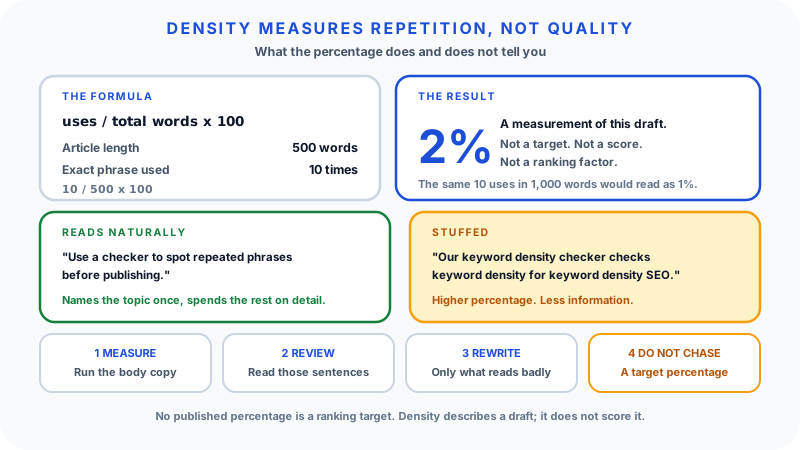
density = (keyword occurrences / total words) x 100Both halves of that fraction matter. The same count produces a very different percentage depending on how long the page is, which is why density figures are only comparable between texts of similar length.
Exact-match density
Most checkers, including this one, count exact matches: the literal sequence of words you asked about. "Running shoes" and "shoes for running" are different strings, so they are counted separately even though a reader treats them as the same idea.
This is worth holding onto, because it is the source of most misreadings. Exact-match density measures string repetition. It does not measure whether a page covers its topic, and the two can move in opposite directions: a page can raise its density while becoming less informative, or lower it while covering the subject far better.
A worked example
Take an article of 500 words that uses the exact phrase "keyword density checker" 10 times.
10 / 500 x 100 = 2%The result is 2 occurrences per 100 words. Now consider what that reading has and has not told you.
It has told you that the exact phrase appears on average twice per 100 words, or once every 50 words. It does not mean that 2% of the individual words belong to the phrase. In a 500-word piece, that repetition may be noticeable if the uses cluster in a few paragraphs.
It has not told you whether the article is useful, whether it answers the question behind the search, whether the repetition reads naturally, or whether 2% is better or worse than 1% or 4%. There is no percentage that search engines are known to reward, and no threshold that makes a page safe or unsafe. The 2% is a measurement of your draft, in the same way that "eleven paragraphs" is a measurement of your draft.
The useful next step is not to adjust the number. It is to read the 10 sentences containing the phrase and ask whether each one earns its place.
Why the number is descriptive, not a target
Rankings depend on relevance, usefulness, intent match, structure, links, page experience, and technical factors that a word counter cannot see. Density sits outside all of that. It is a property of your text, computed from your text, with no knowledge of the query or the competition.
The moment a percentage becomes a target, the writing starts serving the metric. Sentences get bent to include an exact phrase, or perfectly good sentences get gutted to bring a number down. Both directions make the page worse for the reader while leaving the underlying quality untouched.
Old advice that named specific percentages was a guess dressed as a rule. Treat any fixed figure the same way, including one produced by a tool.
How the BlinkCalc checker counts
Describing what your tool actually does prevents a lot of confusion. The Keyword Density Checker inspects words and phrases you already care about:
- Targets. Enter one or more known target words or phrases, separated by commas or new lines. Every target stays in the result, including targets with zero occurrences.
- Tokenizing. Unicode text is normalized before exact matching. Apostrophes, hyphens, decimals, thousands separators, and technical terms such as "Node.js", "C++", and ".NET" remain intact.
- Case. Matching is case-insensitive by default, so "SEO" and "seo" are the same token. A case-sensitive option is available.
- Exact matching. A word does not match inside a longer word. Phrase words must be consecutive and matches do not cross punctuation, new lines, masked URLs or email addresses, or excluded numbers.
- Numbers. Numeric tokens can be included or excluded. When excluded, they leave both the denominator and target matching; when included, values such as "3.14" and "1,000" stay whole.
- Rate. Each target reports an occurrence count and occurrences divided by total analyzed words, multiplied by 100. For a phrase, this is occurrences per 100 words rather than the share of words occupied by the phrase.
- Scope and privacy. The checker does not build generic keyword-discovery tables. Use Keyword Extractor to discover recurring keywords or keyphrases, or Word Frequency Counter for a complete word census. The check runs locally in the browser.
Different tools make different tokenizing choices. Two checkers can report different percentages for the same text without either being wrong, which is another reason to compare drafts within one tool rather than comparing numbers across tools.
When percentages mislead
Short pages
A short page can produce an alarming percentage from a small count. A 120-word product blurb that uses the product name four times sits above 3%, but four mentions in a short description is unremarkable. Below roughly a hundred words, the percentage is dominated by the denominator and tells you very little.
Read the count, not the percentage, on short text.
Narrow technical content
Some subjects genuinely require the same word repeatedly. A reference page about HTTP headers will say "header" constantly, because there is no accurate substitute. The same is true of glossary entries, specification pages, ingredient lists, and legal text, where precision matters more than variety.
A high density in that context is a property of the subject, not a fault in the writing. The test is whether a replacement would be clearer, and often it would not.
Low percentages
A low percentage is equally uninformative on its own. A well-researched guide can mention its exact target phrase twice while covering the topic thoroughly through examples, related terms, and structure. Nothing about that is a problem.
The one case worth checking is when the main subject barely appears anywhere, including headings and the opening paragraph, which sometimes signals that the page drifted away from the thing it set out to explain.
Template text versus body copy
If you paste a whole rendered page rather than the article body, navigation menus, footers, sidebars, cookie notices, and repeated calls to action all enter the count. A phrase in a global footer appears on every page and can dominate a short one.
For editorial review, analyze the body copy alone. Analyzing the full page is only useful when you are specifically checking whether template text is drowning the content, which is a real problem on thin pages with heavy chrome.
Keyword stuffing and what actually goes wrong
Keyword stuffing is unnatural repetition intended to influence search visibility rather than to inform a reader. Early search engines leaned heavily on visible text, and some site owners responded by repeating terms in paragraphs, footers, hidden text, and doorway pages.
What makes stuffing a problem now is less mysterious than it sounds: it produces bad pages. A page repeating "cheap laptop repair" every other sentence has spent its space on the phrase rather than on price, turnaround time, location, warranty, and which devices are covered. Readers leave because the page did not answer anything.
Compare these:
Stuffed:
Our keyword density checker helps you check keyword density because keyword
density is important for keyword density SEO. Use this keyword density checker
to improve keyword density on every keyword density page.
Natural:
Use a keyword density checker to spot repeated phrases before publishing. If one
term dominates the draft, rewrite a few sentences with clearer examples or more
useful detail.The second version still names the topic. It simply spends the remaining words on something the reader can use.
Writing for topic coverage instead of frequency
Related terms and variations
Human writing about one subject naturally produces a family of terms. A piece about this topic might use "keyword density", "term frequency", "repetition", "overused phrasing", and "word count" while discussing the same area. That variety helps readers follow the argument and reflects genuine coverage rather than padding.
The Keyword Extractor is useful here. If a draft's extracted terms are one phrase repeated and little else, the article is probably narrow. If they form a sensible spread of related concepts, the coverage is likely better.
This is not an instruction to scatter synonyms. Terms should appear because you are explaining something that requires them.
Branded and required terms
Product names, brand names, chemical names, statute names, and technical identifiers should not be swapped for vague pronouns to bring a percentage down. Precision is worth more than variety, and replacing a product name with "it" three sentences running usually makes a page harder to follow.
The same applies to headings. Vary them because each section covers something different, not because the target phrase appeared too many times.
When the metric is genuinely useful
Density earns its place in a few specific jobs:
- Spotting accidental repetition. Writers develop tics they stop noticing. Inspecting a suspected phrase shows whether you have leaned on it eleven times without realizing.
- Comparing drafts. Run a draft, edit for clarity, run it again. If the dominant phrase falls and the supporting vocabulary spreads out, the edit probably worked. This is the strongest use of the tool, because you are comparing like with like.
- Cleaning template-heavy text. On pages where boilerplate outweighs content, checking known template phrases makes that visible quickly.
- Editorial QA at scale. Across a batch of pages, an outlier is worth a human look. It may be fine. It may be a page that was written to a target rather than to a reader.
- Starting a conversation. "This phrase appears 34 times, can we vary the examples?" is a more useful note to a writer than "make the density 2%."
When not to use it
- Chasing a target percentage. There is no known percentage that improves rankings, so optimizing towards one optimizes towards nothing.
- Forcing exact-match terms. If a sentence is worse with the phrase in it, the phrase does not belong there.
- Substituting for intent analysis. Density cannot tell you what the searcher wanted, which questions the page must answer, or what competing pages already cover well.
- Judging quality. A page can hit any percentage you like and still be thin, inaccurate, or unhelpful. Density has nothing to say about accuracy or usefulness.
- Diagnosing thin content. When a page underperforms, the fix is almost always missing substance: examples, limitations, comparisons, troubleshooting, or definitions. Adjusting repetition changes nothing about what the page is missing.
Limits of frequency-based analysis
Frequency counting has no model of meaning. It cannot tell that "car insurance" and "auto cover" are the same subject, that a phrase appears inside a quotation, or that a paragraph is a code sample rather than prose.
It is also less reliable across languages. Word forms that inflect, compounding, and scripts written without spaces all interact with tokenization in ways a simple counter handles imperfectly. A phrase that looks repetitive to the tool may be grammatically ordinary, and a genuine repetition may be missed because the tool treats two word forms as unrelated.
Acronyms, product identifiers, code snippets, and quoted material all distort counts for the same reason. Automated frequency analysis is a reading aid, and it reads nothing.
A responsible editing workflow
- Write the draft for the reader, without watching any counter.
- Check coverage first. Does the page answer the question, show an example, name its limitations, and say who it is for?
- Run the density check on the body copy alone.
- Read the sentences containing your targets rather than reacting to the percentage.
- Rewrite what reads badly. Cut what repeats a point already made.
- Run it again and compare with the first reading, using the change as the signal rather than the absolute number.
The Word Counter helps at step three, since length is half of the calculation, and the Meta Tag Analyzer covers the same instinct in titles and descriptions, where repeating an exact phrase three times in 155 characters rarely helps anyone choose your result.
Common mistakes
Treating a percentage as a target. The number describes the draft. It does not prescribe one.
Removing necessary terms. A guide about PDF metadata will say "PDF" often, and should.
Stuffing headings. Headings exist so readers can scan. Repeating the target query in each one defeats that.
Watching single words only. Single-word density can look unremarkable while a two-word or three-word phrase repeats awkwardly.
Comparing percentages across tools. Different tokenizing and filtering rules produce different numbers for identical text.
Trying to fix thin content with repetition. Better examples, clearer structure, and real answers do the work that keywords cannot.
FAQ
What is keyword density?
Keyword density here is an occurrence rate: exact target occurrences divided by total analyzed words and multiplied by 100. For a multi-word phrase, the result is occurrences per 100 words, not the share of individual words occupied by the phrase.
Is there an ideal keyword density percentage?
No. There is no published or verifiable percentage that search engines reward, and page types differ too much for one figure to apply. Density is a description of your text, not a target.
What is keyword stuffing?
Keyword stuffing is unnatural repetition of a term intended to influence search visibility. It usually makes the page harder to read and crowds out information the reader actually needs.
Can keyword density still be useful?
Yes, as a diagnostic for targets you already have in mind. It reveals whether a required or suspected word or phrase is absent or repeated, and it is most useful when comparing two versions of the same page.
How do related terms help SEO content?
Related terms usually appear because a page genuinely covers more of its subject. The coverage is what helps; the vocabulary is a side effect of it, not a substitute.
Should I remove every repeated keyword?
No. Repetition is often necessary, especially with product names, technical terms, and legal language. Rewrite the repeats that read badly or add nothing, and leave the ones that are doing work.