
Here is an illustrative case, built from round numbers rather than a real person's file, because the arithmetic is the part worth seeing.
Carla earns $70,000. Her employer matches 100% of the first 6% of pay, so the most it will contribute is $4,200 a year. For her first four years she contributes nothing, and the employer contributes nothing. For the next four she contributes 2%, which captures $1,400 of match and leaves $2,800 unclaimed each year.
Add it up: four years at $4,200 missed, then four years at $2,800 missed, is $28,000 of employer money never paid, before counting any growth it would have earned. Nothing unusual happened to Carla. She simply never read the two lines of her plan summary that describe the formula.
This article is for the version of Carla who reads those two lines this week instead of in eight years.
What a 401(k) match actually is
A 401(k) match is a contribution your employer makes to your retirement account, based on how much you contribute yourself. It is part of the compensation package; it is just paid into an account you will not draw on for decades, instead of into the bank account you check on Friday.
The defining feature is that it is conditional on your own contribution. If you put in nothing, the employer puts in nothing. If you put in a small amount, the employer matches a small amount. Above a certain threshold, the match stops; you can keep contributing on your own, but the employer's share will not increase further.
Different employers structure the conditional bit differently. The three patterns below cover the vast majority of plans.
Common match formulas
100% match up to a percentage of salary. Often expressed as "100% on the first 4%" or "100% on the first 6%." The employer matches dollar-for-dollar on every dollar you contribute, up to that ceiling. Above the ceiling, your contributions continue, but no further match is added.
Partial match up to a percentage of salary. Often expressed as "50% on the first 6%" or "50% on the first 8%." The employer adds 50 cents for every dollar you contribute, up to the cap.
Tiered match. A few plans combine the two: "100% on the first 3%, then 50% on the next 2%." This is the same idea split across two thresholds.
The differences are mathematically meaningful. A 100% match on 4% is the same total employer contribution as a 50% match on 8%. The amount you have to contribute personally to capture the full match, though, is twice as high in the second case. That detail matters a lot when planning around a tight monthly budget.
Reading your own plan summary carefully, once and in detail, is the single best return on a half hour of time you will get in your working life.
What "full match" means
The full match is the maximum amount the employer is willing to contribute in a given year, given by their formula. To capture it, you must contribute enough to clear the formula's threshold.
For a "100% on the first 5%" plan, you have to contribute at least 5% of your salary to receive the full match. Contribute 4% and you get a 4% match, three quarters of what was on the table. Contribute 0% and the employer contributes 0%.
The trap is that contributing some feels like progress, and in absolute terms it is. But while you are below the match threshold, every additional dollar you contribute earns more than a dollar in real return, because the match doubles or adds to it. That is the only time in personal finance that you are reliably getting a 100% return on a savings dollar. Once you cross the threshold, the match stops; the saving continues, but the multiplier disappears.
Vesting: when the match actually belongs to you
Receiving a match and owning it are not the same thing. The match is subject to a vesting schedule, which describes how much of the employer's contribution you keep if you leave the company before a certain point.
Three vesting patterns are common.
Immediate vesting. You own the match the moment it lands in your account. Many newer plans, particularly at tech companies and startups, work this way.
Cliff vesting. You own 0% of the match until you have been at the company for a set period, then 100% after that. For employer matching contributions in a 401(k), federal law caps the cliff at three years of service, so a plan can make you wait three years but not five.
Graded vesting. A schedule that increases with each year of service. The slowest schedule the law allows for matching contributions is six-year graded: 20% vested after two years of service, then another 20% each year, reaching 100% after six. Plenty of plans are faster than that; none may legally be slower.
Your own contributions are always fully yours, regardless of vesting. The IRS vesting page is explicit that employee elective deferrals are 100% vested from the moment they are withheld. Only the employer's portion is subject to a schedule, and every participant must be fully vested by the plan's normal retirement age or if the plan terminates.
The place to find your own schedule is the summary plan description, the plain-language booklet the plan is required to give you. The U.S. Department of Labor's booklet What You Should Know About Your Retirement Plan describes what that document must cover, including when contributions vest.
This matters most for people who change jobs frequently. The match looks like compensation, but a portion can evaporate if you leave too soon. For most workers staying multiple years, vesting is a footnote; for shorter tenures, it is a real consideration in job moves.
The match and the contribution limits are two different things
This is the single most common point of confusion, and it is worth separating carefully.
The elective deferral limit is yours alone. For 2026 the IRS caps employee salary deferrals to 401(k), 403(b) and most 457 plans at $24,500. Workers aged 50 and over can add a catch-up contribution of $8,000, and participants aged 60 to 63 have a higher catch-up of $11,250 where the plan offers it. Those figures are announced annually; the IRS notice for 2026 is the primary source.
The employer match does not count against that limit. It counts against a separate, much larger ceiling on everything credited to your account in a year: your deferrals, the match, any profit-sharing contribution, and reallocated forfeitures. For 2026 that annual additions limit is $72,000, or $80,000 once catch-up contributions are included. The IRS contribution limits page sets out how the two interact.
A third limit quietly caps the match itself. Only the first $360,000 of compensation in 2026 can be counted by the plan when it applies its formula. A 6% match on a $500,000 salary is calculated on $360,000, not on $500,000. Most readers will never touch this, but high earners who expect a percentage of their whole salary are often surprised.
So "I maxed out my 401(k)" and "I captured my full match" are different achievements, and it is entirely possible to do one without the other.
How the match is paid matters more than people expect
Most plans compute the match each pay period, not once at year end. That mechanical detail creates a trap for anyone who front-loads.
Suppose the formula is 100% on the first 5%, you earn $120,000 across 24 pay periods, and you decide to hit the $24,500 deferral limit by June. From January to June you defer heavily and the plan matches 5% of each of those paychecks. From July onward you are at the limit and contribute nothing, so there is nothing to match on the second half of the year, and roughly half the annual match never arrives.
Some plans protect against this with a true-up: after year end the employer recalculates the match on your annual totals and deposits the difference. Many plans do not. Whether yours does is stated in the summary plan description, and it is worth checking before changing your deferral percentage mid-year. If there is no true-up, spreading contributions evenly across all pay periods is the safer default.
Contribution percentage vs dollar amount
Plans usually let you set your contribution as a percentage of salary or as a fixed dollar amount per pay period. Both methods reach the same destination, but the percentage version stays aligned with salary changes.
If you set 6% and your salary goes up by $4,000, your contribution rises automatically. If you set $250 per pay period and your salary rises, your contribution stays flat, drifting below the match threshold over time.
A reliable habit is to set contributions as a percentage at least equal to the match cap, and to revisit the percentage annually around performance review time. Most people who lose the match later in their career do so because their contribution drifted, not because they chose to opt out.
The 401(k) Calculator is built around this kind of percentage view: enter salary, contribution percentage, and match formula, and it shows total annual contributions including the employer share.
A worked example
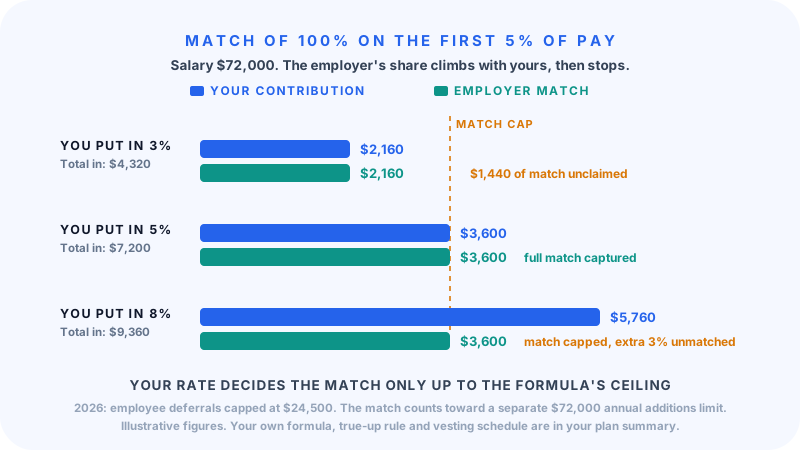
Aaron earns $72,000 a year. His employer's match is 100% on the first 5%.
If he contributes the full 5%, his contribution is $3,600 per year, the employer contributes a matching $3,600, and the total going into the account is $7,200, twice what came out of his pay.
If he contributes only 3%, his contribution is $2,160 and the employer contributes $2,160. He is leaving $1,440 of employer money on the table every year.
If he contributes 8% (above the threshold), his contribution is $5,760 and the employer still contributes $3,600 (the cap). Aaron is saving more, but the match portion does not grow beyond what the formula allows.
Over a 30-year career, assuming flat salary, which is unrealistic but a simple baseline, that $1,440-per-year gap grows substantially. At a 6% annual return, the Future Value Calculator shows the missed match alone compounds to roughly $113,000 by retirement. That is the same money the spreadsheet does not put on his paycheck today.
Once salary growth and dollar-cost averaging are layered in, the number is larger still. The exact figure depends on assumptions; the magnitude is the part worth remembering.
The long shadow of a missed match
The most painful version of this story is not someone who misses a year. It is someone who misses a decade because of a single early-career assumption: "I'll start when I'm earning more" or "I'll catch up later." Compound returns are unforgiving to delays.
A simple comparison clarifies it. Two workers each earn $60,000, get a 100% match on 5%, and contribute 5% for the years they participate. Worker A contributes from age 25 to age 45 and then stops. Worker B contributes from age 35 to age 65 and never stops. Both retire at 65. Both got the same match while contributing. At a 6% return, Worker A, who contributed for 20 years and stopped early, usually ends with more, simply because the early dollars had ten more years to compound.
The lesson is not that you should stop contributing at 45. It is that the first decade of contributions, including the match, carries far more weight than its share of the calendar suggests. Skipping the match early is one of the most expensive financial decisions most people are unaware of making.
What to do with the rest of your savings capacity
Once you are capturing the full match, you have several reasonable next steps. The order depends on your situation, and the conversation with a financial planner is the right place to make the call. But the general framing most planners use is something like:
- Contribute enough to get the full employer match. This is universally agreed-on as a high priority.
- Pay down high-interest debt aggressively. Credit card balances at 22% will outpace nearly any investment return.
- Build an emergency fund of three to six months of essential expenses.
- Continue contributing to the 401(k) or to an IRA, depending on the tax treatment that suits your bracket and goals.
- Above retirement-account caps, consider taxable investing tied to specific goals.
For the broader retirement-readiness question, am I saving enough?, the Retirement Calculator is the right next step. The match is a key input; it is rarely the whole picture.
What a 401(k) calculator can and cannot estimate
A calculator is a projection tool, not a statement of account. Being clear about which side of that line each number falls on saves a lot of misplaced confidence.
What it estimates well. Arithmetic that follows directly from your inputs: this year's contribution in dollars given a salary and a percentage, the employer's contribution given a formula, the combined total, and how a chosen contribution rate compares with the match threshold. If you want to know whether 4% clears a "100% on the first 5%" formula, the calculator answers definitively.
What it projects, with widening error bars. Anything involving future years. Investment returns are assumed, not known, and a single assumed rate hides the fact that real sequences of returns are lumpy. Salary growth, promotions, job changes, and years out of the workforce are all guesses. A 30-year projection is a shape, not a forecast, and the further out you read it the more it should be treated as illustrative.
What it does not know at all. Your plan's exact match formula wording, whether the match is trued up at year end, your vesting schedule, plan fees and fund expense ratios, whether your employer's contribution is a match or a separate nonelective contribution, your tax situation, and any plan-specific eligibility waiting period. All of that lives in your plan documents. A calculator that shows a confident total is showing you the consequence of your assumptions, not a prediction of your balance.
Read the output as a comparison rather than an answer. The useful question is "how much does the total change if I move from 3% to 5%?" rather than "what will I have at 65?"
Common mistakes around 401(k) match
Setting and forgetting contribution amounts. A flat dollar amount drifts below the match threshold as salary grows. Use a percentage.
Skipping signup because the paperwork is dry. Many employers automatically enrol new hires; many do not. Make the call yourself rather than letting default behaviour decide for you.
Ignoring vesting in job-change planning. If your match vests on a cliff at three years and you are at two years and ten months, the question of when to leave deserves the math.
Treating the match as bonus money you can take or leave. It is part of the compensation package. Walking past it is a permanent pay cut.
Believing you will "catch up later." Catch-up contributions for older workers do exist in most plans, but they require both available cash flow and the discipline to use them. Most people in catch-up phase tell you they wish they had started ten years earlier.
Confusing the match with the contribution limit. The $24,500 elective deferral limit for 2026 applies to your salary deferrals. The employer match sits outside it and counts instead toward the separate $72,000 annual additions limit. Hitting the deferral limit early in the year can actually cost you match in a plan without a true-up, which is the opposite of what most people assume.
Ignoring the difference between traditional and Roth versions. Your own deferrals can often be traditional (pre-tax) or designated Roth (after-tax). Employer contributions have historically been made on a pre-tax basis and taxed when withdrawn, but that is no longer the only possibility: under section 604 of the SECURE 2.0 Act, a plan may permit matching and nonelective contributions made after December 29, 2022 to be designated as Roth contributions, provided the applicable requirements are met, including that the contribution is fully vested and nonforfeitable when it is made. A Roth-designated employer contribution is included in your gross income for the year it is contributed rather than taxed at withdrawal. Whether the option exists at all is up to your employer's plan, which is not required to offer it, so check your plan documents; the IRS sets out the conditions in Notice 2024-2. None of this changes the match arithmetic; it changes when the tax is paid.
FAQ
What is a 401(k) employer match? A contribution your employer makes to your retirement account, conditional on your own contribution. It is part of compensation, paid in retirement form.
What does "full match" usually mean? The maximum the employer will contribute under their formula, achieved only when your own contribution meets or exceeds the threshold in the formula.
What is vesting, and why does it matter? Vesting is the schedule on which the employer's match becomes legally yours. Immediate vesting means it is yours right away; cliff and graded vesting tie the ownership to time at the company. Your own contributions are always fully yours.
If I leave my job, do I lose the match? You keep the portion that has vested, plus all of your own contributions and their growth. The unvested portion is forfeited, depending on the plan rules.
Should I contribute more than the match amount? Often yes, but it is a personal-finance question that depends on your other goals: debt, emergency fund, and tax situation. The match itself is the highest-priority piece; everything beyond it is a planning decision.
Is the match really free money? It is compensation conditional on participation. You are not entitled to it without contributing. But conditional on participation, the return on the matched dollar is unusually high; there are very few other places where saving a dollar reliably puts two dollars to work.
Sources
- 401(k) limit increases to $24,500 for 2026, IRA limit increases to $7,500 - IRS, annual cost-of-living adjustments.
- Retirement topics: 401(k) and profit-sharing plan contribution limits - IRS, on how deferral limits and the overall annual additions limit interact.
- COLA increases for dollar limitations on benefits and contributions - IRS, source of the annual compensation limit.
- Retirement topics: Vesting - IRS, on vesting schedules and what is always fully vested.
- Notice 2024-2, Miscellaneous Changes Under the SECURE 2.0 Act of 2022 - IRS, on when a plan may treat matching and nonelective contributions as designated Roth contributions.
- What You Should Know About Your Retirement Plan - U.S. Department of Labor, Employee Benefits Security Administration, on summary plan descriptions and participant rights.
Dollar limits are indexed annually. Check the current year's figures before acting on any number above.
What to do this week
Almost everyone reads about 401(k) matching as a generic personal-finance topic. The article that ends up mattering is the one read carefully enough to act on, ideally the same week. Pull up your plan summary today, find the match formula, and check that your current contribution captures it. The work is fifteen minutes. The cost of skipping that fifteen minutes compounds, very quietly, for the rest of a career.