
The first time Marcus saw a $312 invoice from an AI provider, he opened the dashboard ready to argue. He had only made what he thought of as a handful of calls: a long product description fed into a model, a few rewrites, a long thread with the support agent he was prototyping. The console showed something different: hundreds of thousands of tokens consumed across maybe two hundred requests. Nothing was broken. He had simply been paying for something he had not learned to see.
Tokens are the fuel meter for language models. Until you can see them, the bill looks random. Once you can, it stops being a mystery and becomes a design choice.
What a token actually is
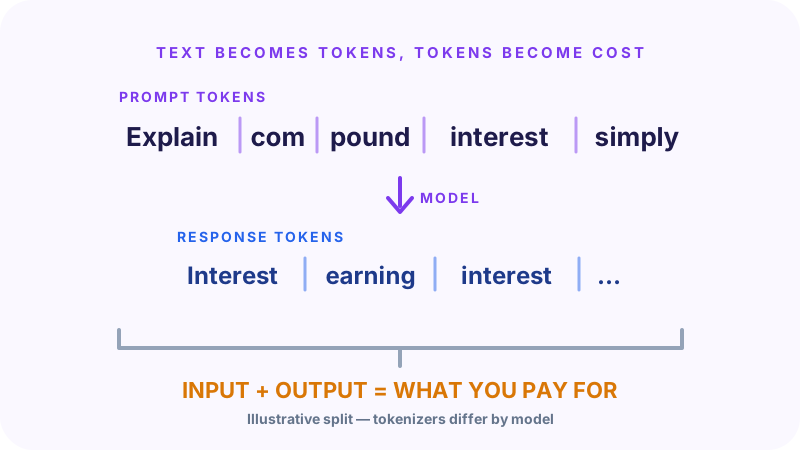
A token is a chunk of text the model treats as a single unit. Before a model sees your text, a piece of software called a tokenizer splits it into these chunks. Words, punctuation, and whitespace all get absorbed into the segmentation, though not one chunk each: most tokenizers attach a leading space to the word that follows it, so " house" is typically a single token rather than a space plus a word. The model never sees raw letters. It sees a sequence of token IDs, predicts the next token ID, and the tokenizer reassembles the result back into text on the way out.
The chunks are not all the same shape. Common English words like the, and, or house are usually one token each. Less common words get split: unbelievably might become three tokens (un, believ, ably). Numbers, code, JSON, and non-English text often tokenize into more pieces than their length suggests. A single emoji can sometimes burn three or four tokens.
The practical implication is that tokens are the unit the provider measures and charges by. Your prompt is converted to tokens, sent in, the model generates a response made of tokens, and you pay for both sides.
Why tokens are not the same as words
The rough heuristic that floats around online, about three-quarters of a word per token, or roughly 750 words per 1,000 tokens, is good for ballpark thinking and bad for invoices. The conversion rate depends on the language, the content type, and even the tokenizer version.
Some quick examples to make this concrete. A sentence of plain English like "*The customer would like a refund.*" is around 8 tokens. The same idea written in JSON, {"intent": "refund_request", "customer": "logged_in"}, is closer to 18 tokens, because punctuation, quotes, and underscores each cost their own units. Code snippets, especially with long identifiers, often tokenize at less than half a word per token. Non-Latin scripts, including Japanese, Hindi, and Arabic, can tokenize at roughly one token per character in some tokenizers, which means the same idea in two languages can have wildly different bills.
The takeaway is simple: estimates work for prose, fail for structured input. If you are sending logs, JSON, code, or non-English text, do not assume your word count predicts your token count.
Input tokens vs output tokens
Almost every provider splits its pricing into at least two rates: one for the tokens you send (input) and another for the tokens the model returns (output). Output is the more expensive side. Checked against the published price lists of the major providers in August 2026, the output rate commonly sits at four to six times the input rate on flagship and mid-tier models, though the exact multiple is a per-model decision and changes with each release. There is a reason for the gap: generating each token requires running the model forward, while reading the input is comparatively cheap.
Providers do not all account for tokens the same way, either. What counts as an input token, how system prompts and tool definitions are billed, and whether images or audio are converted into token equivalents all vary. Read the pricing page for the specific model you are calling rather than porting assumptions across vendors.
This is why a "small" prompt that produces a "long" reply can dominate the cost. Asking for "a one-page memo summarizing this email thread" could send in 1,500 tokens of email and receive back 1,200 tokens of memo, and the reply might be three-quarters of the total spend. The lever you have is the response. Asking for a tight summary, capping output length with the provider's max_tokens parameter, and shaping the prompt to discourage rambling all push the same direction.
Why long chat history quietly inflates the cost
The biggest surprise in production bills usually comes from this: in a chat-style interface, every previous message is resent on every turn. The model itself is stateless between calls. It only knows what is in the prompt this round, so to preserve continuity your application stitches in the prior turns, and you pay tokens for that history again. Some providers now offer server-side conversation state so your code does not have to resend the transcript by hand, but that is a convenience, not a discount: the retained context is still fed to the model and still billed as input.
Picture a customer support bot that has been chatting for fifteen turns. Turn one is cheap. Turn fifteen sends in turns one through fourteen plus the new question. If each turn averaged 200 tokens, turn fifteen has a 3,000-token input before the user has typed anything new. Over a long enough conversation, the same handful of messages can be re-billed dozens of times.
There are three practical ways teams handle this. They cap the number of past turns kept in the prompt, dropping the oldest. They summarize earlier turns into a single shorter "memory" block. Or they redesign the workflow so each call is closer to single-shot, with relevant context fetched on demand rather than carried forward.
Three billing lines the simple model leaves out
The input-plus-output picture is the right starting point, but three refinements change real invoices enough to be worth knowing. All three are provider- and model-specific, so treat them as things to look up rather than as fixed rates.
Cached input. Where a large, unchanging prefix is sent repeatedly, such as a long system prompt, a document, or an unchanged conversation opening, several providers will bill those repeat tokens at a steeply reduced rate. As of August 2026 the discounts on offer run to a large fraction of the standard input price, which is precisely why a chat history that stays stable at the front is far cheaper to resend than one that gets rewritten each turn. Ordering your prompt so the stable material comes first is a real optimisation.
Batch processing. Work that does not need an immediate answer can often be submitted as an asynchronous batch at a discount, typically around half the standard rate. Nightly classification, backfills, and evaluation runs are the natural candidates.
Reasoning tokens. Models that think before answering generate intermediate tokens that you may never see in the response body but that are usually billed as output. A reply that looks like 200 tokens on screen can carry a multiple of that behind it. If you are budgeting for a reasoning model, use the provider's reported usage numbers rather than counting the visible answer.
Because these mechanisms differ between vendors and shift with each release, the durable habit is the same one this whole article argues for: read the usage figures the API returns with each response, and treat any rate you remember as a number that needs re-checking.
Why model choice matters more than people expect
Within a single provider's catalogue, the difference between the cheapest and most capable model is usually large, sometimes ten or twenty times per token. A small model that handles a job well is almost always more economical than a flagship that overqualifies it.
The trap is benchmark instinct. People reach for the most capable model "to be safe," then run it on tasks like classification, tagging, simple extraction, or short rewrites where a far smaller model would perform almost identically. The smaller model also tends to be faster, which compounds the saving in latency-sensitive products. The rule that holds across many teams is: try the cheap model first, evaluate against your real data, only escalate the calls that actually need it.
Most production systems end up with a tiered routing setup. Cheap model for routine work, mid-tier for ambiguous cases, top-tier for the small slice where quality matters most. This is also the place where the API Cost Calculator earns its keep, because it lets you plan the cost of routing under different traffic mixes.
A worked example
Suppose you are building a tool that turns a customer's long-form complaint into a structured triage card. A representative request looks like this:
- System prompt with formatting rules: ~250 tokens
- User-supplied complaint: ~600 tokens
- Few-shot examples to guide the format: ~400 tokens
- Input total: ~1,250 tokens
- Model reply (structured card plus brief reasoning): ~350 tokens
- Output total: ~350 tokens
Take an illustrative price (verify with the provider) of $0.50 per million input tokens and $1.50 per million output tokens.
- Input cost: 1,250 × $0.50 / 1,000,000 = $0.000625
- Output cost: 350 × $1.50 / 1,000,000 = $0.000525
- Cost per request: about $0.00115
Run that 50,000 times in a month and the monthly cost lands around $57. Switch to a model ten times more expensive without changing the prompts and the same usage costs roughly $570. Add a chat history that grows to 4,000 input tokens per call and the bill multiplies again. None of that needs a code change, only a prompt that grew quietly.
To sanity-check the input side without sending the request, the AI Token Calculator lets you paste a prompt and see the token count by model family before you commit.
When the AI Token Calculator is the right tool
The token calculator is for the single request question. How big is this prompt? How does it change if I trim the system message? How many tokens am I burning per example? It is the right tool when you are drafting a prompt, refining a template, or auditing a single end-to-end call.
It is less useful for fleet questions: monthly spend at scale, cost per user, the price of growing from 100 to 10,000 users. For those, you need to compose token estimates with traffic assumptions.
When the API Cost Calculator does the heavier lifting
The API Cost Calculator is the planning tool. It takes per-request token estimates and multiplies them across users, requests per user, and overage tiers. If the token calculator asks "how big is one request?", the cost calculator asks "what does my month look like if 5,000 people each send 30 of these?"
A reasonable workflow: use the token calculator to lock down the average input and output sizes for your typical request, then take those numbers into the cost calculator to model the month at different growth scenarios. Tweak one or the other; do not try to do both in your head.
How a word counter and character counter help with rough size
You will not always have a real tokenizer on hand. Sometimes you just want to know whether a draft prompt is roughly 200 words or 2,000. The Word Counter gives a fast estimate that, for English prose, sits within reasonable error bars of the token count. Roughly multiply by 1.3 to 1.4 to estimate tokens for plain English text.
The Character Counter is sharper when you are checking whether a payload will fit a known cap, for example the context window of a specific model or a hard input-length limit in an internal pipeline. Counters are an early-warning tool, not a substitute for measuring tokens directly. Use them to filter obviously oversized content before pushing through the proper tokenizer.
Common mistakes that show up in production bills
Treating one token as one word. It is the most expensive shortcut in this domain. For prose it is in the ballpark; for code, JSON, structured payloads, and non-English content it is wrong, sometimes by a factor of three.
Forgetting that the response is billed separately. Many cost surprises come from a prompt that quietly invites long replies. Adding max_tokens and explicitly asking for "a concise response" is not stylistic; it is fiscal.
Letting chat history grow unchecked. Production chat surfaces frequently end up sending the entire conversation on every turn. Bounding the history, summarizing older turns, fetching relevant context on demand, or arranging the prompt so a cacheable prefix sits at the front all bend the cost curve away from growing with the conversation.
Choosing a high-end model by default. Every job is a candidate for the cheapest model that meets the bar, with escalation reserved for the requests that genuinely need it.
Pricing in averages instead of percentiles. A typical request might cost $0.001, but the 99th-percentile request might cost $0.05. If your traffic has long-tail prompts, such as large documents, technical files, and multi-step reasoning, the average undercounts the bill.
Ignoring system prompts in the math. A 500-token system prompt is silently appended to every request. Over a million calls, that is half a billion input tokens you may not have planned for.
FAQ
What is a token in AI models? A token is a chunk of text, usually part of a word, a short word, or a punctuation mark, that a language model treats as a single unit when reading or generating. Pricing is measured in tokens.
Are tokens the same as words? No. A rough rule of thumb is that 1,000 tokens is around 750 English words, but the ratio shifts a lot for code, JSON, numbers, or non-English text. Always measure rather than assume.
Why do AI replies cost more than my prompts? Most providers price output tokens higher than input tokens, commonly four to six times higher as of August 2026, because generating each token requires running the model forward. The multiple is set per model, so check the current price list rather than assuming a ratio.
Does chat history really make every reply more expensive? Yes. In most chat designs, the entire prior conversation is resent with each new message. Long conversations can have very high effective input sizes by the end.
Is a cheaper model always the right pick? For routine tasks, often yes, but only if it meets your accuracy bar. Many teams use a tiered approach: a small model by default, a larger model for hard cases, evaluated against real data rather than benchmarks.
Should I count tokens before sending a request? For drafting and tuning, absolutely. Counting tokens once for a representative prompt turns the bill into a predictable function of traffic. For high-volume systems, building token counting into your monitoring is well worth the effort.
A short closing
The reason AI bills surprise people is rarely a pricing trick. It is that tokens are invisible by default, and what is invisible drifts. The minute you start counting them, for one prompt, then for a full conversation, then for the month, the spend stops being a black box and becomes a number you can budget, optimize, and defend. That is the only thing worth doing the math for: not the optimization itself, but the visibility that makes optimization possible.