
A piece of writing has three measurable dimensions: how long it is, how dense it is, and how easy it is to read. Word and character counts answer the first two; readability scores answer the third. Each has real uses, and each is misused in a predictable way, usually by treating a rough guideline as a hard rule.
Key Takeaways
- Word count = number of word tokens, typically separated by whitespace.
- Character count comes in two forms: with spaces and without spaces. Platforms rarely count the way you expect.
- Readability scores estimate the surface difficulty of text from sentence length and word length. They do not measure quality or accuracy.
- Flesch-Kincaid is the most common readability formula in English, and both of its variants are worth computing by hand once so you know what moves them.
- Widely quoted length limits are often guidelines, not caps. Google explicitly states there is no meta description character limit.
How Word Count Is Measured
The standard definition: a word is any sequence of non-whitespace characters separated from other sequences by whitespace.
Most word counters split text on whitespace (spaces, tabs, newlines) and count the resulting tokens. This usually matches what humans intuitively call words.
Examples:
- "Hello world" gives 2 words
- "Hello, world!" gives 2 words, since punctuation does not count
- "I'm here" gives 2 words, since apostrophes typically do not split words
- "co-operation" gives 1 word, since hyphens usually do not split
- "well-known author" gives 3 words
Edge cases vary by tool:
- Hyphenated compounds: "twenty-five" can be 1 or 2 words depending on the counter.
- Numbers: "$1,000" or "2026-05-11" typically count as 1 word.
- URLs and emails: usually count as 1 word.
- Words joined by a dash with no space: typically do not split.
For most purposes the variation is small, a percent or less. For strict requirements such as academic word limits or contest submissions, run the text through the specific counter that will judge it. A 5,000-word limit enforced by a submission system is not the same as a 5,000-word limit measured by your word processor.
Character Count: With and Without Spaces
Two common variants:
- Characters with spaces: every character in the text, including all whitespace.
- Characters without spaces: every character except spaces, and sometimes tabs and newlines.
Example: "Hello, world!" is 13 characters with spaces, 12 without.
Beyond that split, three distinctions cause real bugs:
- Code points vs bytes. In UTF-8 an emoji is usually 4 bytes but displays as one character. A database column declared as 160 bytes will not hold 160 emoji.
- Code points vs grapheme clusters. A family emoji or a flag is several code points joined together, and a letter with an accent can be stored as one composed code point or as a letter plus a combining mark. Depending on which a tool counts, the same visible text yields different numbers.
- Weighted counts. Some platforms deliberately do not count characters one for one. See X below.
When a platform enforces a limit, the platform's definition wins. Test against the real interface rather than a general-purpose counter.
Length Limits, and Which Ones Are Real
This table is the part of the topic most often repeated wrongly. The right-hand column is the important one.
| Context | Commonly quoted figure | What is actually true |
|---|---|---|
| X (Twitter) post | 280 characters | 280 for standard accounts and up to 25,000 for Premium. Counting is weighted: Latin text counts 1 per character, but emoji and CJK characters count 2, and any URL counts as a flat 23 characters however long it is |
| Meta description | 160 characters | No limit. Google states the snippet is truncated as needed to fit the device width, so there is no character cap to hit |
| Title tag | 60 characters | Also truncated by display width, not character count. 60 is a rough proxy for the pixel width that usually fits |
| SMS | 160 characters | 160 only in GSM-7 encoding. One emoji or curly quote switches the whole message to UCS-2, dropping it to 70. Multi-part messages lose header space and fall to 153 or 67 per segment |
| Email subject | 60 characters | A mobile-inbox preview convention, not enforced anywhere |
| Blog post | 1,500 to 2,500 words | An observed correlation in ranking studies, not a ranking factor |
| Academic abstract | 150 to 300 words | Usually a real, enforced limit. Check the specific venue |
The pattern is worth internalising: hard limits come from protocols and submission systems; soft targets come from display conventions. The SMS limit is real because it is in the cellular standard. The 160-character meta description is not, because search engines truncate visually and vary the cutoff by device.
The SMS case is the one that costs money. If a marketing message contains a single curly apostrophe pasted from a word processor, the encoding flips to UCS-2, the 160-character message becomes three segments, and the send cost triples. Straightening the quotes fixes it.
Readability Scores: What They Measure
Readability formulas estimate how easy a text is to read from two surface features: how long the sentences are, and how long the words are. Both Flesch formulas come from the same 1975 U.S. Navy research report that also produced the Automated Readability Index.
Flesch Reading Ease
A score usually falling between 0 and 100, where higher is easier.
Formula: 206.835 - 1.015 x (total words / total sentences) - 84.6 x (total syllables / total words)
| Score | Reading level |
|---|---|
| 90-100 | Very easy (5th grade) |
| 80-90 | Easy (6th grade) |
| 70-80 | Fairly easy (7th grade) |
| 60-70 | Plain English (8th-9th grade) |
| 50-60 | Fairly difficult (10th-12th grade) |
| 30-50 | Difficult (college) |
| 10-30 | Very difficult (college graduate) |
| 0-10 | Extremely difficult (professional) |
The scale is not bounded in practice. Dense text can score below zero, and a string of very short sentences can score above 100.
Flesch-Kincaid Grade Level
Outputs an approximate U.S. school grade.
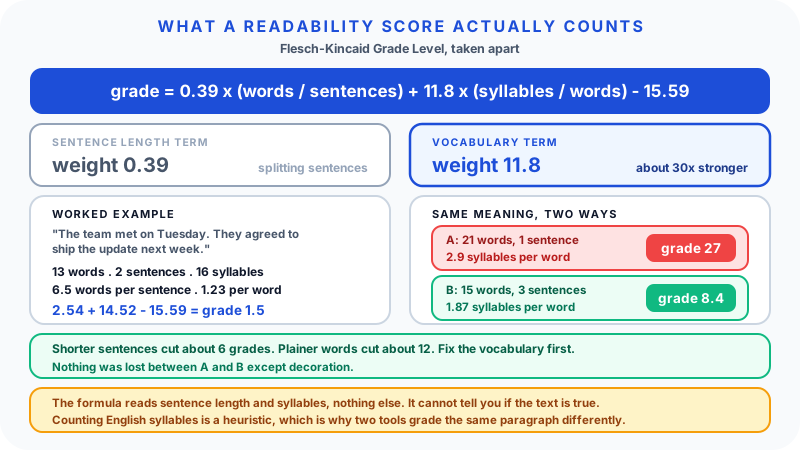
Formula: 0.39 x (total words / total sentences) + 11.8 x (total syllables / total words) - 15.59
A worked example
Take this text: "The team met on Tuesday. They agreed to ship the update next week."
- Sentences: 2
- Words: 13
- Syllables: 16
- Words per sentence: 13 / 2 = 6.5
- Syllables per word: 16 / 13 = 1.23
Grade level = (0.39 x 6.5) + (11.8 x 1.23) - 15.59 = 2.54 + 14.52 - 15.59 = 1.5
Reading ease = 206.835 - (1.015 x 6.5) - (84.6 x 1.23) = 96
Two things follow from doing this once. First, the formula has no idea what the sentence says; "The team met on Tuesday" and "The bomb went off on Tuesday" score identically. Second, the syllable term is multiplied by 11.8 while the sentence-length term is multiplied by 0.39, so word choice moves the score far more than sentence length does. Splitting one long sentence in two is a smaller edit than replacing "utilization" with "use".
Other common formulas
| Formula | Definition | Notes |
|---|---|---|
| Gunning Fog | 0.4 x [(words / sentences) + 100 x (complex words / words)] | Complex words are 3+ syllables, excluding proper nouns and words made long by -ed, -es, or -ing |
| SMOG | 1.0430 x sqrt(polysyllables x 30 / sentences) + 3.1291 | Designed for health materials; needs at least 30 sentences to be meaningful |
| Automated Readability Index | 4.71 x (characters / words) + 0.5 x (words / sentences) - 21.43 | Uses characters instead of syllables, so it is fast and deterministic |
| Coleman-Liau | 0.0588 x L - 0.296 x S - 15.8, where L is letters per 100 words and S is sentences per 100 words | Also syllable-free |
The syllable-free formulas exist for a good reason. Counting English syllables is a heuristic, not an algorithm. Tools disagree on "fire", "every", "business", and most names, and that disagreement is the main reason two readability checkers give you different grades for the same text. If two tools differ by a grade or so, the text has not changed; their syllable dictionaries have.
Target Reading Levels by Context
| Content type | Typical target grade |
|---|---|
| Children's books | 1-4 |
| Newspaper articles | 6-8 |
| Web content and blogs | 7-9 |
| Popular magazines | 8-10 |
| Technical documentation | 10-12 |
| Academic papers | 14-16 |
| Legal documents | 14+ |
| Patient health information | 6-8 |
Lower grade level usually means broader reach. But readability scores measure surface complexity, not topic difficulty, so plain language at a high grade level is a sign of unnecessary decoration rather than depth. The reverse also holds: you cannot make a genuinely hard idea easy by shortening the words around it.
How to Improve Readability
Two levers move the score, and one of them is much stronger than the other.
Shorter words. This is the 11.8 coefficient. Where a short alternative exists, prefer it: "use" over "utilize", "show" over "demonstrate", "now" over "currently", "about" over "approximately". Abstract nouns ending in -tion and -ment are usually a verb in hiding.
Shorter sentences. This is the 0.39 coefficient, so it moves the number less, but it often helps the reader more than the score suggests. Average 12 to 18 words, and vary the length; alternating long and short reads better than uniform.
Other fixes that improve reading without registering on any formula:
- Break long paragraphs into shorter ones
- Use active voice and name the actor
- Replace jargon with plain terms, or define it on first use
- Put the conclusion first, not last
- Read it out loud; anything hard to say is hard to read
A practical workflow: write the draft, check the score, target one or two grades lower, edit toward that, then stop. Editing past the point where the prose reads naturally is optimising the metric rather than the text.
When Not to Optimize Readability
Readability scores measure surface complexity, not quality. Lowering the grade level can strip nuance from technical writing, make academic content sound condescending, reduce information density, and discourage precise technical terms that specialists actually want. Standards documents, legal contracts, and research papers score badly and should. For an audience that wants the complexity, a low score is not the goal.
Worked Example: Comparing Two Versions
Version A: "In order to maximize operational efficiency, organizations should systematically implement strategies that facilitate the optimization of resource allocation across departmental boundaries."
21 words, 1 sentence, 61 syllables. That is 2.9 syllables per word, roughly double normal English. Flesch-Kincaid returns a grade of about 27, and Flesch Reading Ease returns about -60. Gunning Fog agrees, at about 29. All three are saying the same thing: this is off the scale, not merely difficult.
Version B: "To improve efficiency, companies should share resources across departments. Plan it carefully. Track what works."
15 words, 3 sentences, 28 syllables. Flesch-Kincaid grade of about 8.4, Reading Ease about 44.
Note where the improvement came from. Splitting one sentence into three cut the words-per-sentence term from 21 to 5, worth about 6 grades. Replacing the abstract nouns cut syllables-per-word from 2.9 to 1.87, worth about 12. The vocabulary did most of the work, and the meaning survived intact. What was lost was decoration.
Common Mistakes
Treating readability scores as quality scores. A grade-9 essay can be brilliant or terrible. The formula cannot read.
Treating soft display conventions as hard limits. Meta descriptions and title tags are truncated by pixel width, not character count. Writing exactly 160 characters guarantees nothing.
Counting characters when words matter, or the reverse. Know which unit the destination enforces before editing to fit.
Forgetting encoding. One emoji can halve an SMS limit, and one pasted curly quote can triple a campaign's cost.
Assuming a platform counts one character per character. X weights emoji and CJK at 2 and fixes every URL at 23.
Padding to hit word counts. If the requirement is 1,500 words, 1,400 strong words usually beat 1,500 padded ones.
Trusting one formula in isolation. If Flesch-Kincaid says grade 7 and SMOG says grade 11, look at the text; the gap usually means the sentence lengths and the vocabulary are pulling in different directions.
Practical Scenarios
Drafting a post for X. The composer reads 287 and you need to cut 7. Check what is actually costing you first: a URL is 23 characters whatever it looks like, and three emoji are 6. Trimming "in order to" to "to" and "due to the fact that" to "because" is usually faster than deleting content.
Writing a meta description. Aim for roughly 150 to 160 characters so the important part survives a narrow mobile snippet, but treat that as a display target rather than a cap. Front-load the distinctive information; anything past the truncation point is lost regardless of the number.
Preparing patient instructions. A target of grade 6 to 8 is standard for health materials. Drafts often come in at grade 12. The fastest route down is vocabulary, not sentence surgery: replace the multisyllabic clinical terms first, keeping the ones that must stay and defining them inline.
Sending a marketing SMS. Count in GSM-7. Straighten quotes and dashes, drop the emoji if the message is near the boundary, and check the segment count rather than the character count, because segments are what you are billed for.
The Word Counter and Character Counter give the length figures, and the Reading Time Calculator converts a word count into an estimated reading time.
FAQ
What is a word count? The number of words in a piece of text, typically defined as whitespace-separated tokens. Most tools agree within about a percent; hyphenated compounds and numbers are where they differ.
What is the difference between characters with and without spaces? Characters with spaces counts every character including blanks. Characters without spaces excludes them. Platforms specify which they use, and some, like X, use a weighted count that matches neither.
What is a good readability score? For general consumer writing, a Flesch Reading Ease of 60 to 70, roughly grade 8 to 9, is the usual target. Health and government materials often aim for grade 6 to 8. Specialist content can legitimately go higher.
Is a lower grade level always better? No. Lower is better for broad audiences. For specialists who want precision, forcing the level down removes the terms that carry the meaning. The right level matches the reader.
How do readability formulas work? Most combine average sentence length with a measure of word complexity, either syllables per word or characters per word. In Flesch-Kincaid the word-complexity term carries a coefficient of 11.8 against 0.39 for sentence length, so vocabulary dominates the result.
Why do different readability tools give different scores? Mostly because counting English syllables is a heuristic. Tools disagree on words like "fire" and "business", and different formulas weight sentence length and word complexity differently. They usually agree on direction and can differ by a grade or two on magnitude.
Is there really a 160-character limit on meta descriptions? No. Google's documentation states there is no limit and that snippets are truncated as needed to fit the device width. 160 is a useful working target because it is about what fits, not a cap the search engine enforces.
Does word count affect SEO? Indirectly. Thorough coverage of a topic tends to take more words, and thorough coverage is what gets rewarded. Length itself is not a ranking factor, and padding to reach a number hurts both readability and quality.
Sources
- Derivation of New Readability Formulas for Navy Enlisted Personnel - Kincaid, Fishburne, Rogers and Chissom, 1975, the report that introduced the Flesch-Kincaid Grade Level and the Automated Readability Index.
- Control your snippets in search results - Google Search Central, stating that there is no meta description length limit and that snippets are truncated to fit the device width.
- Counting characters - X developer documentation, on weighted character counting, the weight of 2 for emoji and CJK, and the fixed 23-character cost of any URL.
- What is the SMS character limit? - Twilio, on the 160-character GSM-7 limit, the 70-character UCS-2 limit, and the 153 and 67 character segments in concatenated messages.
- How to post on X - X Help Center, on the 280-character standard limit and the longer limit for Premium accounts.
Related Tools
The Word Counter and Character Counter handle length measurements, and the Reading Time Calculator turns a word count into an estimated reading time.
Related Articles
Final Thoughts
Word count, character count, and readability are three lenses on the same text, and each is useful once you know which of its numbers are real. Protocol limits are real; display conventions are targets. Readability formulas are real arithmetic over two surface features, which is exactly why they can tell you that a sentence is doing too much and can never tell you whether it is true. Compute one by hand once, learn that vocabulary outweighs sentence length by a factor of thirty, and the scores stop being mysterious and start being useful.