
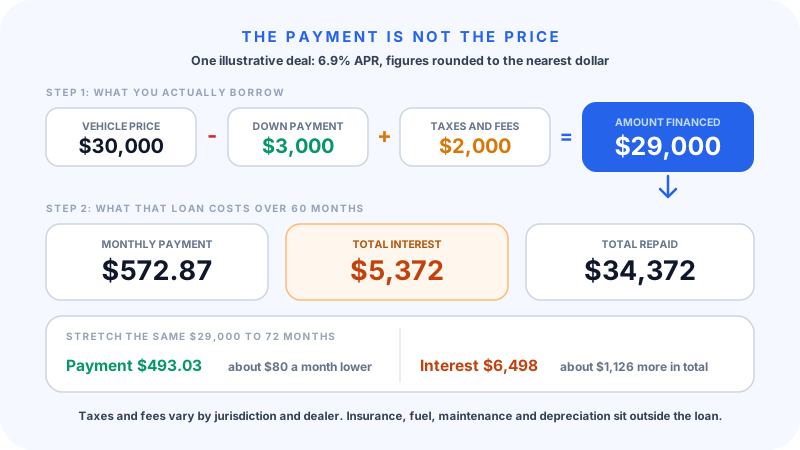
The salesperson lowers the monthly payment and the deal suddenly feels easier. $489 becomes $421, and the car seems more affordable. But the car did not get cheaper. The loan usually got longer, the down payment changed, a fee moved, or the interest cost simply spread out where it is harder to see. That is the central trap in car financing: the monthly payment is the most visible number and rarely the most important one.
The Federal Trade Commission makes the same point in its consumer guidance on car financing, advising buyers not to focus solely on the monthly payment and to know their total cost, since "lower monthly loan payments often require longer terms and higher interest rates, which will substantially increase your overall cost."
A good auto loan comparison looks at the amount financed, the APR, the term length, the fees, and above all the total interest. An auto loan calculator can show all of these in seconds, but only if you understand what the inputs mean and which costs sit outside the calculator entirely. This guide explains the payment formula, works through examples you can reproduce yourself, and shows why a longer term can lower your payment while quietly raising what the car costs you.
Purchase price versus amount financed
The purchase price is the negotiated price of the vehicle. The amount financed is the loan principal: what is left after your down payment and trade-in equity are subtracted, and after taxes, title, registration, dealer documentation fees, and any add-ons are added in. A $32,000 car can become a $35,200 financed amount once taxes and fees are rolled in, or a $27,000 financed amount after a strong down payment. The calculator works on the amount financed, so getting that figure right matters more than the sticker price.
Tax and fee treatment is not uniform, and no single example describes every buyer. Sales tax rates, whether tax is charged on the full price or only on the price net of a trade-in, registration and title charges, and the size and regulation of dealer documentation fees all vary by jurisdiction and by dealer. Ask for an itemised out-the-door price rather than assuming any percentage.
Down payment, trade-in, and negative equity
A down payment reduces the loan principal, which lowers both the monthly payment and the total interest, because interest is charged on a smaller balance. On the $28,000 example below at 6.9% APR over 60 months, putting an extra $3,000 down cuts the payment from about $553 to about $494 and the total interest from about $5,187 to about $4,631.
A trade-in helps in the same way, but only if the trade-in value exceeds what you still owe on the old car. If you owe more than the trade is worth, that shortfall is negative equity, and rolling it into the new loan increases your debt before the new car leaves the lot.
This is not a rare edge case. The CFPB's analysis of its auto finance data pilot found that about 11.7% of vehicle loans originated between 2018 and 2022 included financed negative equity, with the mean rolled-in shortfall around $5,073 on new vehicles and $3,284 on used. Those loans also ran longer, at roughly 73 months against 67 to 68 months for other borrowers, and the CFPB reported the vehicles were repossessed within two years at more than twice the rate of loans with positive trade-in equity.
Run the arithmetic on that pattern. Add $5,073 of negative equity to the $28,000 example and stretch the term to 72 months to keep the payment tolerable: the payment lands near $562 and the total interest near $7,411, against $5,187 on the clean 60-month loan. The monthly figure moved by nine dollars. The financing cost moved by more than two thousand.
APR versus the interest rate, and fees
The interest rate is the price of borrowing the principal. The annual percentage rate is defined in Regulation Z, which implements the Truth in Lending Act, as "a measure of the cost of credit, expressed as a yearly rate, that relates the amount and timing of value received by the consumer to the amount and timing of payments made." Because the APR is derived from the disclosed finance charge rather than from the interest rate alone, it is the better number for comparing offers: a low rate paired with large financed charges can carry a higher APR than a slightly higher rate with fewer charges.
Two practical caveats. First, the APR is disclosed within a tolerance, generally one-eighth of a percentage point for regular transactions and one-quarter for irregular ones, so small differences between quoted APRs are not always meaningful. Second, optional products, extended warranties, and other add-ons folded into the loan raise the principal and the interest charged on it. The FTC's guidance is blunt on this point: add-ons are optional, and it is fine to decline them.
The monthly payment formula
An auto loan is an amortizing loan: each payment covers the month's interest first and puts the rest toward principal. The standard payment formula is:
Monthly payment = P * [ r(1 + r)^n ] / [ (1 + r)^n - 1 ]Here P is the principal (the amount financed), r is the monthly interest rate (the APR divided by 12, as a decimal), and n is the number of monthly payments. The structure explains why early payments are mostly interest: when the balance is large, the month's interest is large, so less of the payment reduces principal. As the balance falls, more of each payment attacks the principal.
Dividing the APR by 12 is the convention every mainstream auto loan calculator uses, and it is what lenders quote against. It is a nominal monthly rate rather than a compounded equivalent, so an APR quoted this way and an effective annual yield are not quite the same figure. For comparing car loans against each other the convention is consistent and the distinction does not change the ranking.
Worked example
Suppose you finance P = $28,000 at a 6.9% APR over 60 months. The monthly rate is r = 0.069 / 12 = 0.00575, and n = 60.
(1 + r)^n = (1.00575)^60 = 1.410595
Monthly payment = 28,000 * [0.00575 * 1.410595] / [1.410595 - 1]
Monthly payment = 28,000 * [0.00811092 / 0.410595]
Monthly payment = $553.11
The payment is $553.11. Over 60 months you pay $33,186.81, so the total interest is $5,186.81 on top of the $28,000 you borrowed. The payment alone never told you that interest figure; you only see it once you multiply the payment by the number of months and subtract the principal.
Loan term: lower payment, higher total interest
Stretching the term spreads the same principal across more payments, so each one is smaller. But interest keeps accruing for longer, so the total cost rises. The table below shows the same $28,000 at 6.9% APR across four common terms. Figures are computed from the unrounded payment and then rounded to the nearest dollar, so a lender's amortization schedule may differ by a dollar or two on the final payment.
| Term | Monthly payment | Total paid | Total interest |
|---|---|---|---|
| 36 months | $863.28 | $31,078 | $3,078 |
| 48 months | $669.20 | $32,121 | $4,121 |
| 60 months | $553.11 | $33,187 | $5,187 |
| 72 months | $476.03 | $34,274 | $6,274 |
Moving from 36 to 72 months cuts the payment by about 45%, from $863 to $476, which is why long terms are tempting. But the total interest roughly doubles, from $3,078 to $6,274, and you stay in debt for three extra years while the vehicle keeps depreciating. The comfortable payment is the expensive one over the life of the loan.
Two things follow from this that are easy to miss. A longer term does not only add months of interest; longer terms are also often priced at higher APRs, so the two effects compound. And because the balance falls more slowly, a long loan spends more of its life in the window where the amount owed exceeds what the car would sell for.
Monthly payment versus total interest
These two numbers answer different questions. The monthly payment tells you whether the loan fits this month's budget. The total interest tells you what the financing actually costs. You need both. A payment that fits comfortably but generates thousands in extra interest may still be a poor choice if a shorter term, a larger down payment, or a cheaper vehicle is realistic for you.
Affordability versus approval
Being approved for a loan is not the same as being able to afford it. Lenders approve based on credit and income formulas; affordability depends on your whole financial picture, including the costs a lender does not scrutinise. A loan can pass the approval test and still strain your budget once real life is added in.
The costs the calculator leaves out
An auto loan calculator models the loan, not the cost of owning the car. It generally excludes insurance, fuel, maintenance and repairs, registration renewals and taxes, parking, and depreciation. Cars lose value over time, and a loan balance does not fall just because the market value does, which is how negative equity develops mid-loan. A payment that looks fine in the calculator can feel tight once an insurance renewal, a repair, and a month of fuel land together.
Prepayment and payoff flexibility
If you choose a longer term for a lower payment, you can often reduce the total interest by paying extra toward principal later. Whether that works depends on how the loan computes interest.
Most auto loans in the United States are simple-interest loans: interest accrues on the outstanding balance day by day, so paying early or paying extra genuinely reduces what you owe. Some contracts instead use precomputed interest, where the finance charge is fixed at signing and built into the payment schedule; paying such a loan off early does not save the full remaining interest, and any rebate follows the contract's stated method. Before counting on prepayment as your escape route from a long term, confirm three things in the contract: that the loan is simple interest, that extra payments are applied to principal rather than held as future instalments, and that no prepayment penalty applies.
Practical note: the budget test
Before signing, test the payment against both a normal month and a rough month. Insurance renewals, repairs, fuel, parking, and registration can all land outside the loan payment, sometimes in the same month. A useful habit is to ask for the out-the-door price, the amount financed, the APR, the term, the total of all payments, and an itemised list of fees. The Truth in Lending disclosure you sign contains most of these figures; read it before, not after. If the conversation keeps drifting back to the monthly payment alone, pause and ask for the full structure, because the complete loan is what you are actually buying.
Common mistakes
Shopping only by monthly payment. A lower payment can hide a longer term, a higher APR, or added financed costs.
Ignoring add-ons. Optional products rolled into the loan increase the principal and the interest charged on it.
Forgetting taxes and registration. The financed amount often exceeds the negotiated vehicle price, and the tax and fee structure varies by jurisdiction.
Treating APR and interest rate as identical. The APR is derived from the finance charge and is the better number for comparing offers.
Overlooking negative equity. Rolling old debt into a new loan raises the balance, usually lengthens the term, and starts the new loan already underwater.
Assuming early payoff always refunds interest. That holds on a simple-interest loan, not on a precomputed-interest contract.
FAQ
Why is my auto loan payment lower with a longer term? The same principal is spread across more months, so each payment is smaller. The trade-off is that interest accrues for longer, raising the total interest and keeping you in debt longer. Longer terms are also frequently priced at higher APRs, which compounds the effect.
Should I focus on APR or monthly payment? Use both. APR helps you compare the true borrowing cost between offers, while the monthly payment shows whether the loan fits your budget. The total of payments ties the two together.
Does a down payment reduce interest? Usually yes. A down payment lowers the amount financed, so interest is charged on a smaller balance. In the example above, an extra $3,000 down saves about $556 in interest over 60 months.
Can fees be financed into a car loan? Often yes, depending on the fee and lender. Financing fees increases the loan balance and the interest you pay, so it raises the total cost even though it lowers the cash you need upfront.
What is negative equity on a trade-in? Negative equity means you owe more on your old vehicle than it is worth. If that shortfall is rolled into the new loan, it increases your new debt from day one. CFPB data show these loans tend to be larger, longer, and repossessed more often.
Is a shorter auto loan always better? Not always. Shorter terms usually cut total interest but raise the monthly payment. The right term fits your budget without creating avoidable long-term cost or pushing you toward negative equity.
Sources
- Financing or Leasing a Car - Federal Trade Commission consumer guidance on APR, finance charges, long loan terms, and optional add-ons.
- Auto loans - Consumer Financial Protection Bureau resources on shopping for and negotiating vehicle financing.
- Negative Equity Findings from the Auto Finance Data Pilot - CFPB, June 2024, the source of the negative-equity prevalence, amount, term, and repossession figures cited above.
- 12 CFR 1026.22: Determination of annual percentage rate - Regulation Z definition of the APR and its disclosure tolerances.
Related tools and reading
Run your own figures in the Auto Loan Calculator, compare offers with the APR Calculator, and test extra payments in the Loan Payoff Calculator. For the underlying mechanics, see How Loan Interest Is Calculated and How to Compare Loan Deals Using APR.
Educational only. Auto loan rates, fees, taxes, insurance, depreciation, and lender rules vary. This is not financial advice.