
Every loan has the same underlying math, even when it looks different on the paperwork. Interest is the cost of borrowing money, calculated against the unpaid principal over time. The complications come from how often interest accrues, how payments split between principal and interest, and what the lender chose to include in the APR.
Key Takeaways
- Interest accrues against the outstanding principal, not the original loan amount.
- Most consumer loans use monthly amortization: each payment pays interest first, then principal.
- Early payments are mostly interest; late payments are mostly principal.
- Daily interest accrual (common in some mortgages and in credit cards) applies a daily rate to the current balance. Day-count conventions vary by lender and product.
- Extra principal payments reduce future interest by shrinking the base that interest is calculated on, provided your lender applies them to principal and your contract has no prepayment penalty.
- APR is not the same as the interest rate. APR is a disclosure figure that can fold in certain fees; the contract (note) rate is what actually accrues against your balance.
The Core Mechanic
When a lender quotes a 7% rate on a $300,000 mortgage, that is a nominal annual rate. Under the monthly convention used by most US consumer mortgages and instalment loans, you turn it into a monthly rate by dividing by 12:
Monthly rate = 7% / 12 = 0.5833%
That divide-by-12 step is a convention, not a law of arithmetic. Some products (and some jurisdictions) quote an effective annual rate instead, in which case the monthly rate is derived differently. Check which figure your loan documents quote.
For the first month, interest is calculated against the full principal:
Month 1 interest = $300,000 × 0.005833 = $1,750
If your monthly payment is $1,996, the remaining $246 goes to principal. The new balance is $299,754. Month 2's interest is calculated against the new, slightly smaller balance.
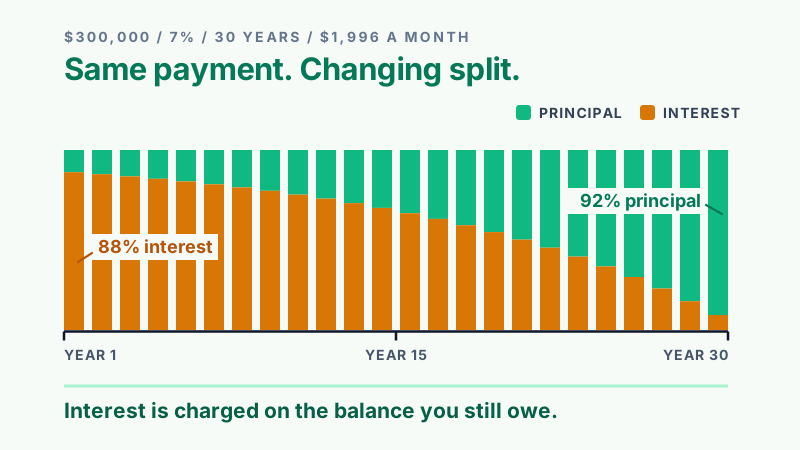
That is amortization. The payment stays constant, but the split between principal and interest shifts every month.
Amortization in Action
Here is what the first six months and last six months of a $300,000, 30-year, 7% mortgage look like:
| Month | Payment | Interest | Principal | Balance |
|---|---|---|---|---|
| 1 | $1,996 | $1,750 | $246 | $299,754 |
| 2 | $1,996 | $1,749 | $247 | $299,507 |
| 3 | $1,996 | $1,747 | $249 | $299,258 |
| 4 | $1,996 | $1,746 | $250 | $299,008 |
| 5 | $1,996 | $1,744 | $252 | $298,756 |
| 6 | $1,996 | $1,743 | $253 | $298,503 |
| ... | ... | ... | ... | ... |
| 355 | $1,996 | $68 | $1,928 | $9,807 |
| 356 | $1,996 | $57 | $1,939 | $7,869 |
| 357 | $1,996 | $46 | $1,950 | $5,919 |
| 358 | $1,996 | $35 | $1,961 | $3,957 |
| 359 | $1,996 | $23 | $1,973 | $1,984 |
| 360 | $1,996 | $12 | $1,984 | $0 |
Figures are computed from the unrounded payment of $1,995.91 and rounded for display, so individual rows can differ by a dollar from a schedule that rounds each month before carrying the balance forward. Lenders differ in exactly where they round, and most adjust the final payment slightly to bring the balance to zero.
Early in the loan, 88% of each payment is interest. By the end, 99% is principal. This is the classic "front-loaded" structure of amortized loans, and it is the reason refinancing or extra principal payments are most effective early in a loan's life.
Daily vs Monthly Accrual
Different loan products calculate interest on different cycles.
Monthly accrual. Standard for most fixed-rate personal loans and traditional mortgages. Interest is calculated once a month against the balance on the statement date.
Daily accrual. Common for mortgages with daily-interest provisions, most credit cards, and many home equity lines of credit. The daily rate is typically the annual rate divided by 365, though some contracts use 360 ("banker's days"), and a few use actual/actual. Interest accumulates each day on the current balance.
Day-count conventions are not standardised across lenders. A 30/360 convention, an actual/365 convention, and an actual/360 convention will each produce slightly different interest for the same rate and balance, and actual/360 in particular charges marginally more over a year. Your loan agreement states which one applies.
Daily accrual matters in two cases:
- Payment timing. Paying a daily-accrual loan 5 days early reduces the interest charged that month, because the balance is smaller for those 5 days.
- Carrying a balance. On a credit card, today's balance generates today's interest, which is added to tomorrow's balance. That is daily compounding, and it is why high-APR cards are expensive.
The Loan Payment Formula
The standard formula for the monthly payment on an amortizing loan is:
M = P × [r(1 + r)^n] / [(1 + r)^n − 1]
Where:
- M = monthly payment
- P = principal (loan amount)
- r = monthly interest rate (annual rate / 12, as decimal)
- n = number of monthly payments
For the $300,000 mortgage at 7% over 30 years:
- P = 300,000
- r = 0.07 / 12 = 0.005833
- n = 360
M = 300,000 × [0.005833 × (1.005833)^360] / [(1.005833)^360 − 1] M = 300,000 × [0.005833 × 8.116] / [8.116 − 1] M = 300,000 × 0.04735 / 7.116 M ≈ $1,996
This formula is the engine behind every mortgage, auto loan, and amortized personal loan calculator.
Simple-Interest Loans
A small number of loan products (most notably some auto loans and short-term personal loans) use simple interest. Interest accrues based on actual days the balance is outstanding, with no interest-on-interest. The formulas:
Daily interest = Principal × (Annual Rate / 365) Period interest = Daily interest × Days in period
Pay early: less interest accrues. Pay late: more accrues. Each payment is applied first to outstanding interest, then to principal.
The distinction matters less than the rate itself, but on a simple-interest auto loan the payoff math is cleaner: the payoff figure is the outstanding principal plus interest accrued to the payoff date, so paying early genuinely reduces the interest you owe. That is not automatically the same as paying nothing extra to close the loan. Some contracts still carry a prepayment penalty, and precomputed-interest loans (which are not simple-interest loans) calculate a payoff using a rule such as the Rule of 78s that returns less of the unearned interest. Read the payoff clause before assuming early repayment is free.
What Affects Total Interest Paid
Five variables drive total interest cost over a loan:
- Rate. Single biggest lever. Each percentage point on a 30-year mortgage shifts total interest by tens of thousands.
- Loan term. Longer terms reduce monthly payment but balloon total interest. At the same rate, a 30-year mortgage typically costs well over twice the total interest of a 15-year. On $300,000 at 7%, the 30-year pays about $418,500 in interest against roughly $185,400 for the 15-year.
- Principal. Larger loans accrue more total interest at the same rate.
- Payment frequency. A true biweekly schedule shaves years off a long loan because 26 half-payments add up to 13 monthly payments a year. This only works if the lender credits each half-payment when it arrives; some servicers hold the money and apply it monthly, which removes most of the benefit.
- Extra payments. Any payment beyond the scheduled amount reduces future interest, but only if the servicer applies it to principal rather than holding it as a prepaid future instalment, and only if the contract has no prepayment penalty.
Worked Example: The Cost of an Extra $200/month
Same $300,000 mortgage at 7% over 30 years. Standard payment: $1,995.91. Total interest over 30 years: about $418,500.
Add $200/month applied to principal:
- Loan paid off in roughly 275 payments, about 22 years and 11 months instead of 30 years
- Total interest paid: about $302,000
- Savings: roughly $117,000 in interest, plus about 7 years freed from the loan
That is the leverage of attacking principal early: the entire compounding effect runs in reverse when you shrink the base.
Two caveats. The figures assume every extra dollar lands on principal in the month you pay it, and that there is no prepayment penalty. Some contracts, particularly on personal and auto loans, charge a fee for early payoff or compute the payoff using a precomputed-interest rule rather than the outstanding balance. Confirm both before committing to a prepayment plan.
Common Mistakes
Assuming every loan behaves like a fixed-rate loan. On a fixed-rate amortized loan, the rate and the scheduled payment are both fixed for the term; only the principal/interest split inside each payment moves. On a variable-rate or adjustable-rate loan it is different: when the index moves, the lender recalculates, and the payment, the term, or both can change. Interest-only loans are different again, since the scheduled payment covers accrued interest only and the balance does not fall until the amortizing phase begins.
Thinking refinancing late in the loan saves money. Refinancing resets the amortization clock. Late-stage loans are mostly principal, so refinancing into a new 30-year often increases lifetime interest even at a lower rate.
Confusing the note rate with APR. APR is a disclosure figure intended to make offers comparable, and it can include certain origination fees and points; the note rate is the rate that actually accrues against your balance. On a no-fee loan the two are often identical, but they are not the same thing, and two loans with the same APR can carry different note rates depending on fee structure. Interest is calculated from the note rate, not the APR.
Ignoring escrow. Mortgage payments often include taxes and insurance. The "P&I" (principal and interest) portion is what amortizes; the escrow portion is pass-through.
Misapplying extra payments. Some lenders apply extra funds to future scheduled payments rather than current principal. Confirm with the lender that extra payments reduce principal directly.
Practical Scenarios
Scenario 1: Choosing 15- vs 30-year mortgage. $400,000 at 6.5%. 30-year payment: $2,528, total interest: ~$510,000. 15-year payment: $3,484, total interest: ~$227,000. Higher monthly cost, dramatically lower lifetime cost.
Scenario 2: Refinance breakeven. Current loan: $250,000 balance, 7%, 28 years remaining, payment $1,699. Refinance offer: 6% over a new 28-year term, $4,000 closing costs, payment $1,538. Monthly saving: about $161. Simple breakeven: 4,000 / 161 ≈ 25 months. If you plan to stay past that, the refinance is likely worth it. Note that the term you refinance into changes the answer: stretching back to a fresh 30 years would cut the payment further, to about $1,499, while adding two years of interest.
Scenario 3: Auto loan with prepayment. $25,000 at 8% over 5 years. Standard payment: $507, total interest: $5,415. Adding $100/month: paid off in 4 years, total interest: ~$4,300. Savings: about $1,100.
FAQ
Does my interest rate change as I pay down the loan? On a fixed-rate loan, no. The rate is fixed for the life of the loan. What changes is the dollar amount of interest, because it is applied against a shrinking balance.
Why is my early mortgage payment mostly interest? Because the balance is largest at the beginning. With a $300,000 balance at 7%, the first month's interest is $1,750, most of the $1,996 payment. As principal shrinks, the interest portion shrinks too.
Can I save money by paying biweekly instead of monthly? Usually yes, if the servicer credits each half-payment on arrival. Biweekly means 26 half-payments per year, equivalent to 13 monthly payments, and the extra one goes to principal. Some servicers hold half-payments in suspense and post them monthly, which removes most of the saving, and some charge a fee to enrol in a biweekly programme. Ask how yours applies the money.
Does paying extra principal lower my monthly payment? On most fixed-rate loans, no. It shortens the loan term instead. To lower the monthly payment, you would need to recast (where the lender offers it, often for a fee) or refinance.
What is amortization? The process of paying down a loan over time through scheduled payments that include both principal and interest. The schedule front-loads interest and back-loads principal.
How is credit card interest different? Credit cards use daily compounding on the average daily balance, with no fixed amortization. Minimum payments often barely cover interest, which is why card balances can persist for years.
What is negative amortization? A loan structure where the payment is less than the accrued interest, so the balance grows over time. Rare today but historically common in certain adjustable-rate mortgages.
Related Tools
Build your own schedule with the Loan Calculator or the Loan Amortization Calculator. For mortgages specifically, the Mortgage Calculator handles escrow, taxes, and PMI. The Auto Loan Calculator is optimized for shorter terms and trade-in scenarios.
Related Articles
Final Thoughts
Loan interest math looks intimidating because of the formula, but the mechanic is simple: interest accrues against unpaid principal, and your payment chips away at both. The faster you reduce principal, the less interest accrues, which is why early extra payments compound into significant savings. Use the amortization schedule as a planning tool: it tells you exactly where your money is going, month by month, for the life of the loan.