
Most people think of calorie burn as something that happens during workouts.
The run counts. The cycling class counts. The hard set of squats counts. The watch buzzes, the app gives a number, and the workout feels neatly converted into energy.
That is only a small slice of the day.
Your body burns calories while you sleep, sit, digest food, walk to the kitchen, stand in line, think, maintain body temperature, repair tissue, and keep organs running. A person who never does a formal workout still has a daily energy burn. A person who trains hard for one hour can still have a surprisingly sedentary day.
The number most people want is total daily energy expenditure, or TDEE. It is the best estimate of how many calories you burn across an entire day. Use BlinkCalc's TDEE Calculator for a starting point, then treat the result as a working estimate rather than a verdict from the universe.
A note on what this article can and cannot do. Everything below describes how energy expenditure works and how estimates are produced. No equation or calculator measures your actual daily burn. Measuring it properly requires laboratory methods such as indirect calorimetry or doubly labelled water. If you have a medical condition, take medication that affects metabolism or appetite, are pregnant or breastfeeding, or are managing an eating disorder, work with a clinician or registered dietitian rather than a calculator.
The four-part calorie burn picture
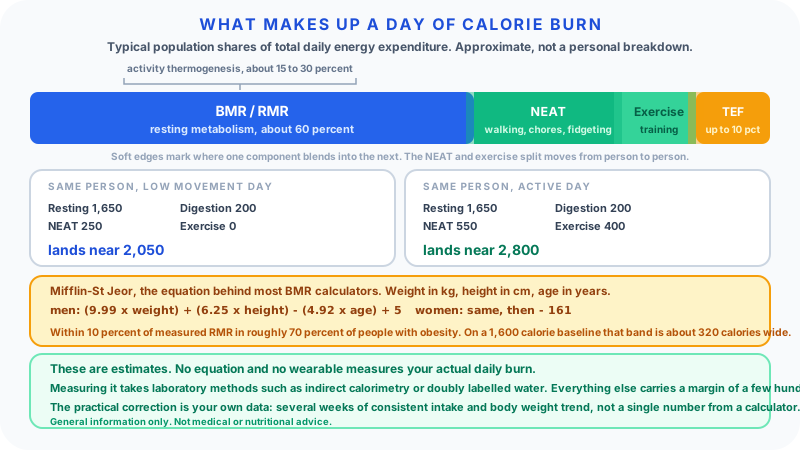
Daily energy expenditure is usually described in four parts. The typical shares below come from a review in Mayo Clinic Proceedings, and they are population generalisations, not your personal breakdown.
| Component | What it means | Typical share of TDEE |
|---|---|---|
| BMR or RMR | Energy used at rest | About 60% |
| NEAT | Non-exercise movement | Part of the 15% to 30% activity share |
| Exercise | Planned training or sport | Also part of that activity share |
| TEF | Energy used to digest food | Up to about 10% |
BMR means basal metabolic rate: the energy your body uses for basic survival functions, measured under strict conditions (fasted, fully rested, thermally neutral, typically on waking). RMR, resting metabolic rate, is measured under slightly relaxed conditions and comes out a few percent higher. The difference is small enough that most calculators and most everyday planning use the terms interchangeably, but they are not identical, and a lab report will specify which one it measured.
NEAT stands for non-exercise activity thermogenesis: walking around, standing, cleaning, gesturing, fidgeting, climbing stairs, carrying groceries, and all the movement that is not formal exercise.
Exercise is the intentional part: running, lifting, swimming, rowing, sport, classes, intervals, and long hikes. Together, exercise and NEAT make up activity thermogenesis.
TEF means thermic effect of food: the energy cost of digesting, absorbing and processing what you eat, which accounts for up to roughly 10% of total intake. Protein carries a higher thermic cost than carbohydrate or fat, which is a genuine but modest effect and not a fat-loss lever on its own.
BMR: the quiet baseline
For many adults, resting metabolism accounts for the largest single share of daily calorie burn. That surprises people because resting feels passive. Physiologically, it is busy.
Your heart pumps. Your liver processes nutrients. Your brain uses energy. Your kidneys filter blood. Your cells maintain ion gradients, repair structures, and synthesize molecules. None of this looks like exercise, but it costs energy every minute.
Body size is one of the strongest drivers. Larger bodies generally burn more calories at rest because there is more tissue to maintain. Lean mass matters too. Muscle is metabolically active, but organs are more energy-demanding per unit of mass. This is why the claim that "muscle burns huge calories all day" is overstated. More muscle helps, and it helps for several reasons beyond resting burn, but it does not turn resting metabolism into a bonfire.
What the equations actually say
Most calculators, including BlinkCalc's BMR Calculator, use the Mifflin-St Jeor equation, published in 1990 from a sample of 498 healthy adults aged 19 to 78. With weight in kilograms, height in centimetres and age in years, it gives resting energy expenditure in calories per day:
- Men: RMR = (9.99 × weight) + (6.25 × height) − (4.92 × age) + 5
- Women: RMR = (9.99 × weight) + (6.25 × height) − (4.92 × age) − 161
The original paper also offers a rounded version using 10 × weight and 5 × age, which is the form many calculators actually implement; the difference between the two is small.
Read the structure and the limits become obvious. The only inputs are weight, height, age and sex. Body composition, genetics, thyroid status, medication, illness, ethnicity and training history are all absent, because they are harder to measure and were not in the model. The Academy of Nutrition and Dietetics recommends Mifflin-St Jeor as the most accurate of the common equations while noting that it lands within 10% of measured RMR in roughly 70% of people with obesity, and that it was not validated on racial groups other than white participants.
That accuracy figure deserves a moment. "Within 10%" on a 1,600 calorie baseline is a band roughly 320 calories wide, and about three people in ten fall outside even that. The equation is a well-chosen starting point, not a measurement.
TDEE: the number people actually mean
When someone asks, "How many calories do I burn per day?" they usually mean TDEE.
TDEE starts with resting metabolism, then adds movement, exercise, and digestion. It is the number most relevant for body weight trends because it describes total daily output.
Common calculators estimate TDEE by multiplying BMR by an activity factor. The conventional set runs roughly from 1.2 for sedentary through about 1.9 for very heavy activity, with intermediate steps around 1.375, 1.55 and 1.725.
That sounds tidy, but every source of error in the BMR estimate is multiplied along with it. A BMR estimate 10% too high becomes a TDEE estimate 10% too high, and the multiplier adds its own uncertainty on top, because it compresses everything you do in a day into one of five labels.
Two people can both choose "moderately active" and live very different lives. One lifts three days per week but sits the rest of the time. Another walks 12,000 steps daily, works on their feet, and does easy cycling. The second person may burn more even if the first identifies more strongly as someone who trains.
This is why the Calorie Calculator can help with planning, while real body weight trends remain the feedback that corrects it.
NEAT: the underestimated variable
NEAT is the reason calorie burn can vary so much between people who look similar on paper.
One person sits for work, drives everywhere, and relaxes on the sofa. Another stands, walks during calls, takes transit, cooks, cleans, and paces without noticing. The gap is not trivial: research on posture and movement patterns has estimated that if people with obesity adopted the NEAT patterns of their leaner counterparts, it would represent on the order of an extra 350 calories per day.
NEAT also changes with dieting. When calories drop, some people unconsciously move less. They sit more, gesture less, avoid stairs, and feel less spontaneous energy. This is not laziness. It is one way the body conserves energy, and because it is unconscious it rarely shows up in anyone's training log.
NEAT changes with environment too. A walkable city, active job, dog, children, stairs, public transport, and household chores all raise daily movement. A remote desk job with delivery meals and elevator access lowers it.
Practical takeaway: if fat loss or maintenance is not matching the calculator, look at daily movement before concluding that something is wrong with your metabolism.
Exercise calories are real, but easy to overestimate
Exercise matters. It improves fitness, strength, insulin sensitivity, mood, cardiovascular health, and body composition. It also burns calories.
The catch is scale.
A 30-minute moderate run might burn somewhere in the region of 250 to 450 calories depending on body size, pace, terrain, and efficiency. That is meaningful. It is also easy to eat back without noticing, and the range itself tells you how imprecise any single figure is.
Strength training may burn fewer calories during the session than people expect, but it supports muscle retention and long-term function, which matter independently of the session's calorie count. High-intensity intervals can burn energy quickly, but they also create fatigue and cannot be repeated endlessly.
Use the Calorie Burn Calculator to estimate specific activities. Then keep the estimate humble. Machines, apps, and watches are all working from limited information about you.
Why two people burn different amounts in the same workout
Imagine two people jogging side by side for 30 minutes.
Alex weighs 210 pounds and is newer to running. Jordan weighs 145 pounds and has trained for years. Same route. Same time. Same weather.
Alex likely burns more calories because moving a larger body a given distance costs more energy. Jordan may be more mechanically efficient, which lowers energy cost at the same pace. If Jordan runs faster at the same heart rate, the comparison changes again.
Calorie burn depends on:
- Body mass
- Fitness level
- Movement efficiency
- Pace or power output
- Terrain and wind
- Heat and humidity
- Training status
- Technique
That is why "one hour of exercise burns X calories" is usually too generic. The activity matters, but the body doing it matters too.
Wearables: useful trend tools, weak calorie rulers
Fitness watches estimate calories using heart rate, movement sensors, age, height, weight, sex, and proprietary formulas that are not published and cannot be independently checked. Some estimates are reasonable for steady aerobic work. Others can be well off, especially for lifting, cycling, intervals, pushing a stroller, carrying loads, or activities where wrist motion does not reflect effort.
Heart rate adds context, but heart rate is not the same as calorie burn. Caffeine, stress, heat, dehydration, poor sleep, illness, and excitement can raise heart rate without matching increases in energy expenditure.
Wearables are best used for trends:
- Did your daily steps rise?
- Are training sessions becoming more consistent?
- Is resting heart rate changing?
- Are you sleeping less during a hard training block?
They are weaker as exact food budget tools. Eating precisely to match a watch's exercise calorie estimate often leads to frustration, because the error in that estimate can be larger than the deficit you were aiming for.
Adaptive metabolism is real, but often exaggerated
When people lose weight, daily calorie burn usually drops. Some of that is straightforward: a smaller body costs less energy to move and maintain.
There can also be adaptive changes. The body may reduce energy expenditure somewhat more than body size alone predicts, hunger may increase, NEAT may fall, and training output may decline. This is sometimes called adaptive thermogenesis, and the size of the effect is actively debated among researchers rather than settled.
The internet often turns this into "my metabolism is broken." That phrase is rarely helpful. Adaptation does not mean physics stopped working. It means the body responded to lower energy availability and a smaller body mass.
The practical response is not extreme dieting. It is better planning: moderate deficits, adequate protein, resistance training, sleep, realistic timelines, and periodic reassessment.
Does age change your calorie burn?
The common belief is that metabolism slows steadily through adult life. Large-scale data complicates that story. A 2021 analysis in Science pooled doubly labelled water measurements from 6,421 people across 29 countries, aged eight days to 95 years, and found that once you adjust for body size and composition, total energy expenditure is essentially stable from about age 20 to age 60. The decline that follows is real but gradual, on the order of 0.7% per year, reaching roughly 26% below middle-aged values in people over 90.
That matters for how you interpret a calculator. If your maintenance calories fell between 30 and 50, adjusted metabolic rate is probably not the main explanation. Changes in body composition, daily movement, job, sleep and life circumstances usually account for more.
A realistic daily example
Consider a 35-year-old person whose estimated BMR is 1,650 calories. The figures below are illustrative, built to show how the components stack, not a prescription.
On a low-movement day:
- Resting metabolism: about 1,650
- Digestion: about 150 to 250
- NEAT: about 250
- Exercise: 0
TDEE might land near 2,050.
On an active day:
- Resting metabolism: about 1,650
- Digestion: about 200
- NEAT: about 550
- Exercise: about 400
TDEE might land near 2,800.
Same person. Different day. A weekly average matters more than one isolated number, and the honest version of both figures carries a margin of a few hundred calories either way.
How to use calorie burn estimates without getting trapped
Start with a calculator estimate. Track a few weeks of consistent food intake, body weight trend, and activity. Ignore day-to-day scale noise. Look at the trend.
If body weight is stable, your average intake is probably close to your average TDEE. If weight is rising gradually, intake is likely above expenditure. If weight is falling gradually, intake is likely below expenditure.
This feedback method has its own limits. Water retention, menstrual cycle changes, sodium, stress, training soreness, digestion, and imprecise food logging can all mask or mimic trends. But over enough weeks, your own data is more informative than any equation, because it is the only measurement that includes you specifically.
Avoid aggressive calorie cuts based on a single estimate. Large deficits can worsen hunger, reduce training quality, increase fatigue, and encourage rebound eating. For many people, smaller sustainable adjustments work better.
Activity multipliers are guesses with labels
Most TDEE calculators ask you to choose an activity level. The labels sound simple: sedentary, lightly active, moderately active, very active. The trouble is that people interpret those labels emotionally.
A person who trains hard three times per week may choose very active because the workouts feel demanding. But if the rest of the week is mostly sitting, lightly active or moderately active may be closer. Another person may never go to the gym but walk 14,000 steps daily, stand at work, and carry groceries home. Their daily burn may be higher than the gym-goer expects.
Think of activity multipliers as a starting hypothesis. If your chosen multiplier predicts maintenance at 2,600 calories but your weight rises steadily at that intake, the multiplier was too high for your current life. If your weight falls quickly, it was too low, or your intake tracking is drifting.
The label does not matter. The trend does. Revisit it whenever your routine changes meaningfully enough to alter daily movement.
What changes calorie burn over a season
Daily calorie burn is not fixed even when body weight is stable.
A summer with outdoor walks, yard work, and weekend hikes may raise expenditure. A winter of shorter days, more driving, and less spontaneous movement may lower it. A new job, a puppy, a commute change, a training block, an injury, or a move to a more walkable area can all shift TDEE.
This is why old calorie targets go stale. If a plan worked last year but not now, your context may simply have changed. Recalculate after meaningful changes, then use several weeks of real-world feedback to adjust.
The safest interpretation
The best calorie-burn estimate is not the most precise-looking one. It is the one you are willing to update.
Use calculators to avoid guessing from nothing. Use wearable data to notice patterns. Use body weight trends and performance to check reality. Use hunger, mood, sleep, and training quality to decide whether the plan is livable.
Calories are measurable in a laboratory. Outside one, everything you have is an estimate with a margin, and treating it that way is what keeps it useful.
FAQs
How many calories does the average person burn per day?
Many adults fall somewhere between roughly 1,800 and 3,000 calories per day, but the range is wide and the averages hide a great deal. Body size, body composition, sex, age, occupation, exercise, and daily movement all matter. An average is not a target for any individual.
What is the difference between BMR and TDEE?
BMR estimates calories burned at rest for basic body functions, and is typically the largest single component. TDEE estimates total calories burned across the whole day, adding movement, exercise, and digestion to that baseline.
Why do two people burn different calories doing the same workout?
Body weight, fitness, movement efficiency, pace, terrain, heat, technique, and physiology all affect energy cost. The same workout can represent very different effort and calorie burn for different people.
Are fitness watch calorie estimates accurate?
They can be useful for tracking your own trends over time, but individual calorie estimates can be well off, and the underlying algorithms are proprietary. They are better for comparing your own activity week to week than for deciding exactly how much to eat.
What is NEAT?
NEAT is non-exercise activity thermogenesis: walking, standing, chores, fidgeting, stairs, and other movement outside planned workouts. It varies enormously between people and is often the largest source of difference in daily burn between two otherwise similar individuals.
Can dieting lower the calories you burn?
Yes. Weight loss lowers the energy cost of maintaining and moving a smaller body, and some people unconsciously move less during dieting. Additional adaptive changes appear to occur, though their size varies between individuals and remains an active research question.
Sources
- Villablanca PA, Alegria JR, Mookadam F, Holmes DR Jr, Wright RS, Levine JA. Nonexercise activity thermogenesis in obesity management. Mayo Clinic Proceedings. 2015;90(4):509-519. Component shares of total energy expenditure and the NEAT difference between lean and obese individuals.
- Mifflin MD, St Jeor ST, Hill LA, Scott BJ, Daugherty SA, Koh YO. A new predictive equation for resting energy expenditure in healthy individuals. American Journal of Clinical Nutrition. 1990;51(2):241-247. Original derivation of the Mifflin-St Jeor equation from 498 adults.
- Academy of Nutrition and Dietetics Evidence Analysis Library, Determination of Resting Metabolic Rate. Recommendation of Mifflin-St Jeor and its reported accuracy and population limitations.
- Pontzer H, Yamada Y, Sagayama H, et al. Daily energy expenditure through the human life course. Science. 2021;373(6556):808-812. Doubly labelled water data from 6,421 people showing adjusted expenditure stable from age 20 to 60.
The bottom line
Daily calorie burn is not one fixed number. It is a moving estimate built from resting metabolism, ordinary movement, exercise, digestion, body size, and adaptation. Calculators give a useful starting point with a margin of error worth respecting. Your habits, activity, and long-term trend data are what turn that starting point into something practical.
This article is general information about how energy expenditure works. It is not medical or nutritional advice, and it is not a diagnosis or a treatment plan. Speak with a qualified health professional about your own circumstances.