
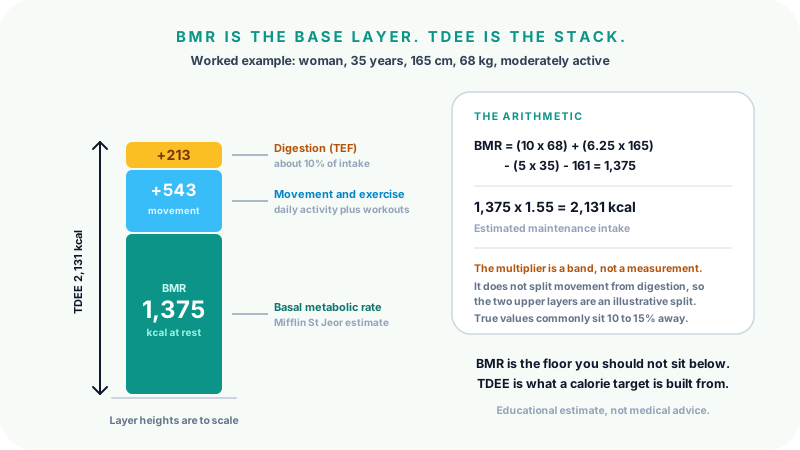
Every diet app and fitness tracker eventually shows you two numbers: one labeled BMR, one labeled TDEE. They are the foundation of any calorie target, weight management plan, or macronutrient split, and they are routinely confused. BMR is what your body burns to stay alive. TDEE is what it burns living an actual day. The difference between them is everything you do that is not "lying still in a thermoneutral room."
This guide explains both, walks through the formulas, shows how activity multipliers translate BMR into TDEE, and addresses the practical question most people are really asking: how do I set a realistic calorie target?
This article is educational. Calorie needs vary by individual, medical history, and conditions like pregnancy or hormonal disorders. Consult a registered dietitian or physician before making significant dietary changes.
Estimated Is Not Measured
Before any formula, one distinction does more work than the rest: energy expenditure can be measured or estimated, and a calculator only ever does the second.
Measurement means laboratory methods. Indirect calorimetry infers energy expenditure from oxygen consumed and carbon dioxide produced, and is the reference for resting metabolic rate. The doubly labeled water method tracks the disappearance of two stable isotopes over one to two weeks and is the reference for total daily expenditure in free-living people; it is the technique behind the large international dataset discussed later in this article.
Estimation means putting your height, weight, age, and sex into a regression equation built from other people's measured values. The output is the average expenditure of people who look like you on paper. It is a starting point, not a reading, and the sections below quantify how wide the gap can be.
What BMR Actually Measures
Basal Metabolic Rate (BMR) is the energy your body uses to keep its essential systems running while you are at complete rest. Heart, lungs, brain, kidneys, liver, basic cellular repair: all of it. BMR is measured under strict conditions: 12+ hours fasted, fully rested, lying still in a comfortable temperature.
For most adults, BMR accounts for roughly 60–75% of total daily energy expenditure. It is by far the largest single component of how many calories you burn in a day, which is why it is the starting point for any calorie calculation.
A related concept, Resting Metabolic Rate (RMR), is measured under slightly less strict conditions (no overnight fast required) and typically runs a little higher than BMR, on the order of 10%. In practice, fitness calculators use equations fitted to resting measurements and apply the result the way RMR is applied. The names are used interchangeably in most consumer tools, and the difference is small enough to ignore for general planning.
The Mifflin-St Jeor Formula
The most widely recommended estimation equation is Mifflin-St Jeor, published in the American Journal of Clinical Nutrition in 1990 and derived from indirect-calorimetry measurements in 498 healthy adults. It is more accurate than the older Harris-Benedict equation for contemporary populations and is the default in most clinical and consumer tools. It is a regression fitted to a sample, not a law of physiology.
For men: BMR = (10 × weight in kg) + (6.25 × height in cm) − (5 × age in years) + 5
For women: BMR = (10 × weight in kg) + (6.25 × height in cm) − (5 × age in years) − 161
Worked Example
A 35-year-old woman, 165 cm tall, 68 kg:
BMR = (10 × 68) + (6.25 × 165) − (5 × 35) − 161 BMR = 680 + 1,031.25 − 175 − 161 BMR = 1,375.25 calories per day
That is the estimated energy cost of existing. Every step, conversation, and stress response on top of that adds to her actual total.
For imperial measurements, convert first: 1 inch = 2.54 cm, 1 pound = 0.4536 kg. Most online calculators handle this automatically.
Other BMR Formulas
Three other equations appear in older literature and some calculators. Use Mifflin-St Jeor unless you have a specific reason not to.
- Harris-Benedict (revised by Roza and Shizgal, 1984): Tends to overestimate resting expenditure relative to Mifflin-St Jeor, by roughly 5% in typical comparisons.
- Katch-McArdle: Uses lean body mass instead of total weight, so it does not need separate terms for sex or age. More accurate for very lean or very muscular individuals if you know your body fat percentage. BMR = 370 + (21.6 × lean body mass in kg).
- Cunningham: Closely related to Katch-McArdle and derived in athletic populations.
If you have a recent DEXA or bioelectrical impedance reading and know your lean body mass, Katch-McArdle is the better choice, though it inherits the error of whatever body-composition method produced that number. Otherwise Mifflin-St Jeor wins.
What TDEE Adds
Total Daily Energy Expenditure (TDEE) is BMR plus everything else: movement, digestion, the heat your body generates breaking down food, and any structured exercise.
TDEE is composed of four parts:
- BMR: roughly 60–75% of total
- Thermic Effect of Food (TEF): energy used to digest and process food, roughly 10% of intake on a mixed diet, higher on high-protein intakes
- Non-Exercise Activity Thermogenesis (NEAT): fidgeting, walking, posture, daily movement; the most variable component
- Exercise Activity Thermogenesis (EAT): intentional workouts; small for most people, large for athletes
NEAT is the most underestimated component and the one that varies most between individuals. The difference between an office worker who walks during phone calls and one who sits still all day can amount to several hundred calories per day. That is why two people with the same BMR and the same gym schedule can have very different TDEEs.
Activity Multipliers
Calculators convert BMR into TDEE using an activity multiplier, a single number meant to capture all non-BMR energy expenditure.
| Activity Level | Description | Multiplier |
|---|---|---|
| Sedentary | Desk job, little or no exercise | 1.2 |
| Lightly Active | Desk job + light exercise 1–3 days/week | 1.375 |
| Moderately Active | Light job + exercise 3–5 days/week | 1.55 |
| Very Active | Physical job or hard exercise 6–7 days/week | 1.725 |
| Extremely Active | Hard daily training or very physical job | 1.9 |
These multipliers are conventions, not measurements. They are coarse bands inherited from older physical-activity-level literature, they have no error bars, and one person's "moderately active" is another's "lightly active". Treat the table as five rough scenarios rather than five precise coefficients.
Continuing the earlier example, the 35-year-old woman with a BMR of 1,375 who exercises moderately:
TDEE = 1,375.25 × 1.55 = ~2,131 calories per day
That is her estimated maintenance number: the calorie intake at which weight would be expected to stay roughly constant.
A Note on Multiplier Overestimation
Most people overestimate their activity level. A "moderately active" lifestyle in the multiplier table is fairly demanding: real, structured exercise four or five days a week on top of being on your feet during work hours. Office workers who go to the gym three times a week are usually closer to lightly active.
If your calculated TDEE consistently leaves you gaining weight at maintenance calories, the activity multiplier is the most likely culprit. Drop one level and recalculate.
How to Set a Calorie Target
Once you have a TDEE estimate, choose a goal:
- Maintenance: Eat at TDEE.
- Weight loss: Eat at a deficit of 10–20% below TDEE.
- Weight gain (muscle): Eat at a surplus of 5–15% above TDEE.
Translating those percentages:
- TDEE = 2,131
- 20% deficit: ~1,705 calories, a deficit of about 426 per day
- 10% surplus: ~2,344 calories
The familiar shorthand is that one pound of body fat stores about 3,500 calories, so a 500-calorie daily deficit produces a pound of fat loss per week. On that arithmetic the 426-calorie deficit above works out to roughly 0.85 lb per week, not a full pound.
The shorthand itself deserves a caveat. Kevin Hall's analysis in the International Journal of Obesity showed the 3,500-calorie rule approximately matches the energy density of tissue lost in people with high initial body fat, but overestimates the cumulative deficit required per unit of weight loss in leaner people, and it ignores the fact that expenditure falls as body mass falls. Real weight loss curves flatten; the linear rule does not. Use it to set a direction, not to predict a date.
Important guardrails:
- Very low calorie intakes should be medically supervised. The conventional floors used in clinical practice are around 1,200 calories for adult women and 1,500 calories for adult men; these are practice conventions for avoiding nutrient inadequacy, not physiological constants, and they do not apply to everyone.
- Sustainable weight loss is typically 0.5–1% of body weight per week. Faster loss tends to come with more lean mass loss and worse adherence.
Real-World Scenarios
Scenario 1: The Office Worker Who Plateaus
A 40-year-old man, 180 cm, 90 kg. His Mifflin-St Jeor BMR is (10 × 90) + (6.25 × 180) − (5 × 40) + 5 = 1,830. He sets his activity to "moderately active" because he goes to the gym three times a week, giving a TDEE of 1,830 × 1.55 ≈ 2,837. He eats 2,300, expecting a 500-calorie deficit and a pound a week, and loses nothing over a month.
The issue is almost certainly the multiplier. Three gym sessions plus a desk job is closer to lightly active: 1,830 × 1.375 ≈ 2,516. His actual deficit is around 216 calories, not 500, which is well inside the error band of the whole estimate. Adjusting either intake or daily movement restores a real deficit.
Scenario 2: Recalculating During Weight Loss
The same 35-year-old woman drops from 68 kg to 62 kg over six months.
New BMR (Mifflin-St Jeor): (10 × 62) + (6.25 × 165) − (5 × 35) − 161 = 620 + 1,031.25 − 175 − 161 = 1,315.25
At the same activity level, new TDEE = 1,315.25 × 1.55 ≈ 2,039.
Her estimated maintenance dropped by about 92 calories per day from the weight change alone, before accounting for any adaptive reduction in expenditure beyond what the equation predicts. If she keeps eating at her original deficit, progress slows. Recalculating every 5–10 lbs lost keeps the target honest.
Scenario 3: Muscle Gain in a Lean Trainee
A 22-year-old man, 175 cm, 70 kg, body fat 12%. His lean body mass is 70 × 0.88 = 61.6 kg.
Katch-McArdle BMR = 370 + (21.6 × 61.6) = ~1,701.
Very active (lifts 5x/week plus walking): TDEE = 1,701 × 1.725 ≈ 2,933.
For lean muscle gain, a 10% surplus gives about 3,227 calories per day: high enough to support gains, moderate enough to limit fat accumulation. Note that the 12% body fat figure came from a measurement method with its own error, and that error propagates straight into the BMR estimate.
Common Mistakes
Overestimating the activity multiplier. Single most common error. When in doubt, drop one level.
Forgetting to recalculate after weight change. TDEE moves with weight. Every 10–15 lbs lost or gained, redo the math.
Treating TDEE as fixed. It varies day to day with sleep, stress, hormonal cycles, illness, and ambient temperature. Use weekly averages, not single-day numbers.
Trusting the calorie number on a wearable. A Stanford study of seven wrist-worn devices found that while heart rate was measured reasonably well, no device achieved a median error below 20% for energy expenditure, with median errors running from about 27% to about 93% against indirect calorimetry. The error runs in both directions and varies by device and activity. Treat the watch as a rough guide, not as a license to eat back every calorie it credits you.
Eating too far below BMR. Sustained intake below estimated BMR is associated with lean mass loss, hormonal disruption, and micronutrient inadequacy. Deficits should be calculated against TDEE, not against BMR.
Using BMR as a calorie target. BMR is the energy your body needs at rest. Eating only your BMR while living an active life produces an aggressive deficit and is rarely sustainable.
Ignoring composition for weight. Two people can weigh the same with very different lean mass and very different real resting expenditure. Mifflin-St Jeor assumes an average composition for your height, weight, age, and sex.
Step-by-Step: From Weight Goal to Daily Calorie Target
- Estimate BMR using Mifflin-St Jeor (or Katch-McArdle if you have a body-composition measurement).
- Choose an activity multiplier, and consider choosing one level lower than feels accurate.
- Multiply BMR by the multiplier to get an estimated TDEE.
- Decide on a goal: maintenance, loss, or gain.
- Apply the appropriate adjustment: −10–20% for loss, +5–15% for gain.
- Check guardrails: a sustainable loss rate, adequate protein (commonly 1.6–2.2 g/kg of body weight for people training regularly), and medical supervision for very low intakes.
- Track and adjust. If weight does not move as expected after 2–3 weeks, revise the multiplier or the calorie target, not both at once.
Limitations of BMR/TDEE Formulas
These formulas are population averages. Individual resting expenditure commonly departs from the predicted value by around 10–15%, and sometimes more, because of:
- Body composition: Lean tissue is more metabolically active at rest than fat tissue, and the equations only infer composition from height and weight.
- Genetics: Some people sit persistently above or below the formula's prediction.
- Thyroid function: Hypothyroidism or hyperthyroidism can shift resting expenditure substantially.
- Medications: Some drugs alter metabolic rate or appetite.
- Recent dieting history: Repeated weight-loss cycles are associated with expenditure below what body composition alone predicts (adaptive thermogenesis).
Where the equations do not apply well
Mifflin-St Jeor was derived in healthy non-pregnant adults, so it should not be relied on for children and adolescents, during pregnancy or lactation, in acute or critical illness, at the extremes of body size, after limb loss, or in people with conditions or medications that materially change energy expenditure. In those cases the right answer comes from a clinician, not a calculator.
What actually happens to metabolism with age
The common claim that metabolism declines steadily from your twenties does not survive contact with the best available data. Pontzer and colleagues, writing in Science in 2021, analysed doubly labeled water measurements from more than 6,400 people aged 8 days to 95 years and found four distinct phases: a sharp rise in infancy, a gradual decline through childhood and adolescence, then stability in size- and composition-adjusted total expenditure from about age 20 to age 60, followed by a decline of roughly 0.7% per year thereafter.
That does not make the age term in Mifflin-St Jeor wrong. The equation is a cross-sectional fit, and older adults in such samples carry, on average, less lean mass; the age coefficient partly stands in for that composition shift. But the practical reading changes. A slowing metabolism is not an automatic consequence of turning 35, and much of what people attribute to age is a change in lean mass and daily movement, both of which are more modifiable than a birthday.
Treat the formula as a starting estimate, then adjust based on observed results. If you eat at your calculated TDEE for three weeks and lose weight, your real TDEE is higher than the formula said. If you gain, it is lower. Your own trend is better evidence than any equation.
FAQ
What is the difference between BMR and TDEE? BMR is the calories your body burns at complete rest: the baseline cost of staying alive. TDEE is BMR plus everything else: digestion, daily movement, and exercise. TDEE is what you actually burn in a real day, and it is the right number to base calorie targets on.
Which formula is most accurate for BMR? Mifflin-St Jeor is the standard recommendation for the general population. Katch-McArdle is often better if you know your lean body mass from a body composition measurement. Both are estimates, and for any individual the true value can sit 10–15% away from the prediction.
How do I choose the right activity multiplier? Be conservative. Most people overestimate their activity. If you sit at a desk most of the day and exercise three times a week, you are closer to "lightly active" (1.375) than "moderately active" (1.55). If your calculated TDEE is producing unexpected weight gain, drop one level.
How many calories should I eat to lose weight? Generally 10–20% below TDEE, not below BMR. For most adults that is a 300–500 calorie daily deficit, producing roughly half a pound to a pound per week at the start and less as body mass falls. Sustainable loss is slow loss.
Does BMR change with age? Less than the folklore suggests. Large doubly labeled water data show size- and composition-adjusted total expenditure is broadly stable from about age 20 to 60, then declines around 0.7% per year. Prediction equations still include an age term because older adults typically carry less lean mass, and resistance training plus adequate protein directly address that.
Why does my calculated TDEE feel too high? Usually an overestimated activity multiplier. Many wearables and apps assume "moderately active" by default, which is more demanding than most people's actual lifestyle. Drop one level and re-test for two to three weeks before changing anything else.
Do I need to recalculate TDEE as I lose weight? Yes. A smaller body burns fewer calories, and expenditure can fall a little further than body size alone predicts. Recalculate every 5–10 lbs lost to keep the deficit accurate.
Sources
- Mifflin MD, St Jeor ST, Hill LA, et al. A new predictive equation for resting energy expenditure in healthy individuals. Am J Clin Nutr 1990;51:241-247 - the original derivation of the Mifflin-St Jeor equation, as cited by the National Cancer Institute's measures registry.
- Pontzer H, Yamada Y, Sagayama H, et al. Daily energy expenditure through the human life course. Science 2021;373(6556):808-812 - the doubly labeled water analysis behind the age findings above.
- Hall KD. What is the required energy deficit per unit weight loss? Int J Obes 2008;32(3) - why the 3,500-calorie-per-pound rule overestimates the deficit needed in leaner people.
- Shcherbina A, Mattsson CM, Waggott D, et al. Accuracy in wrist-worn, sensor-based measurements of heart rate and energy expenditure in a diverse cohort. J Pers Med 2017;7(2):3 - the source of the wearable energy-expenditure error figures.
- NIDDK Body Weight Planner - an NIH tool that models the way energy requirements change during weight loss rather than assuming a fixed deficit.
Related Tools and Reading
The BMR Calculator and TDEE Calculator implement both Mifflin-St Jeor and Katch-McArdle so you can compare estimates. The Calorie Calculator applies your TDEE to a specific goal (loss, maintenance, or gain) and outputs a daily target. For the next step, the Macro Calculator splits that target into protein, carbohydrate, and fat grams based on your training and preferences.
For broader health context, the BMI Calculator provides a quick screen for weight status, with the caveat that BMI does not distinguish between fat and muscle. Pair this article with How to Calculate Percentages if you want to understand how the percentage-based calorie adjustments work mathematically.
Conclusion
BMR is the floor. TDEE is the real-world ceiling. Both are estimates produced by regression equations fitted to other people, and both are useful precisely because they give you a defensible starting number rather than a guess. Calculate, eat at the target for two to three weeks, weigh in regularly, and adjust by 100–200 calories in either direction if the trend is off. That iterative approach beats any single calculator output, including this one.