
Imagine two offers landing on the same Friday. One says $31 per hour. The other says $64,000 per year. The salary looks cleaner, and the hourly rate sounds more flexible, but neither number answers the real question by itself: what will you actually earn for the time you give up?
Both offers can win under different conditions. The hourly role may pay more if overtime is common and paid properly. The salary role may be better if it includes paid leave, steadier hours, stronger benefits, and fewer schedule surprises. Comparing them well means translating both into the same language before you decide which offer is financially stronger.
Key takeaways
- An hourly rate and an annual salary are not the same kind of number. One is a price per hour; the other is a total for a year.
- Annualized hourly earnings = hourly rate x paid hours per week x paid weeks per year.
- Effective hourly rate = annual pay divided by the hours you actually work, paid or not.
- Two jobs with identical annual pay can have very different effective hourly rates once real hours, paid leave, and unpaid extra hours are counted.
- Overtime eligibility depends on jurisdiction, job duties, and employment classification. It is not decided by the words "hourly" or "salaried" alone.
- Benefits, paid time off, and bonuses are compensation too, and neither headline number includes them.
The two conversions that make the comparison fair
Almost every hourly-versus-salary question comes down to running one of two calculations.
Going up, from hourly to annual. Multiply the rate by the paid hours in a typical week, then by the number of paid weeks in the year:
annual pay = hourly rate x paid hours per week x paid weeks per year
Going down, from salary to hourly. Divide the annual figure by the hours you actually work in a year:
effective hourly rate = annual pay / actual hours worked per year
Those are not symmetrical. The first uses paid hours, because that is what an hourly worker is paid for. The second uses actual hours, because a salary is spread across all the hours the job takes, whether or not each one is separately paid. Running both is what turns two incomparable numbers into one measure you can hold side by side. The Hourly to Salary Calculator handles the conversion in either direction.
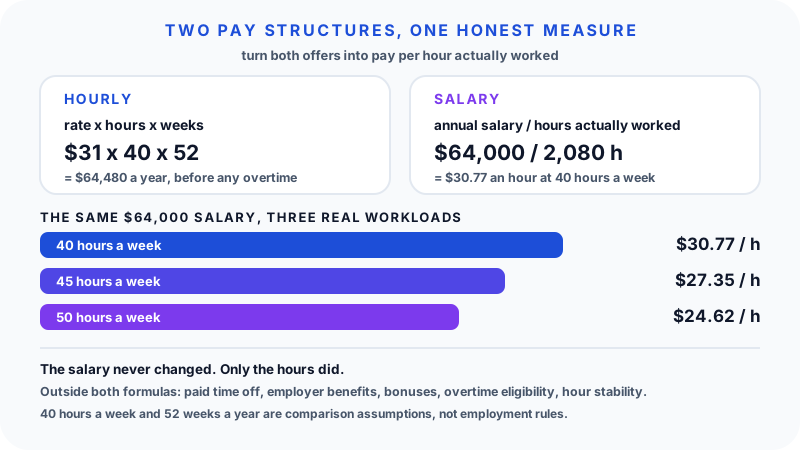
A note on the numbers used throughout this guide: 40 hours a week and 52 weeks a year are comparison assumptions, not employment rules. They give a clean 2,080-hour baseline that makes examples easy to follow. Real contracts use 35, 37.5, 38, 42, or variable hours, and paid weeks depend on leave, closures, and local rules. Substitute your own figures wherever the examples use these.
What hourly pay really means
Hourly pay ties income directly to paid time. If you work 35 paid hours, you are paid for 35. If you work 48 paid hours and qualify for overtime, those extra hours may be paid at a higher rate. The upside is visibility: each additional paid hour has a clear value. The downside is that fewer scheduled hours, unpaid closures, unpaid holidays, or slow weeks can lower annual income.
Hourly roles can also vary more from week to week. A retail worker, technician, hospitality employee, caregiver, or warehouse worker may see income change with shifts, seasonality, staffing needs, and overtime rules. The offer is not just the hourly number; it is the likely number of paid hours.
That makes the schedule part of the pay package. A $28 hourly role with reliable full-time hours may beat a $32 hourly role that routinely drops shifts. A $26 hourly role with frequent overtime may beat both. Ask about average weekly hours, slow-season hours, overtime rules, shift cancellation, paid holidays, and whether breaks are paid.
What salary pay really means
Salary pay usually means a fixed annual amount paid across regular pay periods. A $64,000 salary might arrive as $5,333 per month before deductions or $2,462 every two weeks before deductions. The appeal is predictability. The paycheck does not usually shrink because one week is quiet or because a public holiday reduces working days.
The trade-off is that salary can blur the value of time. If the job routinely takes 45, 50, or 55 hours a week, the annual salary is being spread across more hours than the offer letter implies. Some salaried workers are overtime eligible, but many are not. The label alone does not settle the issue; classification, local law, contract terms, and workplace practice matter.
Salary can also include forms of value that are not in hourly wage math: paid leave, retirement contributions, health coverage, education support, bonuses, stock awards, remote flexibility, and promotion paths. Those benefits can be real compensation. The mistake is treating the salary number as complete before checking the hours and benefits behind it.
Annualizing hourly pay without fooling yourself
The common shortcut is hourly rate times 40 hours times 52 weeks. At $31 per hour, that equals $64,480. That is a useful starting point, and the Hourly to Salary Calculator can do that conversion quickly. But it assumes every week is paid, every week is 40 hours, and unpaid time never appears.
A more honest annual estimate uses paid hours per week and paid weeks per year. If the same $31 role averages 37.5 paid hours across 50 paid weeks, the estimate is $58,125. If it averages 42 hours plus two overtime hours most weeks, it may be much higher. The annual number should reflect the job you are likely to work, not a neat full-time template.
Try three versions: conservative, expected, and busy. Conservative might assume slow weeks, unpaid time, and no overtime. Expected should match what current employees say is normal. Busy can include overtime if it is likely, not merely possible. That range is more useful than a single annualized number that pretends the future schedule is fixed.
The hidden cost of unpaid overtime in salary roles
Salary can quietly become less attractive when extra hours are expected but not separately paid. A $64,000 salary at 40 hours per week is about $30.77 per hour before taxes and deductions. At 50 hours per week, it falls to about $24.62 per hour. The salary did not change, but the hourly value of your time did.
Here is the same $64,000 salary seen through five different workloads. Nothing about the offer letter changes across these rows. Only the hours do.
| Hours actually worked each week | Hours per year | Effective hourly rate |
|---|---|---|
| 35 | 1,820 | $35.16 |
| 40 | 2,080 | $30.77 |
| 45 | 2,340 | $27.35 |
| 50 | 2,600 | $24.62 |
| 55 | 2,860 | $22.38 |
The gap between the top and bottom row is around $12.78 an hour on the identical salary. That is why "what does the job actually take?" is a compensation question, not just a lifestyle one.
This does not mean salary is bad. Some salaried roles offer autonomy, remote flexibility, paid leave, training, bonuses, or promotion paths that are hard to price week by week. It does mean that a salary offer should be read together with expected workload. Ask how many hours people actually work in the role, not only what the official schedule says.
There is also a difference between occasional busy periods and a job designed around constant overwork. A quarter-end push or product launch may be normal in some industries. A permanent 55-hour week should be treated as part of the compensation comparison.
The overtime advantage for hourly roles
For employees who are eligible, overtime can change the comparison fast. Time-and-a-half turns a $31 hourly rate into $46.50 for qualifying overtime hours. Eight overtime hours in a week can add $372 before deductions. Across frequent busy periods, that can move the annual total above a salary that initially looked similar.
Eligibility is the part worth checking rather than assuming. Being paid hourly does not automatically create an overtime entitlement, and being paid a salary does not automatically remove one. Whether extra hours attract a premium depends on jurisdiction, employment classification, job duties, pay level, contract terms, and any collective agreement. Some salaried roles are overtime eligible; some hourly roles are not covered in the way people expect. Treat the offer letter, the contract, and your local rules as the source of truth, and treat any overtime in your estimate as a possibility to confirm rather than a given.
The Overtime Calculator is useful when the job offer mentions seasonal overtime, weekend coverage, or shift premiums. Run a normal week, a busy week, and a slow week. That gives a range instead of one fragile answer.
Overtime has a human cost too. Extra money may be welcome, but extra hours can mean fatigue, child care costs, commute stress, less study time, or less recovery. A financially stronger week is not always a better week. Good comparison math should help you choose with your eyes open, not push you toward the highest possible gross number.
Benefits, paid leave, and schedule risk
A salary package can include paid vacation, paid sick days, retirement contributions, health insurance, life insurance, parental leave, training budgets, or bonuses. Hourly roles may include some of these too, but coverage often depends on employer size, hours worked, country, state, union agreement, and classification.
Paid leave is easy to undervalue. Two jobs can both look like $64,000, but if one gives four paid weeks off and the other has unpaid time away, their real value differs. Benefits also affect take-home pay: an employer-paid health plan or retirement match can be worth more than a small difference in gross wages.
Schedule risk is part of the same conversation. Hourly workers may face reduced shifts. Salaried workers may face expanded responsibilities without extra pay. Neither risk is theoretical. The better offer is the one whose risks you understand and can live with.
Take-home pay is the comparison that matters most
Gross pay is the headline. Take-home pay is what reaches your account after taxes, payroll deductions, retirement contributions, insurance premiums, and other withholdings. Two offers with similar gross annual pay can produce different net pay if benefits are priced differently or deductions vary.
After you have a gross estimate, use a Paycheck Calculator to compare likely net pay by pay frequency. For a salary offer with bonuses or varying deductions, the Salary Calculator helps translate annual, monthly, weekly, and hourly equivalents so the numbers sit next to each other cleanly.
Do not ignore deductions that are voluntary but valuable. A job with a higher paycheck and no retirement match may be weaker than a job with a lower paycheck and a strong employer contribution. Net cash matters, but total compensation matters too.
Worked comparison example
Offer A pays $31 per hour, usually 40 regular hours and 5 overtime hours at 1.5x during 30 weeks of the year. The other 22 weeks are regular 40-hour weeks. Regular annual pay is $31 x 40 x 52 = $64,480. Overtime adds $31 x 1.5 x 5 x 30 = $6,975. Gross annual pay is about $71,455 before deductions.
Offer B pays $68,000 salary, includes 15 paid vacation days, and is expected to average 46 hours per week. Its gross salary is lower than Offer A in this scenario, but the paid leave and steadier paycheck have value. Its hourly equivalent at 46 hours across 52 weeks (2,392 hours) is about $28.43. That does not automatically make it worse, but it makes the trade visible.
Same annual pay, different effective hourly rate
Two offers can land on exactly the same annual number and still not be worth the same.
Both jobs pay $60,000. Job A is a 40-hour week with four weeks of paid leave, so 48 weeks are actually worked: 48 x 40 = 1,920 hours, and $60,000 / 1,920 = $31.25 an hour. Job B is also nominally 40 hours, but there is no paid leave and the role reliably runs to 48 hours a week across all 52 weeks: 52 x 48 = 2,496 hours, and $60,000 / 2,496 = $24.04 an hour.
Same salary. Same job title, potentially. A difference of about $7.21 for every hour of your life the job consumes. Neither offer letter would have shown you that.
The decision may come down to workload tolerance, benefits, commute, schedule control, advancement, and income stability. The better-paid offer is not always the better life fit. The point of the math is to remove the fog before you weigh the human parts.
Quick comparison table
Use this as a thinking aid, not a rulebook.
| Factor | Hourly role | Salary role |
|---|---|---|
| Income stability | Can change with shifts | Usually steadier |
| Extra hours | May trigger overtime | May be unpaid or already included |
| Paid leave | Varies widely | Often clearer in offer |
| Benefits | Depends on status and employer | Often packaged with role |
| Best question to ask | How many paid hours are realistic? | How many hours do people actually work? |
The strongest comparison turns both offers into annual gross pay, estimated take-home pay, and effective hourly value. Then it adds benefits and quality-of-life factors that the calculator cannot price for you.
When the calculators are worth using
Use the Hourly to Salary Calculator when you need to annualize an hourly offer, reverse a salary into an hourly equivalent, or test different weekly-hour assumptions. Use the Salary Calculator when the offer is annual but you want monthly, biweekly, weekly, and hourly views.
Use the Overtime Calculator for any role where extra hours are common enough to affect income. Use the Paycheck Calculator when deductions, tax withholding, benefits, or pay frequency could change the practical comparison. Run more than one scenario. A single optimistic week is not a compensation plan.
Common mistakes
Comparing hourly rate to annual salary directly. A $31 hourly rate and a $64,000 salary are close only if the hourly role really pays about 40 hours for 52 weeks.
Ignoring unpaid time. Unpaid holidays, unpaid sick days, short shifts, and seasonal closures can reduce an hourly worker's annual total.
Treating salary as always 40 hours. The effective hourly value of salary falls when the real workload is consistently higher.
Forgetting benefits. Insurance, retirement contributions, paid leave, and bonuses can outweigh a modest gross pay difference.
Using pre-tax numbers only. Take-home pay can differ because of deductions, benefits, and withholding choices.
FAQ
Is hourly pay better than salary? Not automatically. Hourly pay can be better when overtime is paid and hours are reliable. Salary can be better when it brings stability, paid leave, benefits, and reasonable hours.
How do I compare hourly and salary offers? Convert both to annual gross pay, estimate realistic hours, account for overtime or unpaid time, compare benefits, then estimate take-home pay.
Does salary mean no overtime? No. Some salaried workers are overtime eligible and some are not. Eligibility depends on local law, job duties, salary level, contract terms, and employer policy.
What is effective hourly pay? Effective hourly pay is annual compensation divided by the hours you actually work. It is useful for seeing how long salary weeks change the value of time.
Should I include benefits in the comparison? Yes. Paid leave, health coverage, retirement contributions, bonuses, training, and schedule flexibility can materially change the value of an offer.
Why can two jobs with the same annual pay have different effective hourly rates? Because the annual figure says nothing about the hours behind it. Paid leave reduces the hours you work for the same money; unpaid extra hours increase them. Divide each annual figure by its own realistic hour count and the two stop looking identical.
Can a lower salary be better than a higher hourly offer? Yes, if the salary has better benefits, paid time off, predictable hours, lower commute cost, or a stronger career path. The math is only one part of the decision.
Educational only. Employment rules and tax treatment vary by location, contract, and employer policy. This is not legal, tax, or career advice.