
The first payslip in a new job rarely matches expectations. You sign for a 38,000 pound role and assume that divides into something close to 3,167 pounds a month. On the 2026/27 rates, with a standard tax code and no pension, the actual figure is about 2,573 pounds. Nothing has gone wrong. Two deductions have done their normal work, but the gap is large enough that it is worth understanding how those calculations actually run.
The aim of this guide is not to file a return. It is to take a UK salary apart and explain each piece of the difference, using the rates and thresholds that apply in the 2026/27 tax year, so the numbers on the payslip stop looking like a riddle.
A UK payslip in three lines
Strip the headers off most monthly UK payslips and the deductions usually come down to:
- Income tax under PAYE
- National Insurance contributions (NICs)
- Possibly a pension contribution, and sometimes a student loan repayment
The first two are required for most employees. The last two depend on what you have signed up to and what loans you have. Together they account for most of the gap between gross and net.
For a quick estimate of where a given salary actually lands monthly, the UK Income Tax Calculator handles the standard case (England and Northern Ireland thresholds, single income, no salary sacrifice). For the inverse, turning an hourly rate or weekly amount into an annual figure before tax runs, the Salary Calculator and the Hourly to Salary Calculator are usually the right starting points.
PAYE: the system, not the tax
A common source of confusion is calling PAYE a tax. It is not. PAYE (Pay As You Earn) is the collection method. The tax itself is just income tax. PAYE is the mechanism HMRC uses to take income tax and NICs out of your wages each pay period, so you do not get a single huge bill at year end.
Your employer uses your tax code to calculate the right amount. The code is a short string, usually 1257L for someone with the full personal allowance and no complications, and it tells the payroll system how much tax-free pay you are entitled to in the current year. The number is the allowance with the last digit removed: 1257 stands for 12,570 pounds. Roll past that allowance and the rest of your pay is taxable at the bands below. The L on the end is the most common letter; other letters cover specific situations, such as a marriage allowance transfer, a second job, or an emergency code after a change of employer.
Because PAYE is calculated per pay period, your tax does not get applied to "your salary" in one go. It is spread across the months. That is why a one-off bonus or a missing month of pay can shift withholding noticeably: payroll is trying to apply an annualised figure to a particular slice of the year.
Tax bands and the personal allowance in 2026/27
UK income tax is banded, similar in spirit to US brackets but with different rates and thresholds. For England, Wales, and Northern Ireland, employment income in 2026/27 is taxed like this:
| Band | Taxable income (after allowances) | Rate |
|---|---|---|
| Personal allowance | First 12,570 pounds of income | 0% |
| Basic rate | Up to 37,700 pounds | 20% |
| Higher rate | 37,701 to 125,140 pounds | 40% |
| Additional rate | Over 125,140 pounds | 45% |
Because the allowance sits underneath, the practical thresholds on total income are 12,570 pounds before any tax, 50,270 pounds before the 40% rate starts, and 125,140 pounds before the 45% rate starts.
These figures have not moved since April 2021, and the Autumn Budget 2025 extended the freeze by a further three years, to April 2031. Frozen thresholds with rising wages mean more income drifts into higher bands each year without any rate changing, which is why "fiscal drag" turns up so often in coverage of UK pay.
The personal allowance is withdrawn for income above 100,000 pounds, at the rate of 1 pound of allowance for every 2 pounds of income over the limit. It reaches zero at 125,140 pounds, which is simply 100,000 plus twice 12,570. Inside that band the effective marginal rate is roughly 60%, even though no headline rate says 60%. It is the most surprising part of the UK system for many higher earners.
Scotland is different, and by more than people expect
Scotland sets its own rates and bands for non-savings, non-dividend income. In 2026/27 there are six of them:
| Band | Total income range | Rate |
|---|---|---|
| Starter | 12,571 to 16,537 pounds | 19% |
| Basic | 16,538 to 29,526 pounds | 20% |
| Intermediate | 29,527 to 43,662 pounds | 21% |
| Higher | 43,663 to 75,000 pounds | 42% |
| Advanced | 75,001 to 125,140 pounds | 45% |
| Top | Over 125,140 pounds | 48% |
At a modest salary the difference is small. On 42,000 pounds, a Scottish taxpayer pays about 5,971 pounds of income tax against 5,886 pounds elsewhere in the UK, a gap of around 85 pounds a year. The gap widens quickly above the Scottish higher-rate threshold of 43,663 pounds, which sits well below the 50,270 pound threshold used in the rest of the UK. On 60,000 pounds the same comparison is roughly 13,182 pounds against 11,432 pounds, about 1,750 pounds a year more.
Wales has the legal power to set Welsh rates of income tax but currently sets them so the total matches England and Northern Ireland. The personal allowance and National Insurance are set UK-wide and do not change with residence.
National Insurance: the second tax that is not called a tax
Sitting beside income tax is National Insurance, which funds the state pension and parts of the welfare and NHS system. NICs are a separate calculation on a separate set of thresholds, split into an employee side (Class 1 Primary) and an employer side (Class 1 Secondary). Only the employee side appears on your payslip.
For 2026/27, employee Class 1 NICs on category A work like this:
| Earnings | Employee rate |
|---|---|
| Up to the primary threshold, 12,570 pounds a year (1,048 a month) | 0% |
| Between 12,570 and the upper earnings limit of 50,270 pounds a year (4,189 a month) | 8% |
| Above 50,270 pounds a year | 2% |
Two things often catch people out.
First, NI is calculated on pay period earnings, not annual income, in most employment cases. That is different from income tax, which the payroll system spreads across the year. A single very large month, such as a bonus or a windfall commission, pushes more of that month's earnings past the monthly upper earnings limit, where only 2% applies, and there is no year-end reconciliation to smooth it out.
Second, employer NI is real money even though it never appears on your stub. In 2026/27 employers pay 15% on earnings above a secondary threshold of just 5,000 pounds a year. On a 42,000 pound salary that is 5,550 pounds, so the employer's cash cost is about 47,550 pounds before any employer pension contribution. It does not affect your take-home directly, but it is why employers weigh benefits and salary sacrifice against straight cash.
A worked example: 42,000 pounds, England, 2026/27
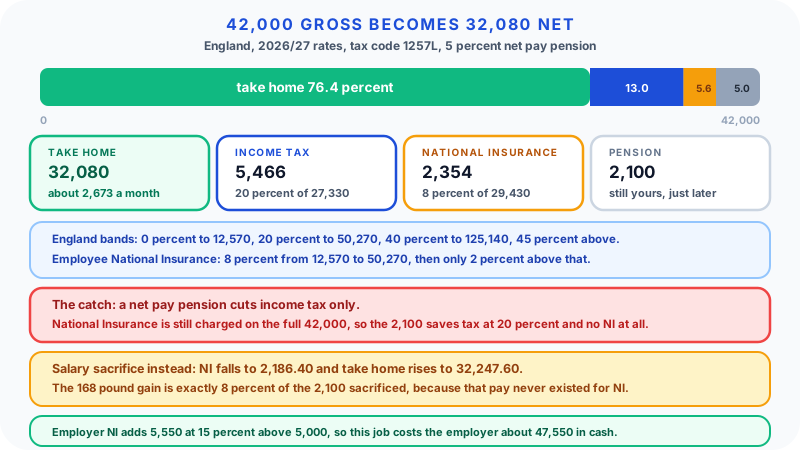
Take an employee on a 42,000 pound annual salary, tax code 1257L, contributing 5% of pay to a workplace pension under a net pay arrangement, with no student loan.
Step 1. Pension. 5% of 42,000 is 2,100 pounds. Under a net pay arrangement this comes out before income tax is calculated, so taxable pay is 39,900 pounds. It does not reduce the pay National Insurance is charged on.
Step 2. Income tax. Taxable pay of 39,900 minus the 12,570 allowance leaves 27,330 pounds in the basic rate band. At 20% that is 5,466 pounds a year, about 455.50 a month.
Step 3. National Insurance. NI is charged on the full 42,000 pounds of earnings. Above the 12,570 primary threshold that leaves 29,430 pounds, all of it below the upper earnings limit, so it is charged at 8%: 2,354.40 pounds a year, about 196.20 a month.
Step 4. What lands in the bank. 42,000 minus 2,100 of pension, minus 5,466 of tax, minus 2,354.40 of NI leaves 32,079.60 pounds a year, about 2,673 pounds a month.
Swap the net pay pension for salary sacrifice and the arithmetic shifts. Sacrificing the same 2,100 pounds reduces gross pay to 39,900 for both tax and NI. Income tax is unchanged at 5,466 pounds, but NI falls to 8% of 27,330, which is 2,186.40 pounds. Take-home rises to 32,247.60 pounds, or about 2,687 a month. The 168 pound gain is exactly 8% of the sacrificed amount, which is the employee NI that is no longer due. The employer also saves 15% of 2,100, which is 315 pounds, and many schemes pass some of that into the pension.
The exact figures shift when bands change. The structure does not. A salary lands in a band, income tax and NI take the headline deductions, the pension takes a slice, and the result is what arrives in the bank.
For a side-by-side that updates with current numbers, the UK Income Tax Calculator gives the annual picture; the Salary Calculator lets you sanity-check by converting weekly or hourly pay before tax. If overtime is part of the picture, the Overtime Calculator helps estimate the extra gross before bands and NI run.
Annual numbers versus monthly reality
A particularly common source of confusion is the gap between annualised tax figures and what shows on a month-by-month payslip.
Income tax under PAYE is calculated cumulatively in most cases. The system asks: based on year-to-date earnings and the year-to-date share of the tax-free allowance, how much income tax should have been deducted by now? Subtract what has already been deducted, and that is this month's tax.
That is why a mid-year pay rise often produces a smaller tax bump than expected: the allowance already used is carried forward and the system catches up gradually. It is also why a missing month of pay, from unpaid leave or a late start, often produces a refund the following month, because the year-to-date allowance kept building while earnings did not.
NI does not work cumulatively for most employees. Each pay period is its own calculation. So a one-off month with a big bonus produces a distinct NI pattern that month, with no later reconciliation.
Pensions, salary sacrifice, and student loans
A few items that frequently show up on payslips:
Workplace pension contributions. UK schemes use one of three mechanisms, and they are not interchangeable. A net pay arrangement takes the contribution before income tax, giving relief at your marginal rate immediately, but leaves NI untouched. Salary sacrifice reduces gross pay itself, so it cuts both income tax and NI for the employee and employer NI for the company. Relief at source takes the contribution from pay after tax, and the scheme reclaims basic-rate relief into the pot; higher and additional rate taxpayers have to claim the rest through self assessment, and a large number never do. The trade-off with salary sacrifice is a lower headline salary, which can affect mortgage applications and some earnings-related benefits.
Student loans. Plan 1, Plan 2, Plan 4, Plan 5, and the Postgraduate Loan each have their own threshold. For 2026/27 the annual thresholds are 26,900 pounds (Plan 1), 29,385 (Plan 2), 33,795 (Plan 4), and 25,000 (Plan 5), each deducted at 9% of earnings above the threshold, with the Postgraduate Loan starting at 21,000 pounds and deducted at 6%. Repayments run through PAYE, are assessed per pay period against the monthly or weekly threshold, and are charged on the same earnings figure as NI. That means a salary sacrifice pension reduces them, and a net pay pension does not.
Benefits in kind. A company car, private medical insurance, or another taxable benefit is usually collected by adjusting your tax code, so the tax comes out gradually through PAYE rather than as a year-end bill. That is why a new car or insurance benefit often shows up as a code change rather than a separate payslip line.
Common mistakes
Treating PAYE as a flat percentage. It is not. PAYE applies bands and a personal allowance, and the effective rate at any salary depends on where the income lands.
Forgetting NI. NI is the second-biggest deduction for most employees, and it is never included when people quote "income tax" rates. Both matter for take-home.
Assuming a net pay pension cuts your NI. It does not. Only salary sacrifice reduces the earnings National Insurance is charged on.
Comparing UK take-home to US take-home directly. The systems are not structurally identical. NI funds things the US handles through separate federal programs, and deductions and credits do not line up. Like-for-like comparisons of "salary" between countries mislead unless you adjust for what each system funds.
Assuming Scotland uses the same bands as England. It does not, for employment income, and the higher-rate threshold is more than 6,000 pounds lower.
Treating the calculator as definitive. A general UK calculator handles the standard PAYE case. Side incomes, dividends, capital gains, salary sacrifice quirks, multiple jobs, K codes, and emergency codes can all change the result. Use it for an estimate, not a final answer.
A few realistic scenarios
A graduate on 29,000 pounds with a Plan 2 loan and a 5% net pay pension takes home about 1,937 pounds a month. The surprise is the loan: the Plan 2 threshold is 29,385 pounds for 2026/27, so at this salary the deduction is zero. Repayments start only once earnings cross the monthly equivalent of 2,448.75 pounds, and then apply at 9% of the excess, so the first payments are pennies rather than the flat percentage many people expect.
A two-earner couple on 58,000 pounds each pays far less than one person earning their combined 116,000 pounds. Each of them pays about 10,632 pounds of income tax and 3,171 pounds of NI, so 27,605 pounds between them. A single earner on 116,000 pounds loses 8,000 pounds of personal allowance to the taper and pays about 37,032 pounds of tax and 4,331 pounds of NI, roughly 41,363 pounds. The gap is close to 13,750 pounds a year, and it exists because the allowance and every band are per person, not per household.
A single earner on 105,000 pounds sits inside the taper. The allowance drops by 2,500 pounds, and the 5,000 pounds of income above 100,000 costs 2,000 pounds in tax on itself plus 1,000 pounds of tax on the allowance that disappeared, which is 3,000 pounds on 5,000 pounds of income, or 60%, before the 2% NI on top. Paying 5,000 pounds into a pension brings adjusted net income back to 100,000, restores the full allowance, and costs about 2,000 pounds net once the relief is counted. That arithmetic is why pension contributions cluster so tightly at this income level.
FAQs
Why is my monthly pay so much less than my annual salary divided by twelve? Income tax under PAYE, National Insurance, and, in most workplace setups, a pension contribution come out before the money hits your account. Add a student loan repayment if one applies and the gap widens further. On 38,000 pounds with a standard code and no pension, the 2026/27 arithmetic is 5,086 pounds of tax and 2,034 pounds of NI, leaving about 2,573 a month rather than 3,167.
What exactly is PAYE? It is the mechanism HMRC uses to collect income tax and NICs through your employer, calculated each pay period. The tax itself is income tax; PAYE is just the collection system.
Do I pay tax on my entire salary? No. Most earners have a personal allowance, currently 12,570 pounds, and then bands above it. Only the portion above the allowance is taxed, and the rates step up as income enters higher bands. The allowance itself is withdrawn above 100,000 pounds.
How does National Insurance differ from income tax? NI is a separate set of contributions with separate thresholds and rates, calculated per pay period for most employees rather than cumulatively across the year. In 2026/27 the employee rates are 8% between 12,570 and 50,270 pounds and 2% above that. It funds the state pension and parts of the welfare and NHS system.
What is my tax code and what does it mean? A short alphanumeric code telling your employer how much tax-free pay to apply when running payroll. 1257L is the standard code for someone with the full 12,570 pound allowance; the number is the allowance with the final digit dropped. Other letters cover marriage allowance, second jobs, or benefits in kind, and a K code means untaxed income or benefits exceed your allowance.
Does my workplace pension reduce my tax? Usually yes, but the mechanism matters. Net pay arrangements and salary sacrifice both lower taxable pay in real time, and only salary sacrifice also lowers National Insurance. Relief at source claims the basic rate back inside the pension and needs a separate self assessment claim for higher-rate relief.
Related guides
Sources
- Income Tax rates and allowances for current and previous tax years - HMRC. Source for the 2026/27 personal allowance of 12,570 pounds, the 37,700 pound basic rate limit, the 125,140 pound additional rate threshold, and the 100,000 pound income limit at which the allowance starts to be withdrawn.
- Rates and thresholds for employers 2026 to 2027 - HMRC. Source for the employee Class 1 primary threshold and upper earnings limit, the 8% and 2% employee rates, the 15% employer rate above a 5,000 pound secondary threshold, and every student loan threshold and rate quoted above.
- Scottish Income Tax rates and bands: 2026 to 2027 - Scottish Government. Source for the six Scottish bands and their rates and ranges.
- Budget: freeze on personal allowance extended - ICAEW. Source for the Autumn Budget 2025 extension of the threshold freeze by three years to April 2031.
- Income tax: freezing the personal allowance and the higher rate threshold - House of Commons Library. Background on the freeze and its fiscal drag effect.
Rates and thresholds were checked against HMRC and Scottish Government guidance in September 2026. UK tax rules change in most fiscal years, so re-check the current figures before relying on any number here. All worked examples are BlinkCalc illustrations of the standard PAYE case.
Reading a payslip with confidence
Three calculations sit behind one net figure: income tax spread cumulatively across the year against a frozen personal allowance, National Insurance charged fresh in every pay period, and whatever pension or loan arrangement you have signed up to. Once you can see them separately, the questions get easier. A bonus month looks odd because NI is not smoothed. A mid-year rise looks gentle because PAYE catches up gradually. A 105,000 pound salary behaves strangely because an invisible allowance is disappearing underneath it. Run your own number through the UK Income Tax Calculator for the annual picture, and treat any figure it gives as a good estimate rather than a final answer.
This article is educational. UK tax rules change in most fiscal years and differ in Scotland. Salary sacrifice, multiple incomes, equity awards, and self assessment situations can all alter the picture. The official HMRC website is the authoritative source. For decisions, speak to a qualified accountant or tax adviser.