
The 21-day habit rule is one of those ideas that sounds useful because it is clean.
Three weeks. A fresh start. A finish line close enough to feel motivating.
The problem is that no study ever produced it, and the studies that did measure habit formation found something both slower and more variable. Drinking a glass of water after brushing your teeth might become automatic quickly. Running five miles before work may take months before it stops requiring negotiation. Reading for ten minutes at bedtime is different from quitting late-night scrolling.
Habit formation is not a countdown until discipline becomes effortless. It is the gradual transfer of effort from conscious decision-making to a familiar pattern. The behavior becomes easier because the cue is clear, the environment supports it, the reward is meaningful, and repetition teaches your brain what comes next.
So the honest answer is: usually a couple of months, sometimes far longer, and for some behaviors it does not happen at all within the window people give it. The numbers below come from the two best pieces of evidence we have.
Where the 21-Day Idea Actually Came From
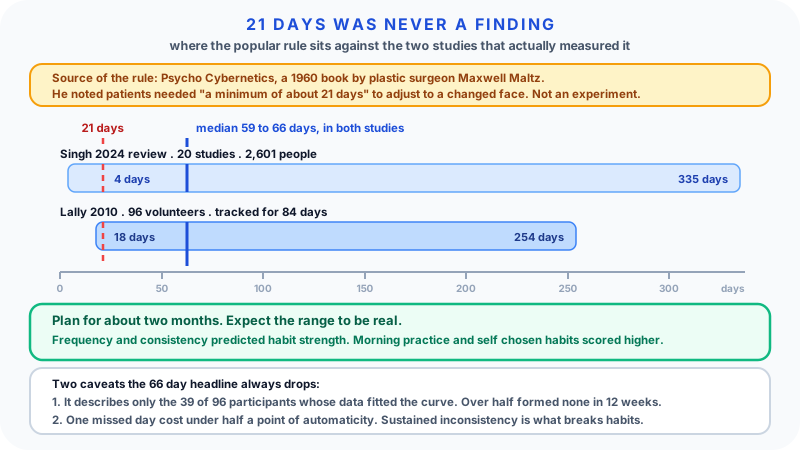
The 21-day rule traces to Psycho-Cybernetics, a 1960 self-help book by Maxwell Maltz, a plastic surgeon. Maltz observed that patients seemed to need "a minimum of about 21 days" to get used to an altered face, and that amputees took roughly the same time to stop feeling a phantom limb.
That is worth reading twice. It was a clinical impression about adjusting to a change in your body, not an experiment about acquiring a behavior. There was no control group, no measurement of automaticity, and no habit in the modern sense. Over sixty-five years the caveat "a minimum of about" was dropped, the context was dropped, and a surgeon's observation became a productivity law.
The slogan spread because people like behavior change advice with a number attached. Numbers create hope. They imply that discomfort has a scheduled end date.
Think of "21 days" as a starting checkpoint, not a promise. At three weeks, you can ask:
- Is the cue obvious?
- Have I reduced the friction?
- Do I know what usually interrupts the habit?
- Is the behavior becoming less mentally expensive?
- Does the reward arrive soon enough to reinforce repetition?
That is more useful than asking whether the habit is officially complete.
What the Research Actually Found
Two studies do most of the useful work here.
Lally and colleagues (2010). Ninety-six volunteers each chose one new daily eating, drinking, or activity behavior tied to a cue, and rated how automatic it felt every day for 84 days. Among the 39 participants whose data fitted the expected curve, the median time to reach 95% of their automaticity plateau was 66 days, with a range of 18 to 254 days.
Two details in that study are usually left out and both matter:
- The 66-day figure describes the successful subset. More than half the participants did not produce a clean habit-formation curve inside twelve weeks at all. "66 days" is not a deadline everyone meets; it is the middle of the group that got there.
- Missing a single day barely moved the curve. A missed opportunity reduced automaticity by less than half a point on the scale, and scores recovered quickly. Consistent absence broke habit formation; one bad Tuesday did not.
Singh and colleagues (2024). A systematic review and meta-analysis published in Healthcare pooled 20 studies covering 2,601 people forming health habits. Median time to habit formation came out at 59 to 66 days, with an overall spread across individuals of 4 to 335 days.
That review also identified what shifted the timeline, which is more actionable than the median itself:
- Time of day. Habits practised in the morning tended to reach greater strength than the same behaviors attempted later in the day.
- Self-selection. Habits people chose themselves formed more strongly than habits assigned to them.
- Frequency and consistency of repetition, rather than intensity of effort.
- Behavior type. Flossing behaves differently from exercise, which behaves differently from dietary change.
Put the two together and the practical summary is: plan for about two months, expect the range to be enormous, and judge yourself on consistency rather than on the calendar.
A Habit Is a Memory for Action
A habit is not simply something you do often. It is something your brain learns to trigger in a familiar context.
The classic habit loop has three parts:
| Part | What it does | Example |
|---|---|---|
| Cue | Tells the brain a pattern is available | Kettle finishes boiling |
| Routine | The behavior itself | Make tea and take vitamins |
| Reward | Gives the brain a reason to repeat | Warm drink, completed task, relief |
The cue is especially important, and it is the part the Lally study built its design around: every participant tied their behavior to a specific existing cue rather than to a vague intention. "I will stretch more" is vague. "After I close my laptop at 5:30, I will stretch for five minutes beside my desk" is easier for the brain to recognize.
The cue should already exist if possible. After brushing teeth. After making coffee. Before opening the laptop. When returning home. After putting the child to bed. Stable cues reduce the number of decisions required.
The routine should be small enough to survive real life. A habit that only works on perfect days is not a habit yet. It is an aspiration with good lighting.
The reward does not need to be dramatic. It can be physical comfort, a visible checkmark, a cleaner room, a calmer morning, a sense of closure, or the relief of not having to think about it later.
Repetition Matters, But Consistency Matters More
People often count repetitions as if each one has equal weight. In practice, context matters.
Doing a habit 30 times in 30 different situations does not build the same automaticity as doing it 30 times after the same cue. The brain learns relationships. If the cue keeps changing, the behavior remains dependent on conscious intention.
This is one reading of why morning habits showed greater strength in the 2024 review: early in the day there is less accumulated fatigue and less competition from unplanned events, so the cue fires in similar conditions each time. "Meditate sometime today" has to compete with the entire day. "Meditate for three minutes after feeding the dog" has a natural anchor.
Consistency also protects you from the biggest habit killer: renegotiation.
Renegotiation is the moment you ask, "Do I feel like doing this today?" That question sounds harmless, but it reopens the decision. A strong habit reduces the need for that conversation.
The best early habit design makes the first step almost too easy to debate:
- Put shoes by the door.
- Open the document before lunch.
- Fill the water bottle at night.
- Place the book on the pillow.
- Keep the guitar on a stand instead of in a case.
- Set the timer before you check messages.
Friction is often mistaken for lack of motivation. Remove the friction and the same person suddenly looks more disciplined.
Realistic Habit Timelines
The table below is a planning aid, not a measurement. The research gives us a central estimate of roughly two months and a range of anywhere from a few days to nearly a year; it does not give us a per-behavior lookup table. What follows sorts habit types by how much of that range they are likely to occupy, based on the determinants the 2024 review identified: complexity, frequency, reward delay, and whether the habit has to displace an existing one.
| Habit type | Where it likely sits in the 4 to 335 day range |
|---|---|
| Tiny add-on to a stable cue | Fast end. Weeks rather than months |
| Simple daily routine | Around or below the 59 to 66 day median |
| Exercise or study habit | At or above the median |
| Habit replacing an old habit | Long end, because the old cue still fires |
| Identity or lifestyle shift | Beyond the studied window. Ongoing refinement |
If you are tracking a streak in days, convert it into weeks before comparing it with anything here, because 66 days is nine and a half weeks and it rarely feels that long when counted in days.
The timeline depends on several forces:
- Complexity: more steps require more planning.
- Frequency: daily habits get more practice than weekly ones, and the research measured daily behaviors.
- Friction: a difficult setup slows repetition.
- Reward delay: benefits that arrive later are harder to reinforce.
- Emotional load: habits tied to stress, shame, or identity take longer.
- Environment: supportive surroundings make behavior easier to repeat.
Someone building a flossing habit may need less time than someone building a writing habit. Someone walking after lunch may need less time than someone training before dawn in winter. The behavior is not only the action. It is the conditions around the action.
Motivation Is a Spark, Not a System
Motivation is useful at the start. It gives you energy to imagine a different pattern and take the first steps. But motivation fluctuates. It rises after a good podcast, a health scare, a new notebook, a deadline, or a burst of optimism. Then ordinary life returns.
Systems are what remain when motivation drops.
A system answers practical questions:
- When does the habit happen?
- What cue starts it?
- What is the minimum version?
- What gets in the way?
- How will I recover after missing it?
- What environment makes it easier?
This is not glamorous. It is effective because habits are built in ordinary conditions. If your plan requires heroic emotional weather, it will fail as soon as the weather changes.
Consider two versions of the same goal.
Version one: "I will start exercising seriously."
Version two: "On Monday, Wednesday, and Friday, after I put my work bag down, I will change into workout clothes and walk for 20 minutes. If it rains, I will do 10 minutes inside. If I miss a day, I resume at the next scheduled slot."
The second plan has less drama and more architecture. It also matches how the studied habits were built: one behavior, one cue, repeated.
Streaks Help Until They Start Lying
Streaks are motivating because they make repetition visible. A chain of checkmarks creates momentum. The Countdown Timer & Stopwatch can help with time-based habits because it gives a clear start and stop, especially for short sessions like reading, stretching, cleaning, or focused work.
But streaks can become fragile. If the entire identity of the habit depends on never missing, one missed day can feel like failure. That is a poor design, and it is also poorly calibrated: Lally's participants lost less than half a point of automaticity for a single missed opportunity and recovered quickly. The evidence says one miss is close to costless. The streak counter says it is total failure. The streak counter is wrong.
Use streaks as feedback, not as a verdict.
A better rule is "never miss twice" for frequent habits. That rule is a practical heuristic rather than a measured threshold, but it points the right way: what the research penalised was sustained inconsistency, not the occasional gap. Missing once is noise. Missing twice is a pattern forming.
For weekly habits, use a recovery window. If you miss the planned day, reschedule within 48 hours. This preserves continuity without pretending schedules never change.
The habit is not the streak. The habit is the return.
Identity Can Help, But Only If It Stays Practical
Identity-based habit advice can be powerful: become the kind of person who reads, trains, saves, studies, cooks, or keeps promises to themselves. It also aligns with one of the clearer findings in the 2024 review, that self-chosen habits form more strongly than imposed ones. A habit that feels like yours has a head start over one you accepted from a program.
The danger is making identity too grand too early. If you have not run in years, declaring "I am a runner" may feel inspiring for two days and false on the third. A smaller identity is often sturdier:
- "I am someone who puts on walking shoes after work."
- "I am someone who opens the document before checking messages."
- "I am someone who keeps a simple breakfast ready."
- "I am someone who comes back after missing a day."
Identity changes through evidence. Each repetition is a small vote. You do not need to believe the whole new story on day one. You need enough proof to make the next repetition plausible.
Environment Does More Than Willpower
A habit-friendly environment makes the desired behavior obvious and the competing behavior slightly less convenient.
If your phone is beside the bed, late scrolling is the default. If your running clothes are buried in a drawer, morning exercise starts with a search. If snacks are on the counter, snacking gets more cues than the meal plan. If the book is in another room, reading loses to whatever is already in your hand.
Changing the environment may feel too simple, but that is the point. You want fewer moments where discipline has to perform.
Try this environmental audit:
| Desired habit | Make it easier | Make the rival harder |
|---|---|---|
| Read at night | Put book on pillow | Charge phone outside bedroom |
| Walk after work | Shoes by door | Do not sit down first |
| Study daily | Open materials in advance | Block distracting sites |
| Drink water | Bottle on desk | Keep soda out of sight |
| Cook more | Prep one base ingredient | Remove delivery app shortcuts |
Most people overestimate how much behavior comes from character and underestimate how much comes from setup.
The Minimum Version Keeps the Habit Alive
Every habit needs a minimum version. This is the smallest acceptable form you can do on a bad day.
Not the ideal version. The survival version.
Examples:
- One push-up.
- Two minutes of tidying.
- Open the language app and do one review.
- Write one sentence.
- Walk around the block.
- Stretch while the kettle boils.
The minimum version protects identity and continuity. It also prevents all-or-nothing thinking, which is one of the main reasons habits collapse.
All-or-nothing thinking says, "If I cannot do the full workout, there is no point." Habit thinking says, "Today is a minimum day. Keep the pattern alive."
Minimum days are not failure days. They are maintenance days. Given that the median habit needs roughly two months of repetition, the ability to keep going on ordinary days matters far more than the quality of your best ones.
Use Time More Honestly
People often build habits on fantasy calendars. They imagine the version of themselves who has clean evenings, quiet mornings, and no interruptions.
That person is rarely available.
Use the Time Calculator to estimate the real time a habit requires across a week. A 45-minute workout may require 75 minutes once you include changing, travel, showering, and transition time. A "quick" meal prep habit may require shopping, chopping, cleanup, and storage.
If the true time cost is too high, shrink the habit before it fails. Ten minutes done consistently beats a 60-minute plan that exists mostly as guilt. This is also the arithmetic case for the minimum version: a habit you have to sustain for two months has to fit the average week, not the good one.
A 60-Day Setup Plan
Thirty days is not long enough to expect automaticity, so plan around the research median instead. Use the first 60 days as a setup phase, and treat the end of it as a review point rather than a finish line.
Days 1 to 7. Make the cue and the minimum version explicit. Write them as one sentence. Track completion, and note what got in the way rather than only whether you did it.
Days 8 to 21. Reduce friction. Move objects, adjust timing, lower the minimum, or change the cue. This is where the old 21-day rule is genuinely useful: not as a finish line, but as the point where you have enough data to fix the design.
Days 22 to 45. Protect consistency and watch for boredom, which arrives well before automaticity does. Keep the habit small enough to repeat when enthusiasm fades.
Days 46 to 60. Test resilience. What happens on a busy day? After a miss? After a week away?
At the end, ask better questions than "Is this automatic?"
- Is it easier than it was?
- Do I know my main obstacles?
- Does the cue work?
- Is the minimum version small enough?
- Do I recover quickly after misses?
- Is the reward meaningful enough to continue?
If the honest answer at day 60 is "easier but not automatic," that is not failure. In the Lally data, plenty of people were still climbing at day 84, and some took the better part of a year.
FAQ
Does it really take 21 days to build a habit?
No. The number comes from a 1960 self-help book by the plastic surgeon Maxwell Maltz, who observed that patients took "a minimum of about 21 days" to adjust to an altered appearance. It was never a habit experiment. Measured studies put the median nearer two months.
How long does habit formation usually take?
Lally and colleagues found a median of 66 days to reach 95% of automaticity, with a range of 18 to 254 days. A 2024 systematic review of 20 studies and 2,601 people put the median at 59 to 66 days, with individuals ranging from 4 to 335 days. Plan for roughly two months and treat the range as real.
Is consistency more important than intensity?
Yes, and this is one of the better-supported findings. Frequency and consistency of repetition predicted habit strength across the 2024 review. A small behavior repeated after the same cue teaches the pattern more reliably than occasional heroic effort.
What should I do if I miss a day?
Resume at the next planned opportunity. In the Lally study a single missed opportunity cost less than half a point of automaticity and recovered quickly. Sustained inconsistency is what prevents habits forming, not one gap. For frequent habits, "never miss twice" is a useful recovery rule.
How do habit loops work?
A habit loop connects a cue, a routine, and a reward. The cue triggers the behavior, the routine is the action, and the reward reinforces the pattern so it becomes easier to repeat. Attaching the routine to a cue that already exists in your day is the part most habit plans skip.
Does the time of day matter?
It appears to. The 2024 review found that habits practised in the morning tended to reach greater strength than the same behaviors attempted later, plausibly because morning conditions repeat more reliably and compete with fewer unplanned events.
Can a timer help build habits?
Yes. A timer can lower resistance by making a habit feel bounded. It works especially well for short habits such as focused work, cleaning, stretching, reading, or practice sessions.
Sources
- How are habits formed: Modelling habit formation in the real world - Lally, van Jaarsveld, Potts and Wardle, European Journal of Social Psychology, 2010. Source for the 66-day median, the 18 to 254 day range, the 84-day study period, and the finding that one missed opportunity had little effect on automaticity.
- How long does it take to form a habit? - University College London. Plain-language summary of the same study, including the point that overall inconsistency, not individual misses, prevented habits forming.
- Time to Form a Habit: A Systematic Review and Meta-Analysis of Health Behaviour Habit Formation and Its Determinants - Singh and colleagues, Healthcare, 2024. Source for the 59 to 66 day median across 20 studies and 2,601 participants, the 4 to 335 day range, and the determinants: morning timing, self-selection, and repetition frequency.
- Psycho-Cybernetics - background on Maxwell Maltz's 1960 book and the "minimum of about 21 days" observation that the 21-day rule was derived from.
Research figures were checked in September 2026. The habit timeline table and all worked examples are BlinkCalc planning aids built on those findings, not measurements reported by the studies.