
A task looks smaller before you start it.
The report seems like two focused hours until you open the old files, find the missing data, wait for feedback, fix the formatting, answer a question, reread the brief, and discover that the final 15 percent contains most of the decisions.
People are not bad at deadlines because they cannot read clocks. They are bad at deadlines because a planned task and a performed task are different objects. In imagination, work runs in a straight line. In practice it branches, stalls, waits on other people, and collects small pieces of coordination that were never in the estimate.
This guide separates the reasons estimates fail, then covers methods that make the next estimate better. Not all of them are psychological, and treating every missed deadline as a thinking error hides the structural causes that are often easier to fix.
Effort time is not elapsed time
The single most useful distinction in estimation is between two different quantities that people report with the same word.
Effort time is hands-on work: the minutes you are actually doing the thing.
Elapsed time is calendar time: how long it takes for the task to become done, including everything that happens between the working parts.
When someone says "that's two hours," they almost always mean effort. When someone asks "when will it be done," they always mean elapsed. Most broken commitments live in that gap.
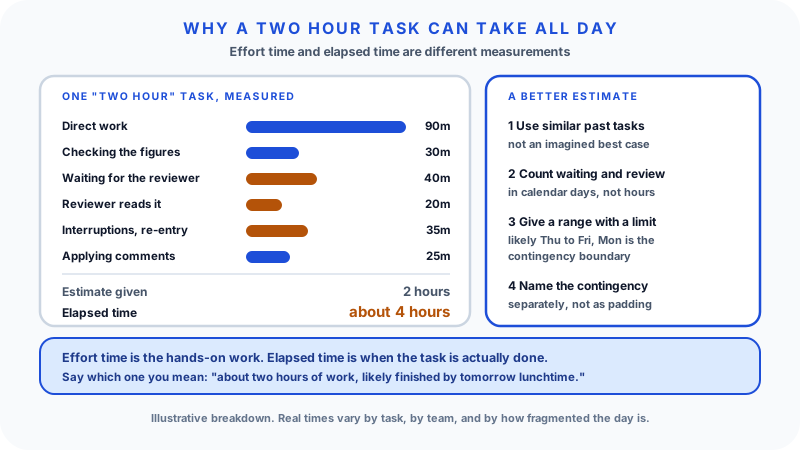
A "two-hour" task, measured properly
Take a routine piece of work: update a report and send it for sign-off. The estimate is two hours. Here is a plausible account of the same task in elapsed terms.
| Component | Time | Type |
|---|---|---|
| Direct work on the report | 90 min | Effort |
| Checking and testing the figures | 30 min | Effort |
| Reviewer reads it and responds | 20 min | Effort, someone else's |
| Waiting for that reviewer to be free | 40 min | Waiting |
| Two interruptions, plus getting back into it | 35 min | Switching cost |
| Applying the review comments | 25 min | Effort |
Direct effort is around two and a half hours, already over the estimate. Elapsed time is closer to four, and that assumes the reviewer replies the same morning. If they reply tomorrow, the task spans two days while consuming the same effort.
Neither number is wrong. They answer different questions. A two-hour task can occupy a full day without anyone being slow, because the day contains waiting, review, and re-entry that the estimate never counted.
The practical habit: when you give an estimate, say which one you mean. "About two hours of work, realistically done by tomorrow lunchtime" is one sentence and removes most of the ambiguity.
The planning fallacy, and the other causes
The planning fallacy is the tendency to underestimate how long a future task will take, even with evidence that similar tasks ran longer. When estimating, the mind assembles a best case: I start on time, I focus, the inputs are ready, the work behaves, nothing urgent lands, the review is quick.
That story is not absurd. It is just incomplete, describing the task under favourable conditions when the deadline has to survive ordinary ones.
But the planning fallacy is only one contributor, and treating it as the whole explanation leads people to fix the wrong thing. Estimates also fail because:
- the work depended on someone else's availability
- requirements changed after the estimate was given
- the task was novel, so no one could have estimated it well
- approval or review cycles were slower than assumed
- the work was scheduled into fragmented time
- the estimate was never an estimate, but a wish someone else wanted to hear
Some of these are cognitive. Several are structural, and no amount of careful personal forecasting fixes a two-day approval queue.
Optimism bias and the spacious future
Optimism bias is the expectation that our own case will run a little more smoothly than the average. In deadline language it sounds like "the hard part is basically done," "I just need to clean it up," or "I work better under pressure."
"Clean it up" is the tell. The phrase compresses proofreading, restructuring, checking data, fixing edge cases, formatting, sending for review, responding to comments, and exporting into one soothing label.
Distance amplifies this. Next month feels open because its details are not visible yet; once it arrives, it holds the same ordinary demands as every other month. This is why people accept future commitments they would refuse for tomorrow.
A quick test: would I accept this deadline if it were next week? If not, name what will actually be different by then. Sometimes there is a real answer, such as a project ending or materials arriving. Sometimes the only difference is distance.
Invisible work
Invisible work is every necessary task that does not appear in the headline description.
Writing a presentation is not only writing slides. It includes finding numbers, checking sources, choosing examples, building charts, aligning with a stakeholder, rehearsing, fixing layout, exporting, and sending the file.
Most estimates fail because they price the visible task and forget its surroundings. Splitting an estimate into four layers surfaces the rest:
| Layer | Question |
|---|---|
| Core work | What is the obvious task? |
| Setup | What must happen before I can begin? |
| Coordination | Who or what can slow this down? |
| Finishing | What makes it truly done? |
The last layer is the dangerous one. Review, corrections, packaging, and delivery are short to describe and long to do.
Dependencies, waiting, and review cycles
Waiting time is invisible in a way that effort is not: nothing is happening, so nothing feels spent, yet the calendar moves anyway.
Three patterns cause most of it.
Dependencies. If your task needs a file, an access grant, a decision, or someone else's output, your estimate silently contains their queue. You control your effort. You do not control their calendar.
Review and approval cycles. A single round of review is rarely single. Send, wait, receive comments, apply them, send again. Each round adds elapsed time roughly equal to the reviewer's response latency, not to the length of their comments. Two rounds with a reviewer who answers within a day is a two-day floor regardless of how fast you work.
Handoff boundaries. Work crossing between people, teams, or systems tends to rest at the boundary. Nobody is idle; the item simply is not anyone's current priority.
The fix is not to work faster. It is to count these in calendar days rather than hours, start dependency-heavy items first, and put a request into someone else's queue before you need the answer.
Calendar blindness and the switching tax
A calendar with blank space is misleading. Blank often means unrecorded rather than available: meals, commuting, messages, transitions, errands, family logistics, and the mental drag of moving between contexts rarely appear on it.
You look at Tuesday and see four open hours. The real Tuesday contains a meeting that runs over, a commute, half an hour of email recovery, a meal, and the fact that your best attention was spent before lunch. Use the Time Calculator to place real blocks rather than trusting the visual impression, and note that three scattered two-hour blocks are not equivalent to one uninterrupted six-hour block.
That inequality is the switching tax. Leaving a complex task to answer a message costs more than the reply: you also lose the thread and have to reconstruct the goal, your place, and the next step. Work that takes 90 minutes in a quiet block can take three hours across a fragmented day, and the cost is highest when the tasks use different mental modes, such as writing to messaging, or analysis to a meeting.
For planning, this means the same work needs a different estimate depending on where it will happen. Protected time and interstitial time are not interchangeable.
Novelty and uncertainty
Estimation accuracy depends heavily on how often you have done the thing before.
Repeated work with a stable shape can be estimated well, because you are recalling rather than imagining. Genuinely new work cannot be, because the unknown part includes discovering what the task even consists of. The honest response to a novel task is not a better guess; it is a small piece of exploratory work first, after which an estimate becomes possible.
A useful split before committing:
- Known work. You have done this shape of thing before and can describe the steps.
- Unknown work. You cannot yet describe the steps, only the goal.
Estimate the known portion normally. For the unknown portion, timebox an investigation and re-estimate afterwards rather than pricing something you have not seen. Presenting these separately, rather than averaging them into one confident number, is more useful to whoever is planning around you.
Procrastination changes the shape of the task
Procrastination is more often emotional avoidance than laziness. People delay work that feels ambiguous, high-stakes, boring, or likely to produce discomfort, and the relief of delaying rewards the delay.
The awkward part is that delay changes the task itself. A report due in two weeks can be drafted, revised, checked, and improved. The same report started the night before must be rushed or rescued: it has less feedback, fewer options, and more pressure. The work may technically fit the remaining time, but quality and stress absorb the difference.
This is why "I work better under pressure" is often a misread. Pressure raises urgency, which helps with starting. It narrows thinking, which rarely helps with judgement.
Parkinson's Law, buffers, and contingency
Work does tend to expand to fill the time available. Loose deadlines invite slow starts and over-polishing.
The opposite mistake is just as common: compressing schedules because tight deadlines look efficient. A tight deadline can remove fluff. It cannot remove dependencies, thinking time, review cycles, or the reviewer's queue. Declaring a one-day sprint does not make feedback instantaneous.
Buffers are how uncertainty gets represented honestly. Two rules make them work.
Size the buffer to the uncertainty, not to the task. Familiar, self-contained work needs little. Novel work, or work depending on other people, needs more, and the buffer for dependencies belongs in calendar days rather than working hours because the delay is waiting, not effort.
Make the contingency explicit and separate. "Five days plus two days of contingency" is planning. Quietly inflating an estimate to seven days is padding: it hides the reasoning, it cannot be reviewed, and when the work finishes early it looks like the estimate was simply wrong. Named contingency can be discussed, defended, and spent deliberately.
Where there is a hard external deadline, an internal target date earlier than it does the same job at the schedule level. If delivery is Friday, working to Wednesday leaves Thursday as correction time rather than panic time. This works only if the internal date is treated as real; a target everyone knows is fake provides no buffer at all.
Estimate from evidence: reference classes
Most people estimate by imagining the steps ahead. A better method is to look backwards at similar work.
Reference-class thinking replaces "how long should this take if it goes well?" with "how long did this kind of thing actually take the last few times?"
| Task | Imagined estimate | Reference-class check |
|---|---|---|
| Write client proposal | 3 hours | Last three took 5 to 7 hours |
| Build report dashboard | 1 day | Similar dashboard took 3 days plus review |
| Pack for a trip | 45 minutes | Usually becomes 2 hours with laundry |
| Publish an article | 4 hours | Editing and upload usually add 3 hours |
The reference class does not need to be precise. It only needs to be more honest than the imagined version. If you have no history of your own, ask someone who has done the task, since their answer will include friction you do not yet know to imagine.
Building that history is the point of tracking. Record the estimate before starting and the actual time on finishing, in whatever form you will maintain: a spreadsheet column, a note, a timer log. After a handful of comparable tasks, patterns appear that no amount of introspection would have produced, such as consistently underestimating review by a factor of two, or estimating solo work accurately and collaborative work badly.
The Countdown Timer & Stopwatch is useful for the routine tasks you misjudge most: email clearing, weekly reporting, the "quick" errand. Some turn out shorter than expected, which reduces avoidance. Others turn out consistently longer, which improves planning. The Time to Decimal converter helps when those logs feed billing or project tracking, turning 2 hours 45 minutes into 2.75 hours.
Use ranges, and say what you mean
A single date implies a confidence that almost no estimate has. A range communicates the same expectation more accurately and is no harder to say.
Compare two answers to "when will this be done?"
Version A:  "Done Friday."

Version B:  "Likely Thursday or Friday. Monday is the contingency boundary
             if the review comes back late."
Version A gives a date and hides everything else: whether Friday is likely or heroic, what happens if it slips, and what the risk actually is. When Friday passes, the only available reading is failure.
Version B says three things. The realistic window is Thursday to Friday. There is a named limit, Monday, beyond which the plan needs revisiting. And the driver of the uncertainty is identified, which lets the other person act on it, perhaps by chasing the reviewer.
Version B is also easier to be right about. If it lands Thursday, that was expected. If it lands Monday, that was declared in advance rather than discovered late.
Two habits keep ranges honest. Avoid false precision: "roughly three weeks" is more truthful than "17.5 days" when the underlying uncertainty is measured in days, and turning a day count into weeks is usually the quickest way to state an estimate at the resolution you actually have. A suspiciously exact number invites more confidence than the estimate deserves. And keep the range narrow enough to be useful, since "somewhere between two days and two months" communicates nothing and will be read as a refusal to commit.
A method for the next deadline
- Define done. Not drafted, not nearly there. What has to be true for this to be finished and delivered?
- List the invisible work. Setup, decisions, coordination, review, formatting, delivery, cleanup.
- Separate known from unknown. Estimate the known part; timebox an investigation for the rest and re-estimate after.
- Check a reference class. What did the last few similar tasks actually take?
- Convert effort into elapsed time. Add waiting, review rounds, and the fragmentation of the calendar you will really have.
- Add named contingency. Sized to uncertainty, stated separately, in calendar days where dependencies are involved.
- Communicate a range with a boundary. Give the likely window, the contingency limit, and what would move it.
- Record estimate and actual. That record is what makes step four possible next time.
This takes a few minutes and pays for itself the first time it prevents a confident commitment from turning into a quiet scramble.
FAQ
Why do people underestimate how long tasks take?
They imagine the clean version of the work and leave out setup, coordination, review, waiting, interruptions, and finishing. Estimates also tend to describe hands-on effort while the question being asked is about calendar time.
What is the planning fallacy?
The planning fallacy is the tendency to underestimate how long future tasks will take, even when similar tasks have taken longer before. It comes from building the estimate around best-case steps rather than realistic conditions. It is one cause of missed deadlines among several, alongside dependencies, changing requirements, novelty, and fragmented schedules.
What is the difference between effort time and elapsed time?
Effort time is the hands-on work. Elapsed time is how long the task takes to become done, including waiting, review cycles, interruptions, and the gaps between working sessions. A two-hour task can easily span a day of elapsed time.
What is invisible work?
Invisible work is necessary work that is not obvious in the headline task: setup, research, coordination, approvals, formatting, cleanup, and delivery.
How can I estimate deadlines more accurately?
Define done, list the hidden work, separate known from unknown, compare against similar past tasks, convert effort into elapsed time, add explicit contingency, and give a range rather than a single date.
Why give a range instead of a single date?
A single date hides the uncertainty and offers only two outcomes, on time or late. A range with a stated contingency boundary communicates the realistic window, the limit beyond which the plan changes, and what is driving the risk, which is more useful to everyone planning around you.
Can timers improve time awareness?
Yes, by replacing an impression with a record. Comparing estimated time against actual time on tasks you repeat is the fastest way to build a reference class of your own.