
Leasing a car can feel like a bargain. The monthly payment is often lower than a loan payment on the same vehicle, so the deal looks easier on the budget. But a lease payment is built from a different recipe than a loan payment, and the same low number can hide a large amount due at signing, expensive fees, or a mileage limit that turns into a bill at the end.
A lease calculator produces the monthly figure quickly. Understanding how that figure is assembled is what stops a low headline from misleading you.
What a lease payment actually pays for
When you buy a car with a loan, your payments retire the whole price of the vehicle. When you lease, you pay for two things only:
- The value the car loses while you have it. This is the depreciation portion, and it is usually the larger part of the payment.
- A finance charge for using the leasing company's money over the term. In lease contracts this is often called the rent charge.
At the end of the term you hand the car back and own nothing. That is the trade being made: a lower monthly figure in exchange for use rather than ownership.
The inputs a lease calculator uses
Capitalized cost
The capitalized cost (cap cost) is the agreed price of the vehicle for the purposes of the lease. It behaves like a negotiated purchase price, and like a purchase price it is negotiable in many deals. Fees can be rolled into it, which raises it.
Anything you pay or trade in at signing reduces it. Down payments, trade-in equity, and rebates are called capitalized cost reductions, and the result after subtracting them is the adjusted capitalized cost. That adjusted figure is what the payment is calculated from.
Residual value
The residual value is the leasing company's estimate of what the car will be worth at the end of the term, usually set as a percentage of the sticker price. It is set by the leasing company, not by you.
The residual matters because you only pay for the gap between the adjusted cap cost and the residual. A car with a high residual has less depreciation to fund, so the payment is lower even if the price is the same.
Money factor
The money factor is how lease interest is expressed: a small decimal such as 0.00125 rather than a percentage.
A widely used shop-floor convention is to multiply the money factor by 2,400 to get an approximate annual rate, so 0.00125 corresponds to roughly 3.0%. Treat that as a rough conversion for comparing offers, not as a legally defined equivalent to an APR on a loan, which is calculated under its own disclosure rules and may include costs the money factor does not.
Term, mileage, fees, and taxes
The lease term is the length in months, commonly 24, 36, or 48. The mileage allowance caps how far you can drive without a penalty, and is set per year or across the whole term.
Fees are separate from the payment formula and vary widely by lender. An acquisition fee is typically charged to start the lease, and a disposition fee may be charged when you hand the car back. Registration, documentation, and similar charges may also appear.
Taxes are applied on top, and the way they are applied differs by location: some places tax each monthly payment, others tax the amount due at signing or the full lease value. A calculator that gives you a base payment has not told you the taxed payment.
The lease payment formula
The simplified formula most lease calculators use is:
Depreciation charge  = (Adjusted cap cost - Residual value) / Term in months
Finance charge       = (Adjusted cap cost + Residual value) x Money factor
Base monthly payment = Depreciation charge + Finance charge
The depreciation charge spreads the value you use up across the months. The finance charge is the rent on the money.
The finance charge uses the sum of the adjusted cap cost and the residual because that sum is twice the average balance outstanding: the balance starts at the cap cost and ends at the residual, so its average is (cap cost + residual) / 2. The money factor convention absorbs that factor of two, which is also why the rough rate conversion uses 2,400 rather than 1,200.
This is the common industry structure, not a universal one. Individual manufacturers and lenders apply their own fee handling, tax treatment, and rounding, so a contract can differ from the simplified result.
A worked hypothetical example
All figures below are invented for illustration and are not a quote.
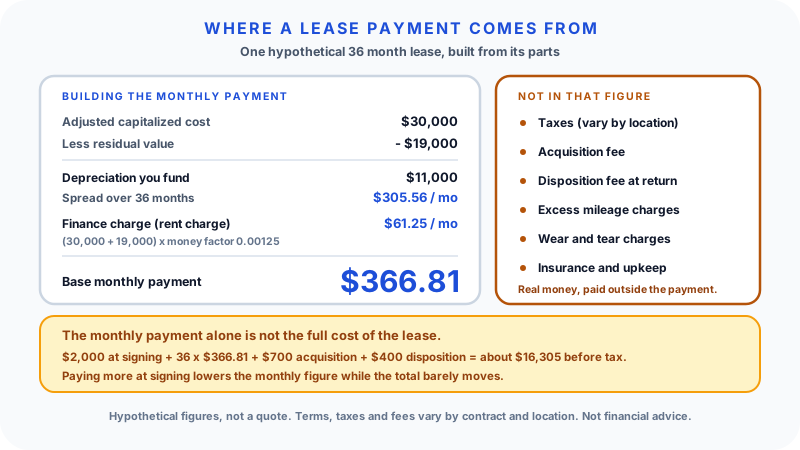
Take a car with a negotiated cap cost of $32,000, a $2,000 down payment, a residual value of $19,000, a money factor of 0.00125, and a 36-month term.
Adjusted cap cost    = 32,000 - 2,000        = $30,000
Depreciation charge  = (30,000 - 19,000) / 36 = $305.56 per month
Finance charge       = (30,000 + 19,000) x 0.00125 = $61.25 per month
Base monthly payment = 305.56 + 61.25        = $366.81 per month
So the depreciation portion is about 83% of this payment and the finance charge is about 17%. That split shifts with the money factor and the residual, and is worth checking on any offer.
Now build the picture the monthly figure does not show:
| Component | Amount |
|---|---|
| Down payment at signing | $2,000 |
| 36 base payments of $366.81 | ~$13,205 |
| Acquisition fee (illustrative) | $700 |
| Disposition fee at return (illustrative) | $400 |
| Total before tax and any mileage or wear charges | ~$16,305 |
Tax is on top of this and depends entirely on where the lease is written. Excess mileage and wear charges, if any, are on top again.
The monthly payment of $366.81 tells you almost nothing about that $16,305 until you also know the term, the upfront cash, and the fees.
Why a lower monthly payment can hide the same cost
The quickest way to shrink a lease payment is to put more money down. Keeping the same car, residual, money factor, and 36-month term, and changing only the down payment:
| Down payment | Adjusted cap cost | Base monthly payment | Payments plus down payment |
|---|---|---|---|
| $0 | $32,000 | ~$424.86 | ~$15,295 |
| $2,000 | $30,000 | ~$366.81 | ~$15,205 |
| $4,000 | $28,000 | ~$308.75 | ~$15,115 |
The monthly figure falls by more than a quarter across that range. The amount you actually part with barely moves, because you paid the same value earlier instead of monthly. The small difference that does appear comes from the finance charge, which is calculated on a smaller balance.
There is also a risk that the monthly figure never shows. A capitalized cost reduction is not equity in a car you will own. If the vehicle is stolen or written off early in the term, the insurance settlement goes to the leasing company for the vehicle's value, and a large upfront payment can be lost. Gap coverage, where it applies, addresses the shortfall between insurance payout and lease balance rather than refunding your down payment. Check what your specific contract and insurer provide rather than assuming.
Total lease cost is the number that compares
The comparable figure between two offers is everything you will hand over across the whole term:
- amount due at signing, including any down payment, first payment, and fees paid upfront
- every monthly payment, taxed, multiplied by the term
- the acquisition fee, if not already counted at signing
- the disposition fee at return, if the contract has one
- a realistic estimate of excess mileage charges if you tend to drive more than the allowance
A quote that wins on the monthly line can lose on this total, particularly if it carries a shorter term, a larger amount at signing, or a tighter mileage cap.
What happens when residual assumptions differ
Because the residual is set by the leasing company, two offers on the same car can differ substantially without either price being better.
Using the same $30,000 adjusted cap cost, 0.00125 money factor, and 36-month term:
| Residual value | Depreciation per month | Finance charge | Base payment |
|---|---|---|---|
| $19,000 | $305.56 | $61.25 | ~$366.81 |
| $21,000 | $250.00 | $63.75 | ~$313.75 |
A higher residual lowers the payment even though nothing about the price changed. That is genuinely cheaper for you over this term, because you are funding less depreciation. It also means the contract's buyout price at the end is higher, which matters if you might want to keep the car. And a residual is a forecast: if the car turns out to be worth more than the residual at return, that upside belongs to the leasing company, not to you.
Mileage, wear, and end-of-term charges
A lease is priced around an expected mileage allowance. Drive past it and the excess is billed at a per-mile rate set in the contract, payable when you return the car. Because the bill only arrives at the end, the cost accumulates invisibly for years.
If your annual mileage genuinely exceeds the allowance, compare the cost of buying extra miles upfront (where offered) against the contract's per-mile overage rate rather than assuming you will drive less than you do.
Wear beyond what the contract treats as normal is charged too, typically covering things like panel damage, tire condition below a stated tread depth, and interior damage. The contract, not general expectation, defines what counts. Reading the mileage cap, the overage rate, and the wear standard before signing is the only reliable way to see the cost the monthly payment hides.
Comparing two lease offers
Line up these items rather than the monthly payments:
| What to compare | Why it matters |
|---|---|
| Negotiated cap cost | The price the whole payment is built from |
| Residual value | Sets how much depreciation you fund |
| Money factor | The borrowing cost; convert roughly by x 2,400 to compare with a loan rate |
| Term in months | Changes total payments and end-of-term timing |
| Amount due at signing | Moves cost forward; makes the monthly figure look lower |
| Mileage allowance and overage rate | The most common source of an unexpected final bill |
| Acquisition and disposition fees | Real money, absent from the monthly figure |
| Tax treatment | Varies by location and changes the true payment |
Two offers matched on all of these will genuinely be close. Two offers that differ on any of them are not comparable by monthly payment alone.
When leasing may suit you, and when it may not
Leasing may fit if you want a newer car every few years, your mileage is predictable and within typical allowances, you prefer a lower monthly outlay to building equity, and you can keep the vehicle in the condition the contract expects.
It fits less well if you drive well above typical allowances, keep vehicles for many years, want the freedom to modify or sell the car, or expect your circumstances to change mid-term, since ending a lease early is usually expensive.
Neither is a maths answer. A calculator can price a term of use; it cannot weigh ownership, flexibility, or how long you keep cars against a lower payment.
What a lease calculator leaves out
A lease calculator assumes the cap cost, residual, money factor, and term you enter are accurate, and returns a base payment from them. It typically excludes:
- taxes, unless you add them, and it does not know your local rules
- acquisition, disposition, registration, and documentation fees
- excess mileage and wear charges
- insurance, maintenance, and running costs
- any judgement about whether the quoted residual and money factor are competitive
Treat the output as the skeleton of the deal, not the bill. Where the numbers matter, confirm them against the contract and ask the leasing company to put the cap cost, residual, money factor, mileage cap, and end-of-term charges in writing.
Run the Lease Calculator alongside the Auto Loan Calculator if you want to see how a lease term compares with financing the same car.
Common mistakes
Shopping by monthly payment alone. It hides the amount at signing, the term, and the fees that determine what you actually pay.
Assuming a large down payment saves money. It mostly moves cost forward, and it puts that cash at risk if the car is written off early.
Ignoring the money factor. A rough conversion, multiplying by 2,400, at least puts it on a scale you can compare with a loan rate.
Underestimating your own mileage. Estimate from what you actually drove last year, not from what you hope to drive.
Forgetting end-of-term charges. Disposition fees, excess mileage, and wear charges arrive years after the payment that looked so attractive.
FAQ
How is a car lease payment calculated? Most calculators use a depreciation charge, (adjusted cap cost - residual value) / term, plus a finance charge, (adjusted cap cost + residual value) x money factor, with tax applied on top. Individual lenders vary in how they handle fees and tax.
What is the money factor and how does it relate to APR? The money factor is lease interest written as a small decimal. Multiplying it by 2,400 gives a rough annual percentage for comparison, so 0.00125 is roughly 3.0%. It is a convention for comparing offers rather than a formal APR equivalent.
What is residual value in a lease? It is the leasing company's forecast of what the car will be worth at the end of the term. A higher residual means less depreciation to fund, which lowers the payment and raises the end-of-term buyout price.
Does a bigger down payment on a lease save money? It lowers the monthly payment but changes the total much less, because you pay the same value either upfront or monthly. It also puts more of your cash at risk, since a capitalized cost reduction is not equity in a car you will own.
What happens if I exceed the mileage limit? You pay the contract's excess mileage rate for each mile over the allowance when you return the car. For high-mileage drivers this can be a significant final bill, so check the allowance and the per-mile rate before signing.
Is leasing cheaper than buying a car? Leasing usually has a lower monthly payment but ends with no asset, while buying costs more per month and leaves you with a car you own. Which works out cheaper depends on how long you keep vehicles, your mileage, and the specific terms on offer.
Educational only. All figures in this article are hypothetical illustrations, not quotes. Lease terms, taxes, fees, mileage rules, and legal obligations vary by contract, lender, and location. This is not financial or legal advice.