
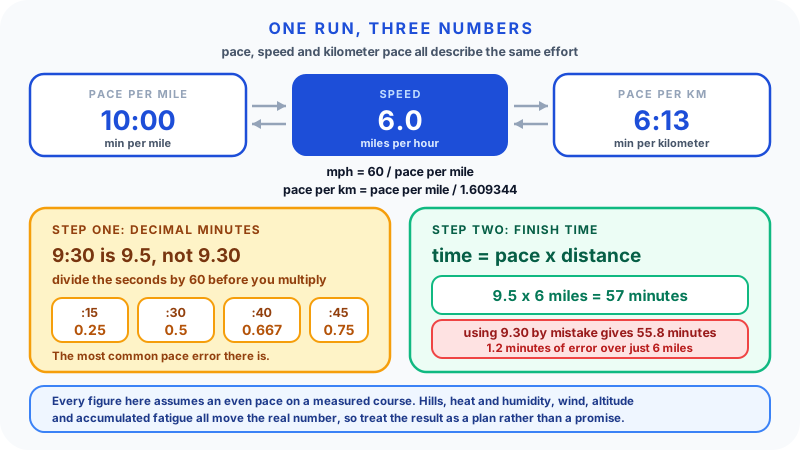
Running pace is one of the most useful numbers a runner has, yet it confuses plenty of beginners. Once it clicks, pace helps you plan a route, hold a steady effort, and estimate how long a race will take. This guide covers what pace means, how it converts to speed and to the other distance unit, the one arithmetic step that trips almost everyone up, and how far you can actually trust a pace-based race prediction.
What running pace means
Pace is the time it takes to cover one unit of distance. For runners that unit is usually a mile or a kilometer, so pace is written as minutes and seconds per mile or per kilometer. A pace of 10:00 per mile means each mile takes ten minutes.
The part that surprises new runners is the direction of the number. A lower pace number means faster running. Going from 10:00 to 9:00 per mile means you are quicker, because each mile now takes less time. Higher numbers mean slower running. Keeping this straight saves a lot of confusion when you compare runs.
Pace vs speed, and how to convert
Pace and speed describe the same movement from opposite directions. Speed tells you how far you travel in a set time, usually miles or kilometers per hour. Pace tells you how long one mile or kilometer takes. They are reciprocals of each other, scaled by the 60 minutes in an hour:
Speed in mph = 60 / pace in minutes per mile
Pace in minutes per mile = 60 / speed in mph
So 6.0 mph is 60 / 6 = 10:00 per mile, and 8:00 per mile is 60 / 8 = 7.5 mph. The same two formulas work for km/h and minutes per kilometer.
This matters because treadmills almost always display speed while watches and race plans display pace. A few reference points for the treadmill:
| Treadmill speed | Pace per mile |
|---|---|
| 5.0 mph | 12:00 |
| 5.5 mph | 10:55 |
| 6.0 mph | 10:00 |
| 6.5 mph | 9:14 |
| 7.0 mph | 8:34 |
| 7.5 mph | 8:00 |
| 8.0 mph | 7:30 |
| 9.0 mph | 6:40 |
| 10.0 mph | 6:00 |
Note that the pace steps are not evenly spaced. Going from 5.0 to 5.5 mph buys you 65 seconds per mile; going from 9.0 to 9.5 mph buys you only 20. Because pace is a reciprocal, the same speed increment is worth less and less as you get faster, which is one reason the last minute of a personal best is so much harder to find than the first.
Converting mile pace to kilometer pace
One mile is exactly 1.609344 kilometers, a consequence of the 1959 international agreement that fixed the inch at exactly 25.4 mm. That gives two clean conversions:
Pace per mile = pace per kilometer x 1.609344
Pace per kilometer = pace per mile / 1.609344
A 10:00 per mile pace is 10 / 1.609344 = 6.214 minutes per kilometer, or 6:13 per km. A 6:00 per kilometer pace is 6 x 1.609344 = 9.656 minutes per mile, or 9:39 per mile.
Because a kilometer is shorter than a mile, your per kilometer pace number is always the smaller of the two. If a converted number comes out larger, you have multiplied where you should have divided.
The step almost everyone gets wrong
Pace links distance and time with one short formula:
Finish time = pace x distance
The catch is that the formula needs pace in decimal minutes, not in the minutes-and-seconds form your watch shows. A pace of 9:30 per mile is 9.5 minutes, not 9.30. To convert, divide the seconds by 60:
| Seconds | Decimal |
|---|---|
| :15 | .25 |
| :20 | .333 |
| :30 | .5 |
| :40 | .667 |
| :45 | .75 |
To go the other way, multiply the decimal part by 60. A calculated pace of 8.4 minutes per mile is 0.4 x 60 = 24 seconds, so 8:24 per mile.
With that in hand: holding 9:30 per mile for 6 miles is 9.5 x 6 = 57 minutes. Flip it around and pace tells you how fast to go for a target time. To finish 10 miles in 90 minutes, divide 90 by 10 for a 9:00 per mile pace.
This is exactly what the Running Pace Calculator is built for. Enter any two of the three values, distance, time, or pace, and it works out the third in the right units. To total a set of splits by hand, the Time Calculator handles hours, minutes, and seconds without the decimal conversion.
Race distances, exactly
Races are defined in metric, and the mile figures are conversions rather than round numbers:
| Race | Metric | Miles |
|---|---|---|
| 5K | 5 km | 3.107 |
| 10K | 10 km | 6.214 |
| Half marathon | 21.0975 km | 13.109 |
| Marathon | 42.195 km | 26.219 |
The usual shorthand of 3.1, 6.2, 13.1, and 26.2 miles is close enough for planning. Over a marathon the rounding is worth about 5 seconds at a 10:00 pace, which is smaller than the error in almost everything else on this page.
Common pace examples
A few reference points make pace easier to feel. At 12:00 per mile, a comfortable jog for many beginners, three miles takes 36 minutes. At 10:00 per mile it takes 30 minutes, and at 8:00 per mile, brisk for a trained runner, it takes 24 minutes.
The same logic scales up. Holding 10:00 per mile across a half marathon of 13.109 miles gives a finish of about 2 hours 11 minutes. Trim to 9:00 per mile and it drops to about 1 hour 58 minutes. A 60 second per mile change bought 13 minutes, because the saving is multiplied by every mile in the race.
If you track activity in steps rather than distance, the Steps to Miles Calculator estimates how far you covered, which you can then turn into a pace.
Predicting one race from another
The best known way to project a finish time at a new distance is Riegel's formula, published by engineer Peter Riegel in American Scientist in 1981:
T2 = T1 x (D2 / D1)^1.06
T1 is a time you have actually run over distance D1, and T2 is the predicted time over the new distance D2. The exponent of 1.06 is what encodes the fact that you slow down as races get longer; an exponent of exactly 1 would assume you can hold your 5K pace forever.
Worked from a 25:00 5K:
- Half marathon: (21.0975 / 5) = 4.2195, raised to the power 1.06 is 4.60. Then 25 x 4.60 = 115 minutes, about 1:55:00.
- Marathon: (42.195 / 5) = 8.439, raised to the power 1.06 is 9.59. Then 25 x 9.59 = 240 minutes, about 4:00:00.
Two caveats matter more than the formula does. First, Riegel's own paper restricts the equation to efforts lasting roughly 3.5 to 230 minutes, so a four hour marathon projection is already past the edge of where he claimed it applies. Second, the formula assumes you have trained for the longer distance. A marathon is limited by fuelling, muscular durability, and heat management, not only by aerobic speed, so recreational runners who project a marathon from a 5K routinely finish slower than the prediction. Treat the number as a ceiling on a good day, not a target.
Why real-world pace changes
A calculator gives a clean number, but the road rarely cooperates. Hills slow you on the climb and rarely give all of it back on the descent. Heat and humidity are the biggest single environmental factor for most runners, because the body diverts blood to the skin for cooling and heart rate rises at the same pace. Wind, soft trails, uneven ground, and altitude all take their share too.
Your own state matters as much. Fitness, sleep, when you last ate, cumulative training fatigue, and general health all move pace from day to day. Two runs at the same pace can feel completely different, and that is normal.
There is also a measurement problem worth knowing about. The "current pace" field on a GPS watch is calculated over a very short window and is genuinely noisy; it can swing by 30 seconds per mile while your effort has not changed at all. Tree cover, tall buildings, and tunnels degrade the satellite fix further. Lap pace or average pace is far more useful for pacing decisions. And because your watch measures the line you actually ran rather than the certified course, a marathon often reads 26.4 miles or more on the watch. The official result uses the certified distance, so a watch-derived pace and a race-derived pace will not agree.
Using pace for easy runs, workouts, and race planning
Pace is most useful when different runs get different targets. Easy runs are meant to feel relaxed, so a higher pace number is the point, not a failure; running easy days too fast is one of the most common ways to stall progress. Intervals and tempo runs use faster paces for set stretches. Race planning uses a goal pace to estimate a finish and, more importantly, to avoid starting too fast.
On race day, aiming for an even effort or a slight negative split, where the second half is run marginally faster than the first, is far more reliable than banking time early. Time banked in the first few miles at an unsustainable pace is repaid with interest in the last few.
A pace estimate pairs well with effort-based tools. The Calorie Burn Calculator gives a rough idea of energy used on a run, and the VO2 Max Calculator offers a general fitness estimate from a test effort. Treat both as estimates rather than measurements, since they rely on population averages and simple inputs.
Mistakes to avoid
- Treating 9:30 as 9.30. This is the single most common pace error and it makes every plan roughly half a percent optimistic per mile.
- Starting far faster than the planned pace, then fading. A steady pace almost always beats an uneven one.
- Mixing units. Minutes per mile and minutes per kilometer differ by more than 60 percent. Pick one and stick with it for a whole run.
- Trusting a prediction far outside what you have trained for. The math will happily project a marathon from a 5K; your legs have not agreed to it.
- Chasing instantaneous pace on the watch. Use lap or average pace, and use effort on hills.
Quick checklist
- Write pace as minutes and seconds per mile or per kilometer.
- A lower pace number means faster running.
- Convert seconds to decimals before multiplying: 9:30 becomes 9.5.
- Use finish time = pace x distance to plan a run.
- Convert between units with 1 mile = 1.609344 km.
- Expect real pace to vary with hills, heat, rest, and health.
- Treat calculator and prediction results as planning estimates, not guarantees.
A note for beginners
If you are new to running or returning after a break, build distance and pace gradually and pay attention to how you feel. Pace numbers are a guide, not a target to force. If you have any health concerns, or you notice pain, dizziness, or unusual symptoms, it is sensible to check with a qualified health professional before pushing your pace. This article is educational and is not medical advice.
FAQ
What is running pace?
It is the time it takes to cover one mile or one kilometer, written as minutes and seconds. A pace of 10:00 per mile means each mile takes ten minutes.
Is a lower pace number faster or slower?
Lower is faster. Pace measures time per distance, so a smaller number means each mile or kilometer takes less time. Running 8:00 per mile is quicker than 10:00 per mile.
What is the difference between pace and speed?
Speed measures how far you travel per hour; pace measures how long one mile or kilometer takes. They are reciprocals: speed in mph = 60 divided by pace in minutes per mile. So 6 mph and 10:00 per mile are the same run.
How do I convert pace to finish time?
Convert the pace to decimal minutes first, then multiply by distance. A pace of 9:30 per mile is 9.5 minutes, so 6 miles takes 9.5 x 6 = 57 minutes. Forgetting the decimal step and using 9.30 is the most common mistake here.
How do I convert pace per mile to pace per kilometer?
Divide by 1.609344. A 10:00 per mile pace is 10 / 1.609344 = 6.214 minutes, or 6:13 per kilometer. To go the other way, multiply by 1.609344. Your kilometer pace number is always smaller than your mile pace number.
Can a running pace calculator predict my race time?
It gives a useful estimate, not a prediction. Riegel's formula, the standard method, was published for efforts of roughly 3.5 to 230 minutes and assumes you have trained for the target distance. Beyond that range, and particularly for a first marathon projected from a short race, real finishes are commonly slower than the estimate.
Why is my real running pace slower than my plan?
Real pace changes with terrain, heat and humidity, wind, altitude, sleep, nutrition, and cumulative fatigue. Your watch adds its own noise: instantaneous pace is calculated over a very short window, and GPS distance drifts under tree cover or between tall buildings.
Sources
- Athletic Records and Human Endurance - Peter S. Riegel, American Scientist 69(3), 1981, the original publication of the T2 = T1 x (D2/D1)^1.06 endurance equation and its stated 3.5 to 230 minute range.
- Marathon - World Athletics, for the standard road race distance of 42.195 km.
- SI Units: Length - NIST, on the 1959 international agreement fixing the inch at exactly 25.4 mm, from which 1 mile = 1.609344 km follows exactly.