
"How much should I save each month?" sounds like it has a universal answer. It does not. The 20% rule, the 50/30/20 split, and the pay-yourself-first rule are all budgeting habits, not answers to a question about a specific goal on a specific date.
The answerable version is narrower: given what you have already saved, what you can add each month, how long you have, and a realistic rate, what balance does that add up to? That is arithmetic, and a Savings Calculator does it in a few seconds.
What follows is how that arithmetic works, what the calculator is actually assuming on your behalf, and how to read the result without mistaking a projection for a promise.
Two questions wearing the same name
Savings questions come in two shapes, and they need different tools.
The fixed contribution question is: "If I put aside $250 a month for five years, where do I land?" You know your capacity and you want to see the destination. That is what a plain savings calculator answers.
The fixed target question is the reverse: "I need $15,000 in 24 months and I have $2,000. What is the monthly transfer?" You know the destination and you need the capacity required to reach it. That is what a Savings Goal Calculator is built for.
They are the same equation solved for different unknowns, but the planning mindset differs. Fixed contribution plans a habit. Fixed target plans a deadline. Trouble usually starts when someone picks a vague monthly amount, hopes it adds up, and discovers in month 20 that it does not.
What the calculator is actually asking you
The BlinkCalc Savings Calculator takes more than the textbook four inputs, and each one changes the answer in a specific way.
Starting balance. Money already set aside for this goal. It earns from month one, so it does more work than the same amount contributed later.
Regular contribution and its frequency. You can enter weekly, biweekly, monthly, quarterly, or annual deposits. Weekly and biweekly amounts are converted to a monthly equivalent (52 and 26 deposits per year respectively, divided across 12 months), while quarterly and annual deposits land only on the months they actually fall on.
Annual interest rate or APY. The yield you expect before tax. This is an assumption you supply, not a rate the calculator knows.
Compounding frequency. Daily, monthly, quarterly, or annually. This sets how often interest is credited to the balance.
Savings period. Years plus optional extra months, up to a 50 year ceiling.
Annual contribution increase. An optional percentage applied to your deposit after each completed 12 months, which is useful if you plan to save more as income rises.
Tax on interest and inflation adjustment. Two optional switches. The tax rate is deducted from interest as it is earned, so it slows compounding rather than arriving as a bill at the end. The inflation rate does not change the projected balance at all; it produces a second figure showing roughly what that balance would buy in today's money.
Pick your inputs and the calculator reports the final balance, total contributions, total interest earned, any tax paid, the inflation-adjusted value, and a year-by-year table.
One detail worth knowing: contribution timing
The calculator credits your deposit at the start of each month and then calculates that month's interest on the new, larger balance. In finance terms this is an annuity due rather than an ordinary annuity.
It is a small distinction that shows up as a small difference. A deposit made at the start of a month earns one extra month of interest compared with a deposit made at the end. Over five years at modest rates the gap is a rounding error; over decades it is not nothing. The point is simply that if your own spreadsheet disagrees with the calculator by a little, deposit timing is a likely reason.
A worked example, with the two halves separated
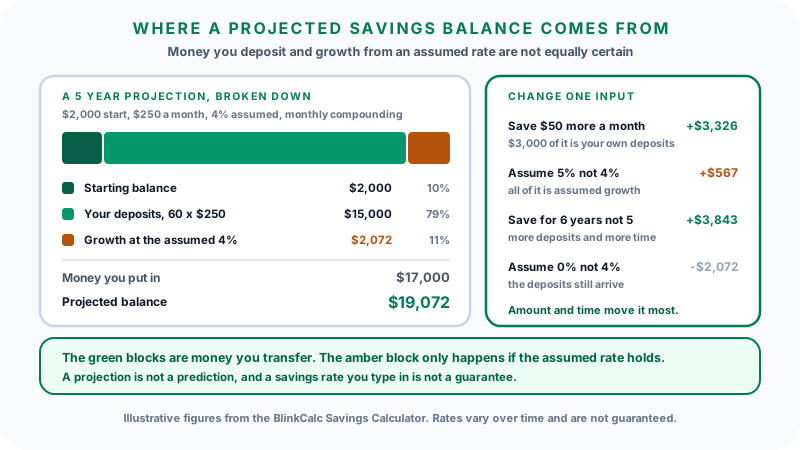
Take a concrete case: $2,000 already saved, $250 a month added, an assumed 4% annual rate with monthly compounding, over 5 years. No contribution increase, no tax, no inflation adjustment.
The calculator projects a final balance of about $19,072. That figure is worth breaking apart, because the two halves are not equally reliable.
| Where the balance comes from | Amount | Share |
|---|---|---|
| Starting balance you already had | $2,000 | 10% |
| Deposits you make (60 x $250) | $15,000 | 79% |
| Interest at the assumed 4% | ~$2,072 | 11% |
| Projected final balance | ~$19,072 | 100% |
You put in $17,000 of your own money. The assumed rate adds roughly $2,072 on top, about 11% of the ending balance.
That split is the single most useful thing on the screen. The $17,000 is money you control: it happens if you make the transfers. The $2,072 is a consequence of an assumption you typed in, and it will be higher or lower depending on what rates actually do over those five years. Two numbers, two very different levels of confidence.
Changing one input at a time
Starting from that same example and altering exactly one thing:
| Change | Projected balance | Difference | Where the difference comes from |
|---|---|---|---|
| Base case | ~$19,072 | - | - |
| Save $300 a month instead of $250 | ~$22,398 | +$3,326 | $3,000 of extra deposits, $326 of extra interest |
| Assume 5% instead of 4% | ~$19,639 | +$567 | Entirely growth |
| Save for 6 years instead of 5 | ~$22,915 | +$3,843 | $3,000 of extra deposits, $843 of extra interest |
| Assume 0% instead of 4% | $17,000 | -$2,072 | All the growth removed |
Read the third column and the pattern is obvious. Over five years, the contribution and the timeline move the result far more than the rate does. Raising the assumed return by a full percentage point adds less than saving an extra $50 a month.
This matters because the rate is the input you have least control over and are most tempted to be optimistic about. On short horizons, optimism about the rate barely moves the answer. Optimism about your own transfers moves it a lot.
Where growth genuinely takes over
Stretch the same $250 a month out to 20 years and the balance of power flips.
| Horizon and rate | Total you deposit | Interest | Projected balance | Growth share |
|---|---|---|---|---|
| 5 years at 4% | $17,000 | ~$2,072 | ~$19,072 | 11% |
| 20 years at 4% | $62,000 | ~$34,444 | ~$96,444 | 36% |
| 20 years at 6% | $62,000 | ~$60,708 | ~$122,708 | 49% |
At 20 years and 6%, growth is contributing roughly as much as every deposit you made. This is the compounding effect people talk about, and the table shows the condition it requires: time. It is not a property of saving, it is a property of saving for a long time.
It also shows where the uncertainty concentrates. In the five-year row, 89% of the result is money you deposited, so the projection is close to a fact. In the last row, half the result depends on an assumed 6% holding for two decades, which no calculator can promise. The longer the horizon, the more of the answer is assumption.
That is the point where a Compound Interest Calculator or a Future Value Calculator becomes the better tool, because long-horizon money is usually invested rather than held in cash, and those tools are built to model lump sums and growth assumptions together. Note also that a savings account and an investment account are not interchangeable: bank deposits in the United States are insured up to the standard limit, while invested money can fall in value. A rate you type into a savings calculator does not carry a guarantee with it.
What the compounding setting does, and does not, do
Compounding frequency decides how often interest is added to the balance so that it can start earning interest itself. Daily compounding credits it most often, annual compounding least.
In practice, over the horizons most savers care about, the compounding choice moves the result by a small amount compared with the contribution and the term. In the five-year example above, switching between the four compounding options changes the projected balance by well under $300 on a $19,000 result, while adding $50 a month changes it by more than $3,000.
There is a related distinction worth carrying into the real world. A quoted annual rate compounded monthly produces a slightly higher effective annual yield than the same nominal rate compounded once a year, which is why banks advertise APY rather than a nominal rate. When you compare two real accounts, compare the APY figures, because those already fold the compounding in.
The tax and inflation switches
Both optional settings answer questions the headline balance ignores.
Tax on interest deducts your entered rate from interest at the moment it is credited. Because the tax comes out before the next period's interest is calculated, it reduces compounding slightly as well as reducing the total. Whether savings interest is taxable, and at what rate, depends on where you live and what kind of account holds the money, so use your own situation rather than a default.
Inflation adjustment is the more important of the two for long goals, and the more commonly skipped. It leaves the projected balance alone and adds a second figure: the purchasing power of that balance in today's money. A $40,000 balance in fifteen years is a $40,000 balance, but what it buys depends on prices then, not now.
For any goal more than a few years out, the inflation-adjusted figure is usually the honest one to plan against, particularly for targets tied to costs that tend to rise, such as travel, education, or building work.
What the result is, and what it is not
A savings projection is a conditional statement: if you make every deposit, and the rate you entered holds for the whole period, then the balance would be roughly this.
Three limits follow from that.
The rate is an assumption you supplied. Savings account rates are variable and change with market conditions, so a rate that is accurate today may not hold for five years. Fixed-rate products such as certificates of deposit lock a rate in exchange for locking the money up, with penalties for early withdrawal.
The projection is not a prediction. It shows the arithmetic consequence of your inputs, and it is exactly as reliable as those inputs. A calculator cannot know whether you will miss four transfers or whether rates will fall.
The result is not guaranteed. Even the deposit half depends on you making the deposits. The growth half depends on conditions nobody controls.
None of this makes the number useless. It makes it a planning figure rather than a bank statement. Treat the deposits as the plan and the growth as a tailwind you did not have to earn.
Choosing a target you can actually hit
A surprising share of failed saving comes from a fuzzy target. A "vacation fund" is a mood. A "vacation fund of $4,200 for the August trip" is a deadline, and deadlines get funded.
A few habits that keep a target from quietly inflating:
- Itemize the big pieces. Flights, accommodation, deposits, taxes. Small items round out inside the buffer.
- Add a 10 to 15 percent buffer for what you forgot. It is cheaper than landing short and reaching for a credit card.
- Anchor in today's prices, then adjust. For goals more than a year out, either add expected price rises to the target or use the calculator's inflation-adjusted figure to check the target still holds.
- Set the floor, not the ceiling. A
$20,000wedding you would happily hold at$12,000is really two different goals. Fund the floor first.
Once the target is firm, the calculator stops being a guess and becomes a stopwatch.
When you have to slow down
Most long savings plans hit a stretch where life needs the money: a move, a medical bill, a thin quarter of income. Two adjustments usually save the plan.
Set a minimum contribution you would not skip even in a bad month, perhaps $50 against a usual $400. The dollars matter less than keeping the transfer alive as a habit.
Then recalculate rather than abandon. If three months were missed, re-run the projection with the balance you actually have. Either the new monthly figure is reachable and you carry on, or it is not and the deadline moves. Both are honest outcomes. Pretending the original plan is intact is not.
Common mistakes
Setting a vague target. "More than now" is not a goal. A number and a date is.
Leaving the starting balance at zero. Money already saved for the goal shortens the plan meaningfully. Enter it.
Typing in the rate you wish you had. Use the yield on the actual account where the money will sit.
Reading the final balance without the split. Always check how much of the projection is your deposits and how much is assumed growth. The two are not equally likely.
Confusing saving with investing. Money needed in 12 months should not depend on market timing. Money untouched for 15 years usually should not sit in a near-zero-interest account. Match the vehicle to the horizon.
Never re-running it. A contribution that fitted last year's income may be wrong now. Re-check after a raise, a job change, or a large expense ending.
FAQs
Is there a standard percentage of income I should save each month? Rules of thumb are useful starting points but they are budgeting habits, not goals. A percentage becomes useful once it is pointed at something specific, such as a defined emergency cushion or a down payment with a date attached.
Should I save in one account or split across goals? Splitting usually works better. Separate balances make progress visible and make accidental spending less likely. A $9,000 balance labelled "Savings" is easy to dip into; the same money split across "Trip", "Car repair", and "Emergency cushion" is harder to touch by accident. Many banks support nicknamed sub-accounts for exactly this.
How much difference does interest really make on short-term savings? Less than most people expect. In the five-year example above, moving the assumed rate from 4% to 5% added about $567 to a $19,000 result, while adding $50 a month added more than $3,000. Chase the better rate, but do not let it stand in for a bigger contribution.
Should I keep saving while paying off debt? Often yes, in small amounts. A modest starter cushion can stop the next unexpected expense from landing back on the card you are trying to clear. How to balance the two depends on your interest rates and circumstances, and is worth discussing with a qualified adviser if the amounts are significant.
Is a savings goal calculator better than a regular savings calculator? They answer different questions. Use the Savings Goal Calculator when the amount and the date are fixed and you need the required monthly figure. Use the Savings Calculator when the monthly figure is fixed and you want to see where it lands.
What if my income is uneven each month? Set the recurring contribution at a level you can sustain in a poor month, then add lump sums in good months. Re-running the projection each quarter with your actual balance tends to work better than trying to forecast twelve months of variable income in advance.
Sources
- U.S. Securities and Exchange Commission, Compound Interest Calculator
- Consumer Financial Protection Bureau, What is a certificate of deposit (CD)?
- Federal Deposit Insurance Corporation, Deposit Insurance
Related guides
- Emergency Funds: How Much Money Should You Really Save?
- Compound Interest Explained
- Small Daily Expenses Add Up
Final thoughts
The mechanical part of saving is genuinely simple: enter what you have, what you can add, how long you have, and a rate you can defend. The calculator does the rest.
The judgement is in reading the answer properly. Separate the money you will deposit from the growth an assumption produced, plan against the first and treat the second as a bonus, and re-run the projection whenever reality moves. A projection that gets updated is worth far more than one that was precise the day you made it.
This article is educational. All figures are illustrative projections, not quotes or predictions. It is not financial, tax, or investment advice. Account rates and products change. Confirm yields, fees, and tax treatment with your bank or a qualified adviser before relying on them.