
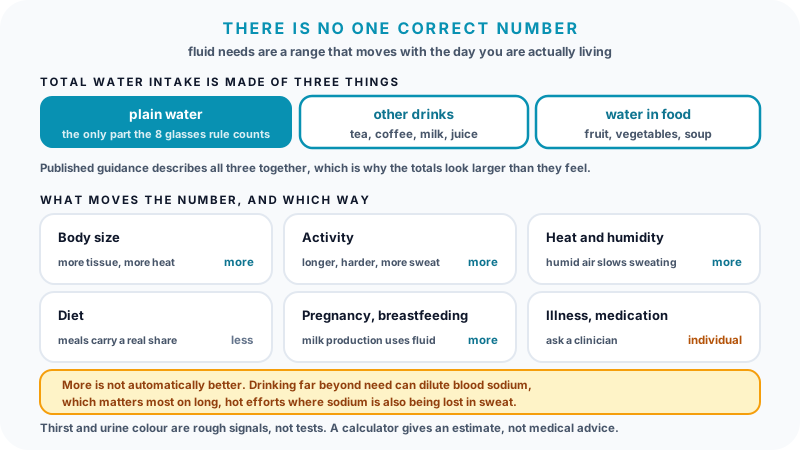
The "8 glasses a day" rule is memorable. That is probably why it survived.
It is also too blunt to be much use. A small office worker in a cool climate, a roofer in humid heat, a runner doing summer intervals, and someone whose diet is mostly soup, fruit, and vegetables do not have the same fluid needs. One number cannot absorb body size, sweat rate, climate, activity, diet, life stage, and health status.
Hydration is better understood as balance: replacing roughly what you lose, without swinging to either extreme. This article explains what actually moves that balance, what the popular rules get wrong, and how to read the signals your body gives you without over-interpreting them.
Where the eight-glasses rule seems to have come from
The figure is usually traced back to mid-twentieth-century US nutrition guidance suggesting an adult might use somewhere around 2.5 litres of water a day. The part that fell off in retelling was the qualifier: much of that was expected to come from prepared food, not from a glass.
So the rule was never "drink eight glasses on top of everything else". A recommendation about total water became, through decades of repetition, a target for plain water alone. That single lost sentence is the origin of a lot of unnecessary bottle-carrying.
Total water is not the same as drinking water
This distinction does most of the work in the rest of the article.
Total water intake is everything: plain water, tea, coffee, milk, juice, soup, and the water inside food. Many fruits and vegetables are largely water by weight, and cooked grains and pasta absorb a good deal of it.
Plain drinking water is one component of that, and for many people it is well under half.
The body does not track where the water arrived from. It tracks fluid balance and the concentration of the blood. Water from a melon counts exactly the same as water from a glass.
Public health bodies publish reference values for total water, and they do not all agree, which is itself informative. Figures commonly cited include roughly 3.7 litres a day for adult men and 2.7 litres for adult women from the US National Academies, and roughly 2.5 litres and 2.0 litres respectively from the European Food Safety Authority. Both sets describe total water from all food and drink, both are population reference values rather than individual prescriptions, and the gap between them reflects different populations and different assumptions rather than one being wrong.
Read against a glass count, those numbers look alarming. Read correctly, as totals including food and every drink of the day, they are a good deal less demanding than they sound.
What actually changes your needs
| Factor | Direction | Why |
|---|---|---|
| Body size | Larger, generally more | More tissue and more heat to manage |
| Activity | Longer and harder, more | Working muscles generate heat, cleared largely by sweating |
| Heat and humidity | Hotter and more humid, more | Humidity slows evaporation, so sweat losses rise for the same cooling |
| Diet | Water-rich food, less to drink | Fruit, vegetables, and soup carry substantial water; salty or high-fibre meals push the other way |
| Altitude | Often more | Breathing rate and dry air increase respiratory losses |
| Pregnancy and breastfeeding | Typically more | Higher blood volume, and milk production draws on fluid |
| Illness | Sometimes much more, sometimes restricted | Fever, vomiting, and diarrhoea raise losses; some conditions require deliberate limits |
| Medication and medical conditions | Individual | Some raise losses, some require fluid restriction |
The last two rows are why no calculator should be treated as an instruction. Everything above them is a reason a sensible estimate needs adjusting for the day you are actually living.
Using a calculator sensibly
BlinkCalc's Water Intake Calculator gives a starting estimate from inputs such as body weight and activity. Treat it the way you would a recipe's cooking time: a reasonable planning reference that assumes an average case, not a measurement of you, and definitely not a medical prescription.
It cannot know your sweat rate, your climate today, how much water your meals carry, whether you are pregnant or breastfeeding, or whether a medical condition or medication changes the picture. If any of those apply, the number to act on comes from a health professional who knows your situation, not from a calculator.
Where an estimate genuinely helps is planning: a long hot workday, an endurance event, or travel where drinking is inconvenient. On an ordinary day, meals, thirst, and easy access to fluid do most of the work without arithmetic.
What water does, and why sweat complicates it
Water supports blood volume, temperature regulation, digestion, joint lubrication, cellular function, and waste removal. In heat or during exercise, sweating becomes the main cooling mechanism: sweat evaporates from the skin and carries heat away with it.
The complication is that sweat is not just water. It carries electrolytes, sodium in particular. And sweat rates vary enormously between people. Two runners can complete the same route at the same pace and lose very different volumes of fluid and quantities of sodium. That variability is the reason blanket hydration advice keeps failing.
Estimating your own sweat loss
If you want an actual number rather than a rule of thumb, weigh yourself before and after a session, and account for anything you drank. A drop of about 1 kg in body weight corresponds roughly to a litre of fluid lost.
Pre-run weight        75.0 kg
Post-run weight       74.2 kg
Weight change          0.8 kg
Fluid drunk on the run 0.4 L
Estimated sweat loss   0.8 + 0.4 = about 1.2 L
This is an approximation, not a laboratory measurement, and most people never need it. It is genuinely useful for endurance athletes, outdoor workers, and anyone training in heat who wants to know whether their instinct is roughly right. It does not mean every drop has to be replaced immediately; it gives context for how much a hard session actually costs you.
Myth: clear urine is always best
Urine colour is a useful rough signal and a poor precision instrument.
Consistently very dark urine, especially alongside thirst, low output, or heat exposure, can suggest you are behind on fluid. Pale yellow generally suggests you are not. But completely clear urine all day often means you are simply drinking more than you need and passing the surplus. Morning urine is normally darker after a night without fluid. Supplements, particularly B vitamins, some medications, and food pigments can change the colour independently of hydration.
So it is one clue among several. More informative is the pattern across a day: whether you are thirsty, whether output is roughly normal for you, and whether the day involved heat or heavy sweating. Chasing perfectly clear urine is not a goal worth having.
Myth: thirst is useless
The claim that "if you are thirsty you are already dehydrated" is repeated so often it has become common sense, and it overstates the case. Thirst is a real physiological signal driven by the concentration of your blood, and for most healthy adults in ordinary conditions, drinking to thirst alongside meals works well.
The signal is less reliable in specific situations: during prolonged exercise, in significant heat, during illness, at altitude, and for some older adults, in whom thirst sensation can be blunted. It also competes badly with a busy day, where people simply do not notice it.
The practical position sits between the two extremes. On a normal day, thirst plus meals plus easy access to fluid is usually enough. When the day is long, hot, or physically demanding, a little planning beats waiting for a signal that may lag.
Habit matters too. Some people drink constantly out of routine rather than need; others ignore thirst all day and then try to catch up in the evening, which mostly buys a broken night. A steady rhythm anchored to things you already do, such as meals and breaks, is easier to sustain than either.
Heat, humidity, and the two opposite mistakes
Heat raises sweat losses. Humidity makes matters worse in a way people underestimate, because sweat that does not evaporate does not cool you: it just drips. Direct sun, dark clothing, still air, protective equipment, and altitude all add to the strain, and the temperature on a weather app captures none of it. The Heat Index Calculator combines temperature and humidity into a figure closer to what the body experiences, which is worth checking before outdoor work or a long walk on a humid day.
In heat, people tend to make one of two opposite errors. The first is underdrinking, common in dry climates where sweat evaporates so fast that clothes never feel wet and the loss goes unnoticed. The second is overdrinking plain water during long events out of fear of dehydration, which carries its own risk, covered below.
Neither is fixed by drinking more as a general policy. Managing heat means pacing, shade, breaks, clothing, acclimatisation, and fluid together. You cannot outdrink reckless heat exposure.
One related point: people generally adapt to heat over repeated exposure, sweating earlier and coping better after a week or two. This changes tolerance rather than removing risk, and the first hot week of the season deserves particular care.
More is not automatically better
Drinking substantially more fluid than the kidneys can clear dilutes the sodium in the blood. In serious cases this contributes to hyponatremia, which is a genuine medical emergency. It is uncommon, but it is documented in endurance events, long hikes, and military training, typically where someone drinks large volumes of plain water over many hours while also losing sodium in sweat.
This is not a reason to be anxious about ordinary drinking. It is a reason to reject "drink as much as you possibly can" as advice. There is no benefit to be had from pushing past what you need, and the ceiling is real even though most people never approach it.
For long events, the sensible approach is to drink according to thirst and a plan matched to conditions, to avoid gaining weight during exercise from overdrinking, and to include sodium when sweat losses are high and the effort is long. Anyone with a medical condition or on medication that affects fluid or sodium balance should follow individual advice rather than any general framework.
Electrolytes: when they matter and when they do not
Electrolytes regulate fluid balance, nerve signalling, and muscle function. Sodium is the one lost in the largest quantity in sweat.
Short, easy workouts generally do not require a special drink, particularly if you eat regular meals; ordinary food contains plenty of sodium. Replacement becomes more relevant for long sessions, hot conditions, heavy sweaters, repeated sessions in a day, and people whose sweat is noticeably salty. White marks on clothing, stinging eyes, and gritty skin after exercise are practical hints in that direction. Cramps are often blamed on electrolytes, though the evidence is mixed and fatigue and conditioning are likely part of the picture.
Electrolytes matter most precisely when fluid intake is also large, because that is when dilution becomes the issue rather than volume.
Hydration around exercise
For sessions under an hour in mild conditions, most people do fine with water before and after and a drink if thirsty.
For longer, hotter, or repeated sessions, a simple framework:
- Start reasonably hydrated, not deliberately overfilled.
- During long sessions, drink to thirst adjusted for conditions and what you know of your own sweat rate.
- Include sodium when the session is long, hot, or very sweaty.
- Afterwards, rehydrate with fluid and food. A meal supplies sodium, potassium, and carbohydrate alongside fluid, which is why recovery generally works better with food than with water alone.
Carbohydrate drinks have a place in long endurance sessions, but that is a fuelling question more than a hydration one.
Pregnancy, breastfeeding, and other individual circumstances
Fluid needs typically rise during pregnancy and more noticeably during breastfeeding, since milk production draws on the body's water. How much more is individual, and the guidance that matters is the guidance from the midwife, doctor, or dietitian who knows the pregnancy.
The same applies wherever hydration stops being a general-lifestyle question: kidney disease, heart failure, some medications, gastrointestinal illness, eating disorders, and occupational heat exposure all change the calculation, and in some cases fluid is deliberately restricted rather than encouraged. General articles and calculators are not the right tool for any of these.
Seek medical advice for symptoms such as confusion, fainting, persistent vomiting or diarrhoea, signs of heat illness, or if you have been told to limit fluids and are unsure how to apply that.
Everyday obstacles
Hydration usually fails for unglamorous reasons rather than misinformation. Long meetings, flights, commutes, protective equipment, and jobs without convenient bathroom access all quietly reduce drinking. People do not drink less because they misunderstood the science; they drink less because the situation made it awkward.
The fix is equally unglamorous: attach fluid to things already in the day, such as meals, a coffee break, or a walk, rather than relying on a bottle to prompt you. When travelling, drinking steadily beats a large catch-up at the end of the day, and on flights alcohol and salty snacks tend to make both thirst and sleep worse.
A practical check, instead of a number
On an ordinary day, the useful questions are:
- Are you thirsty, and are you responding to it?
- Is your urine consistently very dark, or consistently clear all day?
- Are you passing far less than usual?
- Did today involve heat, heavy sweating, alcohol, a flight, or hard exercise?
- Did your meals carry water, or were they mostly dry and salty?
- Do you feel normal during activity?
This is more useful than chasing a target, because it tracks what actually changed today.
Three ordinary days
Maya works indoors, walks 6,000 steps, and eats fruit and soup. Normal drinking with meals, plus responding to thirst, likely covers it.
Eli runs for 75 minutes in summer heat, finishes with salt marks on his shirt, and spends the afternoon outdoors. He needs meaningfully more fluid than Maya that day, and sodium is worth thinking about.
Rina lifts weights for 45 minutes in an air-conditioned gym, sweats lightly, and eats regular meals. Water and food are almost certainly enough; a large electrolyte drink is solving a problem she does not have.
Same three people on a different day would need something different again. That is the whole point.
FAQs
Do you really need 8 glasses of water a day?
Not as a rule. It is a simplification of guidance about total water, including the water in food, and it does not adjust for body size, climate, activity, diet, or health.
What is total water intake?
Everything you take in: plain water, other drinks, and the water contained in food. Population reference values are expressed as total water, which is why they look higher than the amount most people drink from a glass.
Can you drink too much water?
Yes. Drinking far more than the kidneys can clear, particularly over long exercise without sodium replacement, can dilute blood sodium and become dangerous. It is uncommon, but "more is always better" is not sound advice.
Is thirst a reliable hydration signal?
For most healthy adults in ordinary conditions, it works reasonably well. It becomes less reliable during prolonged exercise, in heat, during illness, at altitude, and for some older adults, where planning helps.
Does coffee count toward water intake?
Yes. Caffeine has a mild diuretic effect in some contexts, but coffee and tea still contribute net fluid to the day's total.
Do you need more water during pregnancy or breastfeeding?
Needs typically increase, particularly while breastfeeding. The specific amount is individual, and it is worth asking the midwife, doctor, or dietitian involved in your care rather than relying on a general figure.
When do you need electrolytes?
Mainly during long or hot sessions, heavy sweating, repeated training in a day, or when fluid intake is large enough that sodium dilution becomes the concern. Short easy workouts usually do not require them.
What urine colour means you are hydrated?
Pale yellow generally suggests adequate hydration, but it is a rough clue rather than a test. Clear all day may simply mean surplus, darker morning urine is normal, and vitamins and medications change the colour on their own.
The bottom line
Hydration is not a glass-count contest. It is a balance between what you lose to sweat, heat, activity, and illness, and what you take in from every drink and a fair amount of your food. Use an estimate as a starting point for planning, pay attention to thirst and to how the day actually went, and adjust like a person living in a body rather than following a rule printed on a bottle.
General health information, not medical advice. Fluid needs vary between individuals, and some conditions and medications require specific guidance. Speak to a qualified health professional about your own circumstances.