
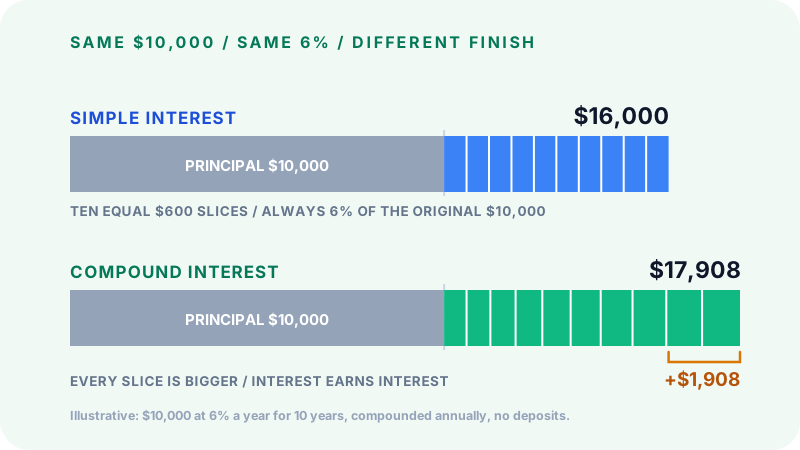
The short answer: simple interest is always charged on the original principal, so it grows in a straight line. Compound interest is charged on the principal plus the interest already added, so it grows in a curve. Same starting amount, same headline rate, different finish.
On $10,000 at 6% for 10 years, simple interest gives you $16,000. Compounded annually, the same deposit reaches $17,908. Stretch that to 30 years, still compounding annually, and the gap grows from $1,908 to about $29,400.
Key Takeaways
- Simple interest earns (or charges) interest only on the original principal.
- Compound interest earns interest on principal plus previously accumulated interest.
- Simple interest produces linear growth; compound interest produces exponential growth.
- The gap is small in year 1 and grows faster and faster after that. Time matters more than frequency.
- Most savings, investments, and consumer debt use compound interest.
The Four Inputs
Every interest calculation runs on the same four inputs. Getting these straight makes both formulas easy to read.
- Principal (P): the starting amount. The deposit you make, or the balance you borrow.
- Rate (r): the annual interest rate, written as a decimal. 6% is 0.06.
- Time (t): how long the money sits, in years.
- Compounding frequency (n): how many times a year interest is added to the balance. Only compound interest has this input.
The Two Formulas, in Plain Language
Simple interest:
I = P x r x t
A = P + I = P(1 + r t)
Read it as: work out one year of interest, then multiply by the number of years. Nothing ever changes the base the rate is applied to. At 6% on $10,000, every single year adds exactly $600, whether it is year 1 or year 25.
Compound interest:
A = P (1 + r/n)^(n t)Read it as: chop the year into n periods, apply a slice of the rate (r/n) in each one, and let the result carry forward. The exponent n t is just the total number of periods. Because each period starts from a slightly larger balance, each period adds slightly more than the last.
That single structural change, a multiplier becoming an exponent, is the whole difference.
Worked Example: 10 Years on $10,000 at 6%
Simple interest:
I = 10,000 x 0.06 x 10 = $6,000
Final balance = $16,000
Compound interest, compounded annually:
A = 10,000 x 1.06^10 = $17,908.48The compound balance is $1,908 higher on the same deposit at the same headline rate.
Here is where that extra money comes from. Simple interest adds an identical $600 slice every year. Compound interest adds a slice that grows:
| Year | Simple interest added | Compound interest added | Compound balance |
|---|---|---|---|
| 1 | $600 | $600.00 | $10,600.00 |
| 2 | $600 | $636.00 | $11,236.00 |
| 5 | $600 | $757.49 | $13,382.26 |
| 10 | $600 | $1,013.69 | $17,908.48 |
By year 10, the compound account earns $1,014 in a single year, because it is charging 6% on $16,895 rather than on the original $10,000.
Why the Gap Widens With Time
In year 1 there is almost nothing to see. With monthly compounding, $10,000 at 6% reaches $10,616.78 against $10,600 for simple interest: a difference of about $17. That tiny gap is why compounding gets dismissed as overhyped.
Run the same numbers out further and the picture changes.
| Year | Simple interest ($10k at 6%) | Compound interest (monthly) |
|---|---|---|
| 1 | $10,600 | $10,617 |
| 5 | $13,000 | $13,489 |
| 10 | $16,000 | $18,194 |
| 20 | $22,000 | $33,102 |
| 30 | $28,000 | $60,226 |
| 40 | $34,000 | $109,575 |
Read the growth rather than the balance and it is starker. After 30 years, simple interest has produced $18,000 of interest. Compound interest has produced $50,226, close to three times as much, from the same $10,000.
The reason is that simple interest adds a fixed amount each year while compound interest adds a fixed percentage of a number that keeps rising. Fixed amounts add up. Percentages of a rising number accelerate.
Compounding Frequency Matters Less Than People Expect
Daily compounding sounds dramatically better than annual. It is better, but only slightly. Here is $10,000 at 6% for 10 years at four frequencies:
| Compounding | Final balance |
|---|---|
| Annually (n = 1) | $17,908 |
| Quarterly (n = 4) | $18,140 |
| Monthly (n = 12) | $18,194 |
| Daily (n = 365) | $18,220 |
Going from annual to daily adds about $312. Going from simple interest to any compounding adds at least $1,908. The compound-versus-simple choice is worth roughly six times more than the frequency choice, and time horizon dwarfs both.
This is also why APY exists: it restates a nominal rate plus its compounding frequency as a single comparable annual figure. See APR vs APY for how that conversion works.
Where Each One Is Used
Simple interest shows up in:
- Many auto loans and short-term personal loans, where interest accrues on the outstanding balance without interest being charged on unpaid interest
- Treasury bills, which are sold at a discount and pay face value at maturity, with no compounding inside the term
- Bond coupon payments, which are calculated on face value
Compound interest is the default for:
- Savings accounts, certificates of deposit, and money market accounts
- Credit cards, which commonly compound daily
- Mortgages and other amortizing loans, where each month's interest is calculated on the balance still owed
- Investment and retirement accounts
- Student loans, once accrued interest capitalizes
If a product does not say, assume compound interest unless it is explicitly labelled a simple-interest loan.
Why Simple Interest Sometimes Helps Borrowers
For a borrower, simple interest is the friendlier structure, for two reasons.
- It cannot snowball. Unpaid interest never becomes new principal, so the base the rate applies to does not grow on its own.
- Prepayment savings are clean. On a simple-interest auto loan, paying extra principal immediately reduces the balance that future interest is calculated on. Interest often accrues daily on that balance, so paying a few days early genuinely costs less and paying late genuinely costs more.
For a saver, simple interest is rarely offered and rarely desirable. Over any meaningful horizon, compounding wins at the same rate.
Common Mistakes
Judging compounding by year 1. The first-year gap on $10,000 at 6% is about $17. The thirty-year gap on the same deposit is more than $32,000. Short comparisons systematically understate the effect.
Confusing simple interest with no interest. Simple interest still grows a debt or a deposit. It just grows in a straight line.
Confusing the instrument with the strategy. A bond pays simple interest on face value. Reinvest every coupon and your overall return compounds. The instrument is simple; the strategy is not.
Assuming compounding frequency is the big lever. As the table above shows, it moves the result by a few hundred dollars over a decade. Rate and time move it by tens of thousands.
Comparing a lump sum to an amortizing loan. An installment loan's interest total is much lower than the lump-sum formulas suggest, because the balance falls with every payment. Use the Loan Calculator for anything with a repayment schedule.
Practical Scenarios
Scenario 1: The same rate, two very different products. A $20,000 simple-interest auto loan at 7% accrues interest only on the balance still owed, and that balance falls with every payment. A $20,000 credit card balance at 22% APR compounds daily while minimum payments barely dent the principal. The structure matters as much as the headline rate.
Scenario 2: T-bills reinvested. A $50,000 ladder of 6-month Treasury bills at 5% pays $1,250 per bill (50,000 x 0.05 x 0.5). Each bill on its own is simple interest. Roll the proceeds back in for 30 years at the same rate and the position grows to about $220,000, a gain of roughly 340% rather than the 150% you get from 5% x 30 years without reinvestment.
Scenario 3: A three-year lump sum. $10,000 left untouched for 3 years at 8%. Simple interest: $10,000 x 0.08 x 3 = $2,400 of interest. Compounded monthly: $10,000 x (1 + 0.08/12)^36 = $12,702, so $2,702 of interest. A $302 difference over three years, which is small in isolation and enormous once you extend the term.
The Gap at Different Rates
Difference between simple and compound interest after 20 years on $10,000, compounded monthly:
| Rate | Simple final | Compound final | Difference |
|---|---|---|---|
| 3% | $16,000 | $18,208 | +$2,208 |
| 5% | $20,000 | $27,126 | +$7,126 |
| 7% | $24,000 | $40,387 | +$16,387 |
| 10% | $30,000 | $73,281 | +$43,281 |
Higher rates amplify the gap sharply. That cuts both ways: it is the argument for starting to save early, and the argument for not carrying a balance on high-rate debt.
FAQ
Which is better for savings, simple or compound interest? Compound interest, at the same rate and term. It never loses to simple interest, and the advantage grows with time.
Which is better for borrowing? Simple interest, where you can get it. It does not snowball and prepayment savings are cleaner. Most consumer debt uses compound interest.
Do mortgages use simple or compound interest? Mortgages compound, but through amortization: each month's interest is calculated on the outstanding principal, and your payment covers that interest first. That is why early payments are mostly interest. See How Loan Interest Is Calculated.
Are credit cards simple or compound interest? Compound, commonly with daily compounding. Interest is added to the balance each day and the next day's interest is calculated on the slightly larger number, which is what makes a carried balance expensive.
Can a loan switch from simple to compound? Yes. Some student loans accrue simple interest while you study and then capitalize, adding the accumulated interest to the principal when repayment begins. From that point the loan compounds.
Is there ever a case where simple interest pays more than compound? Not with the same principal, rate, and term. Where simple interest looks better, the rate or the fee structure is different, not the compounding.
How much does compounding frequency change the answer? Less than most people assume. On $10,000 at 6% for 10 years, moving from annual to daily compounding adds about $312, while moving from simple interest to annual compounding adds $1,908.
Related Tools
Run the same scenario through both and compare: the Simple Interest Calculator handles the linear case, and the Compound Interest Calculator handles the curve, including compounding frequency. For borrowing with a repayment schedule, the Loan Calculator shows the amortization month by month. To work backwards from a target, the Savings Goal Calculator tells you what monthly deposit reaches it.
Related Articles
Final Thoughts
Simple and compound interest start from the same place and end up somewhere very different, and the only variable doing the work is whether interest is allowed to earn interest. The quickest way to feel it is to run one scenario through both calculators at three horizons: year 1, year 10, and year 30. Year 1 makes compounding look trivial. Year 30 is the one worth looking at.
This article is general information about how interest is calculated, not financial advice. Rates, products, and terms vary; check the actual terms of any account or loan before deciding.