
A loan's monthly payment is the single most visible number on the contract, and it is also the number most people use to decide what they can afford. Three variables determine it (loan amount, interest rate, and term), and a handful of secondary factors can move it further. Understanding how those pieces interact is the difference between a sustainable loan and a payment that pinches every month.
Key Takeaways
- Monthly payment depends on principal, interest rate, and loan term.
- Longer terms reduce the monthly payment but increase total interest dramatically.
- Fixed-rate amortized loans have a constant payment even though the principal/interest split changes monthly.
- The formula gives you principal and interest only. Taxes, insurance, and fees are separate and are what usually make the real bill bigger.
- The widely quoted 28/36 guideline is a lender convention, not a legal limit, and it is not the rule that governs mortgage underwriting today.
The Loan Payment Formula
For a fixed-rate loan repaid in equal instalments:
M = P × [r(1 + r)^n] / [(1 + r)^n − 1]
Where:
- M = the payment made each period
- P = principal (the amount actually financed)
- r = the periodic interest rate, not the annual one
- n = the total number of payments
The word periodic is doing real work in that formula. For a monthly loan, r is the annual nominal rate divided by 12 and expressed as a decimal: a 6% loan uses r = 0.06 / 12 = 0.005, and a 30-year term uses n = 360. Put the annual rate in by mistake and the answer will be nonsense. Note also that lenders derive r from the nominal annual rate, not from the APR, which folds certain fees into a single disclosed figure and is therefore a comparison tool rather than a formula input.
This formula is the engine inside every mortgage and auto loan calculator. The math looks dense, but every input has a clear lever: change any one and the payment moves predictably.
What the formula assumes
The equation is exact, but it is exact about a specific idealised loan. It assumes:
- the rate is fixed for the whole term
- payments are equal, on schedule, and at regular intervals
- interest is compounded once per payment period
- nothing is added to the balance after origination, and nothing is paid early
Real loans deviate. Adjustable-rate mortgages reset. Some loans capitalise unpaid interest. Some charge origination fees that are deducted from the amount you receive while interest accrues on the full face value. Treat the formula's output as the scheduled principal-and-interest payment under ideal conditions, then check the actual contract for everything else.
How the Payment Splits, and Why It Shifts
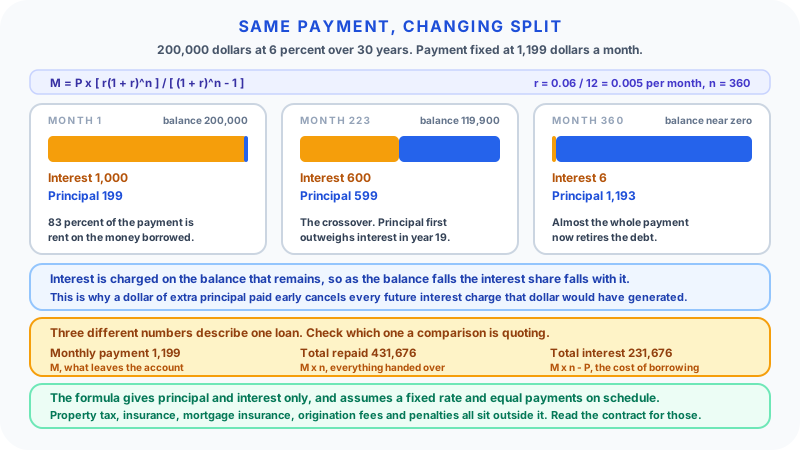
On a fixed-rate amortizing loan the payment never changes, but its composition does. Interest each month is charged on the balance that remains, so as the balance falls the interest portion falls with it and the principal portion grows to fill the gap.
Take the $200,000 loan at 6% for 30 years, with a payment of $1,199. The first month's interest is $200,000 × 0.005 = $1,000, leaving just $199 of principal. After twelve full payments totalling nearly $14,400, the balance has fallen only to about $197,544. Principal does not overtake interest inside the payment until month 223, roughly year 19 of 30.
This is not a trick played by the lender. It is the arithmetic of charging interest on an outstanding balance. But it explains two things borrowers often find surprising: why early extra payments are unusually powerful (every dollar of extra principal cancels all the future interest that dollar would have generated), and why selling or refinancing early in a long loan leaves the balance nearly untouched.
How Each Variable Moves the Payment
Using a baseline of $200,000 at 6% for 30 years (monthly payment ≈ $1,199):
Loan amount. Scales linearly. Double the principal and you double the payment: $400,000 at 6% for 30 years ≈ $2,398.
Interest rate. Each percentage point on a 30-year loan adds roughly $60 to $70 per $100,000 borrowed in the range rates have recently occupied, and the effect grows slightly as rates rise: moving from 6% to 7% adds about $66 per $100,000, and 7% to 8% adds about $68. On the $200,000 baseline, 7% gives $1,331 and 8% gives $1,468.
Term. Inverse relationship, but not proportional. $200,000 at 6%:
- 15 years: $1,688
- 20 years: $1,433
- 25 years: $1,289
- 30 years: $1,199
Cutting the term in half (30 → 15) raises the monthly payment by about 41%, not by 100%. The trade-off is total interest: the 30-year costs about $232,000 in interest; the 15-year costs about $104,000. Less than half the lifetime interest for a 41% larger monthly payment.
Payment, Total Repayment, and Total Interest
Three different numbers describe the same loan, and conflating them is the most common arithmetic error in loan comparisons.
- Monthly payment is M from the formula: what leaves your account each month.
- Total repayment is M × n: everything you hand over across the life of the loan.
- Total interest is M × n − P: the cost of borrowing, separate from the money you borrowed.
On the $200,000 loan at 6% for 30 years, that is $1,199 a month, about $431,676 repaid in total, and about $231,676 of interest. When a comparison says one option "costs more", check which of the three it means.
What Else Affects Your Real Monthly Cost
The principal-and-interest (P&I) calculation is just one part of what shows up on your bill. Everything below sits outside the formula.
Mortgages. Add property tax, homeowner's insurance, mortgage insurance if the down payment is under 20%, and sometimes HOA fees. The bundled monthly figure is called PITI (Principal, Interest, Taxes, Insurance), and servicers usually collect the T and I into an escrow account. Property tax rates vary enormously by jurisdiction, so the gap between P&I and PITI is local rather than universal: check your county's actual millage rather than a national average.
Auto loans. Add comprehensive and collision insurance, gap insurance if applicable, and registration or excise fees. Insurance in particular is priced on the driver and the vehicle, not on the loan, so it varies far more between buyers than the payment does.
Personal loans. Usually no escrow or insurance, so the loan payment is close to the whole monthly cost. Watch instead for origination fees deducted up front, which raise the effective cost without changing the scheduled payment.
Fees and penalties generally. Late fees, prepayment penalties where permitted, and rate-reset provisions on variable loans are all contractual terms, not outputs of the amortization formula. They are also the terms that differ most between lenders offering an identical headline rate.
Debt-to-Income (DTI) and Affordability
Lenders evaluate affordability through DTI: total monthly debt payments divided by gross monthly income. The Consumer Financial Protection Bureau describes the calculation plainly, and notes that limits differ by loan product and lender rather than following one universal number.
Front-end DTI = housing payment (PITI, not P&I) / gross monthly income. The traditional guideline is under 28%.
Back-end DTI = all monthly debt payments / gross monthly income. The traditional guideline is under 36%.
Together these are the "28/36 rule". It is a long-standing industry convention and a reasonable personal budgeting anchor, but it is worth being precise about its legal status: it is not a regulatory cap. The 43% DTI ceiling that once defined a General Qualified Mortgage was removed by the CFPB and replaced with price-based thresholds keyed to how far a loan's APR sits above the average prime offer rate, with mandatory compliance from October 2022. In practice many lenders approve back-end ratios well above 36%, and the guideline is better used as a question about your own comfort than as a prediction of approval.
A household with $9,000/month gross income applying the 36% back-end guideline would keep total debt payments under $3,240/month. If a $2,500/month housing payment plus a $500 car payment plus a $300 student loan totals $3,300, they are slightly over that guideline. They may still be approved; the guideline is telling them the budget is tight, not that the door is closed.
Worked Example: Three Lender Offers
Same borrower, same $350,000 mortgage, principal and interest only. Three offers:
| Lender | Rate | Term | Monthly P&I | Total Repaid | Total Interest |
|---|---|---|---|---|---|
| A | 6.25% | 30 years | $2,155 | $775,804 | $425,804 |
| B | 6.00% | 30 years | $2,098 | $755,434 | $405,434 |
| C | 5.50% | 15 years | $2,860 | $514,763 | $164,763 |
Lender B saves about $57/month and about $20,400 in total interest over A.
Lender C costs about $761/month more than B but saves about $240,700 in interest and is paid off fifteen years earlier.
The "right" choice depends on cash flow flexibility and on what else the money could do, but the trade-offs are explicit. Note also that these three offers differ only in rate and term. Real offers differ in closing costs too, which is what the APR disclosure exists to capture.
Common Mistakes
Buying based on monthly payment alone. A salesperson can hit almost any monthly target by extending the term. A $35,000 car at 7% over 4 years is $838/month with about $5,230 of total interest. Over 7 years it is $528/month, but total interest rises to about $9,372, so the longer term costs about $4,143 more in interest. The monthly saving is real; so is the extra cost.
Confusing extra interest with total interest. In the example above, $9,372 is what the seven-year loan costs in interest, not what stretching the term costs you. The penalty for stretching is the difference between the two loans. Comparisons that quote the larger figure overstate the case.
Ignoring the rate when stretching the term. Longer terms often carry higher rates, because the lender is exposed for longer. When both move against you the combined effect is considerably worse than either alone.
Forgetting variable costs in mortgages. P&I is not the housing payment. Budget from a PITI estimate built on your actual local tax rate and an insurance quote, not from the calculator's P&I output.
Assuming biweekly payments save big without checking. They help, but chiefly because 26 half-payments a year equal 13 monthly payments rather than 12. The same effect comes from adding one twelfth of the payment to each month, usually without the enrolment fee some servicers charge.
Strategies to Lower the Payment
Shop rates aggressively. A 0.25 percentage point difference on a $400,000 30-year mortgage is worth about $65/month and roughly $23,000 over the full term. Comparing several offers is among the highest-value hours in the process.
Increase the down payment. Reduces principal directly and may remove mortgage insurance once equity crosses the threshold in your contract.
Buy points. Paying upfront to cut the rate makes sense only if you hold the loan past the breakeven point, which is simply the upfront cost divided by the monthly saving. Calculate it for your own numbers rather than relying on a rule of thumb.
Extend the term cautiously. A longer term meaningfully lowers the payment at the cost of substantially more total interest. It is a cash-flow decision, and it is defensible when cash flow is the binding constraint.
Consider recasting. Where a lender permits it, a large principal payment followed by re-amortization over the remaining term lowers the payment without a new loan or new closing costs.
Refinance when the arithmetic supports it. Compare the monthly saving against total closing costs, and check the new term as well as the new rate.
Practical Scenarios
First-time homebuyer. A buyer with $90,000 gross income has $7,500/month before tax. The 28% front-end guideline puts total housing costs (PITI) at about $2,100/month. If local taxes and insurance run roughly $400/month, that leaves about $1,700 for P&I, which at 7% over 30 years supports a loan of roughly $255,000. Their $400 of existing monthly debt does not enter the front-end test, but it does bind the back-end one: 36% of $7,500 is $2,700, less $400 leaves $2,300 for housing, so here the front-end guideline is the tighter of the two. Which constraint binds depends on the borrower, which is exactly why both are checked.
Auto loan shopping. The same borrower has a $500/month auto payment target. At 7% APR over 60 months, that supports a loan of about $25,250, before adding insurance and registration to the monthly budget.
Refinance evaluation. Current loan: $300,000 balance at 7% with 28 years remaining, paying $2,039/month. Refinance offer: 5.75%, $4,500 in closing costs. Refinancing into a 28-year term holds the payoff date and gives a payment of $1,798, saving $240/month and breaking even in about 19 months. Resetting to a fresh 30-year term instead gives a payment of $1,751, a larger monthly saving of $288, but adds two years of payments and roughly $26,000 more interest than the 28-year refinance. Both can be reasonable; they answer different questions, and a comparison that quotes the 30-year payment against the old 28-year payment is not comparing like with like.
FAQ
Why doesn't my monthly payment go down as I pay off the loan? On a fixed-rate amortized loan, the payment is constant by design; that is what "fixed payment" means. What changes inside it is the principal/interest split. Early payments are mostly interest because interest is charged on a large remaining balance; late payments are mostly principal.
Can I lower my payment without refinancing? On most fixed-rate loans, no. The exception is loan recasting: some lenders allow a large principal payment followed by re-amortization of the remaining balance over the remaining term, which lowers the payment without a new loan.
Does the rate change my monthly payment over time? Not on fixed-rate loans. On adjustable-rate loans the rate resets on the schedule in the contract, and the payment is recalculated to amortize the remaining balance over the remaining term at the new rate. The caps and reset frequency are contractual, so read them before comparing an ARM's introductory payment with a fixed-rate payment.
What is the difference between P&I and PITI? P&I is principal and interest: the output of the loan formula. PITI adds property taxes and insurance, which servicers typically collect into escrow. PITI is the closer estimate of true monthly housing cost, and it is the figure the front-end DTI guideline is meant to apply to.
Is 43% DTI still the mortgage limit? No. The CFPB removed the 43% DTI limit from the General Qualified Mortgage definition and replaced it with price-based thresholds tied to the loan's APR relative to the average prime offer rate. Individual lenders and loan programs still set their own DTI limits, which vary.
Should I take a longer loan term for a lower payment? That depends on whether the lower payment is necessary for your cash flow, and only you can answer that. What the arithmetic can tell you is the price: longer terms increase total interest substantially. One middle path is to take the longer term for the payment flexibility and then voluntarily pay extra toward principal when you can.
Related Tools
The Loan Calculator handles any amortized loan, and the Mortgage Calculator bundles in taxes and insurance for PITI. Use the Auto Loan Calculator for vehicle-specific scenarios with trade-ins and rebates. Check affordability with the Debt-to-Income Calculator before committing.
Related Articles
Sources
- Consumer Financial Protection Bureau, What is a debt-to-income ratio? - definition and calculation of DTI, and the point that limits vary by product and lender.
- Consumer Financial Protection Bureau, Qualified Mortgage Definition under the Truth in Lending Act (Regulation Z): General QM Loan Definition - the final rule removing the 43% DTI limit and replacing it with price-based thresholds.
- Consumer Financial Protection Bureau, General QM Loan Definition: Delay of Mandatory Compliance Date - mandatory compliance date of October 1, 2022.
Payment, total repayment, total interest, and amortization figures in this article were calculated directly from the fixed-payment formula above and rounded for display.
Final Thoughts
The monthly payment is a planning tool, not a goal. Two loans with the same payment can be wildly different: one front-loaded with interest, the other balanced; one with escrow and insurance stacked on top, the other simple. Always look at three numbers together: the monthly payment, the total interest over the life of the loan, and the all-in monthly cost including everything the formula leaves out. A loan that fits all three is a loan you can live with.
This article explains how loan payments are calculated. It is general information, not financial advice for your situation.