
Value-added tax is a consumption tax collected piece by piece across a supply chain. From the consumer's perspective it looks the same as sales tax: a percentage added at the register. From a business perspective it is more interesting, because every business along the way collects VAT on its sales and reclaims VAT on its purchases, with only the net difference paid to the tax authority.
This guide explains how VAT actually flows, the three formulas that cover nearly every calculation, and the registration decisions that confuse small businesses. Rates and thresholds are jurisdiction-specific and change; the figures here were checked against the official sources listed at the end in September 2026, and you should confirm your own country's current position before acting.
Key Takeaways
- VAT is collected at every stage of production but is ultimately borne by the end consumer.
- Businesses collect output VAT on sales and reclaim input VAT on purchases. They pay the difference to the tax authority.
- Standard rates run from 5% (UAE) to 27% (Hungary). Within the EU the legal minimum standard rate is 15%, and the actual range is 17% in Luxembourg to 27% in Hungary. The U.S. has no federal VAT and uses state and local sales tax instead.
- To add VAT: multiply by (1 + rate). To remove VAT: divide by (1 + rate).
- VAT registration is mandatory above a revenue threshold. Those thresholds changed in several countries in 2025, so check the current figure rather than a remembered one.
The Basic Mechanic
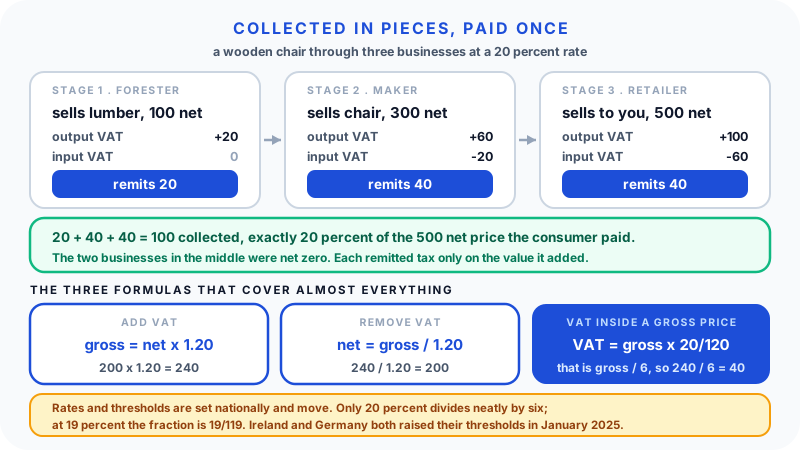
Consider a simplified three-stage supply chain producing a wooden chair, with a 20% VAT rate:
Stage 1: Forester sells lumber. Sells lumber for EUR 100 net. Charges EUR 20 VAT. Total invoice: EUR 120. Forester remits EUR 20 to the tax authority.
Stage 2: Furniture maker buys lumber, builds chair, sells to retailer. Paid EUR 120 (EUR 100 + EUR 20 VAT on input). Sells chair for EUR 300 net, charges EUR 60 VAT. Total invoice: EUR 360.
Furniture maker's VAT calculation:
- Output VAT (collected from retailer): EUR 60
- Input VAT (paid to forester): EUR 20
- Net VAT owed: EUR 40
Stage 3: Retailer buys chair, sells to consumer. Paid EUR 360 (EUR 300 + EUR 60 VAT on input). Sells chair to consumer for EUR 500 net, charges EUR 100 VAT. Total invoice: EUR 600.
Retailer's VAT calculation:
- Output VAT (collected from consumer): EUR 100
- Input VAT (paid to furniture maker): EUR 60
- Net VAT owed: EUR 40
Total VAT collected by the tax authority: 20 + 40 + 40 = EUR 100.
That EUR 100 is exactly 20% of the consumer's net price of EUR 500. The tax was collected in three pieces along the chain, but only the final consumer truly paid it. Every business in between was a net-zero collector. Notice also that each business remits tax on the value it added: the retailer added EUR 200 of value and remitted EUR 40, which is 20% of EUR 200. That is where the name comes from.
The Formulas
Add VAT to a net price: Gross price = Net price x (1 + VAT rate)
A EUR 200 net item at 20% VAT: 200 x 1.20 = EUR 240 gross.
Remove VAT from a gross price (reverse VAT): Net price = Gross price / (1 + VAT rate)
A EUR 240 gross item at 20% VAT: 240 / 1.20 = EUR 200 net.
Calculate VAT alone from gross: VAT amount = Gross price x rate / (1 + rate)
A EUR 240 gross item at 20% VAT: 240 x 0.20 / 1.20 = EUR 40 VAT.
That third formula is often written as a VAT fraction, which is easier to use by hand. At 20% the fraction is 20/120, which simplifies to 1/6, so a gross price divided by 6 gives the VAT. At 19% it is 19/119, at 21% it is 21/121, and at 23% it is 23/123. Only the 20% case simplifies neatly, which is why the "divide by six" shortcut travels badly across borders.
These three formulas handle nearly every VAT calculation a business needs. The VAT Calculator runs all three at any rate.
Common Standard Rates
Standard rates as at September 2026. Most countries also apply reduced rates to essentials such as food, children's items, and books, and zero rates to certain exports and pharmaceuticals, so the standard rate is rarely the whole picture.
| Country / Region | Standard VAT Rate |
|---|---|
| United Kingdom | 20% |
| France | 20% |
| Germany | 19% |
| Spain | 21% |
| Italy | 22% |
| Netherlands | 21% |
| Ireland | 23% |
| Sweden | 25% |
| Hungary (EU high) | 27% |
| Luxembourg (EU low) | 17% |
| Australia (GST) | 10% |
| Canada (GST/HST varies by province) | 5-15% |
| United States | No federal VAT; state and local sales tax instead (0-10%) |
| UAE | 5% |
| Singapore (GST) | 9% |
The EU VAT Directive sets a floor of 15% for standard rates and no ceiling. The EU average standard rate is around 22%.
Input vs Output VAT in Practice
A VAT-registered business runs the following cycle each reporting period (monthly, quarterly, or annually depending on the country and size):
- Sum output VAT from all sales invoices issued.
- Sum input VAT from all purchase invoices received and properly documented.
- Subtract input from output.
- If positive, pay the difference to the tax authority.
- If negative, claim a refund or carry it forward, depending on jurisdiction.
A small consultancy with EUR 30,000 in sales (output VAT EUR 6,000 at 20%) and EUR 5,000 net of eligible business expenses (input VAT EUR 1,000) owes EUR 5,000 net VAT for the period.
Eligible inputs typically include business equipment, professional services, office supplies, rent where VAT applies, and software subscriptions. Commonly excluded: business entertainment, most passenger cars, personal expenses, and anything used for VAT-exempt activities. The exclusions are set nationally and differ more than the rates do, so check your own rules rather than assuming.
A practical point that catches new registrants: a valid VAT invoice is the price of the reclaim. In most jurisdictions you cannot reclaim input VAT on a card receipt that does not show the supplier's VAT number and the tax charged. Losing the paperwork loses the money.
VAT Registration Thresholds
Most countries require registration only above a revenue threshold. Several of these moved in 2025, and stale figures are still widely quoted:
- UK: GBP 90,000 of VAT-taxable turnover. Two tests apply: a backward look at the last rolling 12 months, and a forward look at whether turnover will exceed the threshold in the next 30 days alone. The forward-look test can force registration long before the annual figure gets close. Voluntary deregistration is possible once turnover falls below GBP 88,000.
- Ireland: EUR 42,500 for services and EUR 85,000 for goods, both raised from EUR 37,500 and EUR 75,000 on 1 January 2025.
- Germany: EUR 25,000 in the previous calendar year and EUR 100,000 in the current one under the Kleinunternehmerregelung, raised from EUR 22,000 on 1 January 2025. Crossing EUR 100,000 mid-year ends the exemption immediately rather than at the year end.
- Australia (GST): AUD 75,000 for most businesses, AUD 150,000 for non-profits.
Since 1 January 2025 the EU also operates a cross-border SME scheme. A small business established in one member state can apply the small-business exemption in others, provided it stays under both the host country's national threshold and an EU-wide annual turnover ceiling of EUR 100,000. Before this, a business selling into another member state generally had to register there from the first euro.
Below the threshold, registration is voluntary. It is worth considering when:
- Most customers are VAT-registered, so they reclaim what you charge and your price is effectively unchanged to them
- You have significant input VAT to recover, particularly in a start-up year with equipment purchases
- Being VAT-registered signals scale to B2B buyers
It is generally not worth registering when:
- Most customers are consumers or non-registered businesses, since the added VAT is a real price rise to them
- Your input VAT is minimal
Worked Example: A B2B Consultant Decision
A solo consultant in the UK bills GBP 60,000 a year, all to VAT-registered business clients. Annual eligible expenses are GBP 6,000 net, on which GBP 1,200 of VAT is charged, so they cost GBP 7,200 gross.
Not registered:
- Invoices GBP 60,000, with no VAT to add
- Pays GBP 7,200 for expenses; the GBP 1,200 of VAT is a sunk cost
- Profit before income tax: GBP 52,800
Voluntarily registered:
- Invoices GBP 60,000 + GBP 12,000 VAT. Clients reclaim the VAT, so their real cost is unchanged
- Pays GBP 7,200 for expenses, then reclaims the GBP 1,200 input VAT, so expenses cost GBP 6,000
- Remits GBP 12,000 - GBP 1,200 = GBP 10,800 to HMRC
- Profit before income tax: GBP 54,000
Registration is worth exactly the input VAT recovered, GBP 1,200 a year, against the cost of quarterly filing. For a consumer-facing business with the same revenue the trade reverses: adding 20% to prices that nobody can reclaim is usually worse than losing the GBP 1,200.
One trap worth naming. The UK Flat Rate Scheme, open to businesses with VAT turnover of GBP 150,000 or less excluding VAT, is often suggested to consultants as a simplification. But a business whose goods costs are under 2% of turnover, or under GBP 1,000 a year, is a limited cost business and must use a flat rate of 16.5%. On a gross invoice that leaves almost nothing, and because the scheme also blocks reclaiming input VAT on most purchases, it is frequently worse than standard accounting for a service business with a laptop and a software subscription. Model it before opting in.
Common Mistakes
Confusing VAT with sales tax. Sales tax is collected only at the final sale; VAT is collected at every stage with reclaim mechanics. The total tax reaching the consumer is similar; the bookkeeping is very different.
Calculating VAT on gross instead of net. Applying 20% to a EUR 240 gross price gives EUR 48, not the correct EUR 40. Always multiply up from net, and use the VAT fraction to work back from gross.
Forgetting reverse-charge rules on cross-border B2B services. In many EU and UK contexts the buyer accounts for the VAT, not the seller. Misapplying this triggers penalties on both sides of the invoice.
Reclaiming input VAT on ineligible expenses. Business entertainment, most passenger cars, and personal-use items are typically excluded.
Missing the registration deadline, especially on the forward-look test. Crossing a threshold without registering on time triggers backdated VAT liability plus penalties, and the tax is owed whether or not you charged it to customers.
Not separating VAT-taxable and exempt sales. Some activities are VAT-exempt, such as many financial and healthcare services. Input VAT attributable to those activities is not reclaimable, and mixed businesses have to apportion.
Working from an out-of-date threshold. Ireland and Germany both raised theirs in 2025, and plenty of guides still quote the old numbers.
VAT vs Sales Tax: Quick Comparison
| Feature | VAT | Sales Tax (U.S.) |
|---|---|---|
| When collected | Every stage of production | Only at final retail sale |
| Reclaim mechanism | Yes (input VAT credit) | No, but resale exemption certificates serve a similar purpose |
| Who bears the cost | End consumer | End consumer |
| Common rates | 5-27% | 0-10% combined state and local |
| Compliance burden | Higher; every business in the chain files | Lower; generally only sellers file |
| Cross-border B2B | Reverse charge mechanism | Use tax and exemption certificates |
Both ultimately tax consumption. VAT is more compliance-heavy but harder to evade, because every stage leaves a paper trail that the next stage has an incentive to demand. Sales tax is simpler but concentrates the entire collection risk at the retail stage.
FAQ
What is the difference between VAT and sales tax? VAT is collected at every stage of production with reclaim credits along the way. Sales tax is collected only at the final retail sale. Total tax to the consumer is similar; bookkeeping is very different.
Do I have to register for VAT as a small business? Only if your VAT-taxable turnover exceeds the registration threshold in your country, which in the UK is GBP 90,000, in Ireland EUR 42,500 for services or EUR 85,000 for goods, and in Germany EUR 25,000 for the prior year. Voluntary registration is allowed below the threshold and often pays for B2B-focused businesses.
Can I reclaim VAT on every business expense? No. Reclaim is generally limited to expenses tied to taxable business activities, and you need a valid VAT invoice rather than a card receipt. Entertainment, personal-use items, and most passenger cars are commonly excluded.
How do I calculate VAT from a gross price? VAT = gross x rate / (1 + rate). For 20% VAT on a EUR 120 gross price: 120 x 0.20 / 1.20 = EUR 20. At 20% you can just divide the gross by 6.
Is VAT charged on services or only goods? Both, with exemptions. Most professional services are VAT-taxable; certain financial, medical, and educational services are VAT-exempt, which also blocks input VAT recovery on the costs of those activities.
What happens if I charge VAT but am not registered? Charging VAT without being registered is not permitted. Customers cannot reclaim it, and you owe the collected amount to the tax authority with no input credit to offset it.
Does VAT apply to digital products? Yes, with specific rules. Digital services to consumers are generally taxed at the customer's country rate, reported through a One Stop Shop return in the EU. Cross-border B2B digital services typically use the reverse charge.
Sources
- VAT registration: when to register and Cancel your VAT registration - GOV.UK, for the GBP 90,000 threshold, the 30-day forward-look test, and the GBP 88,000 deregistration threshold.
- VAT Flat Rate Scheme: how much you pay - GOV.UK, for the 16.5% limited cost business rate and its 2% / GBP 1,000 goods test.
- VAT registration thresholds - Irish Revenue, for the EUR 42,500 services and EUR 85,000 goods thresholds.
- VAT special schemes and VAT rates - European Commission, for the SME scheme's EUR 100,000 Union threshold and the 15% minimum standard rate.
- Worldwide Tax Summaries: VAT rates - PwC, for the standard rates in the table above.
Related Tools
The VAT Calculator handles both adding and removing VAT at any rate. The Sales Tax Calculator is the U.S. equivalent. For sale-price math, the Discount Calculator and Percentage Calculator cover the basics.
Related Articles
Final Thoughts
VAT looks like a tax on businesses; it is actually a tax on consumers, with businesses serving as collectors. Understanding the input-output cycle makes the registration decision clearer and removes the mystery from the quarterly return. The math is simple: multiply or divide by (1 + rate). The complexity lives in jurisdiction-specific exemptions, cross-border rules, thresholds that move without much announcement, and the discipline of keeping a valid invoice for everything you intend to reclaim.