
A discount is the simplest percentage calculation in everyday life, and one of the most reliably misread. The arithmetic is never the problem. The problem is that "20% off" can mean four different things depending on what it is applied to, in what order, and whether tax has already been added.
Everything below reduces to one idea: a percentage is always a percentage of something. Identify that something and the rest follows.
Key Takeaways
- Sale price = Original × (1 − rate). One discount, one formula.
- Discount amount = Original × rate. The same calculation, reported as savings instead of price.
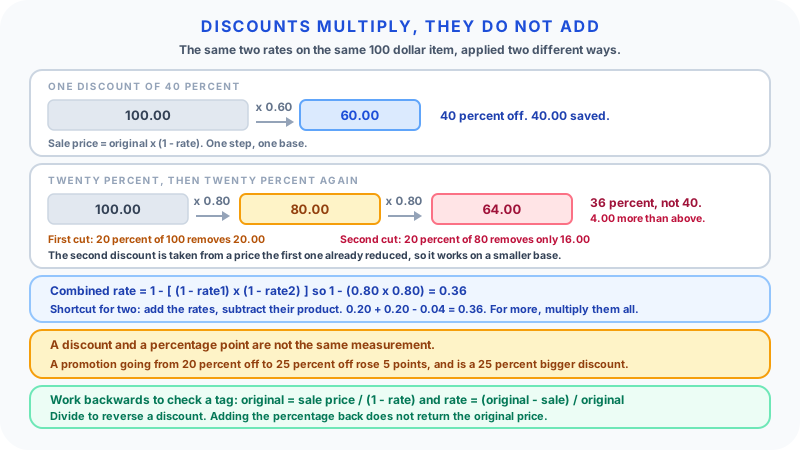
- Two 20% discounts are not 40% off. They are 36% off, because the second applies to a price the first already reduced.
- Reverse the math with Original = Sale ÷ (1 − rate) to check whether an advertised discount matches the actual price drop.
- A discount and a percentage-point change are different things. A price cut is a discount; a margin moving from 20% to 25% is 5 percentage points.
The Core Formula
Sale Price = Original Price × (1 − Discount Rate)
A 25% discount on an $80 jacket:
Sale Price = 80 × (1 − 0.25) = 80 × 0.75 = $60
To report the saving rather than the price:
Discount Amount = Original Price × Discount Rate
= 80 × 0.25 = $20 off
The two always agree: $80 − $20 = $60. Use the first when you want the number at the register, the second when you want the number on the tag.
Converting a percentage to its decimal is the only step people skip. 25% is 0.25, so the multiplier is 0.75. Write the multiplier down first and the rest is one keystroke.
| Discount | Decimal rate | Multiplier | $80 becomes |
|---|---|---|---|
| 10% | 0.10 | 0.90 | $72.00 |
| 15% | 0.15 | 0.85 | $68.00 |
| 25% | 0.25 | 0.75 | $60.00 |
| 33.3% | 0.333 | 0.667 | $53.36 |
| 50% | 0.50 | 0.50 | $40.00 |
| 70% | 0.70 | 0.30 | $24.00 |
Discount vs Percentage-Point Change
These are different measurements and they are routinely swapped.
A discount is a proportional cut in a price. It has a base: the original price.
A percentage point is the plain arithmetic difference between two percentages. It has no base.
If a retailer moves a promotion from 20% off to 25% off, that is:
- an increase of 5 percentage points in the discount rate, and
- a 25% relative increase in the discount itself (5 / 20 = 0.25), and
- on a $100 item, an extra $5 in your pocket.
All three describe the same change. "The discount went up 25%" and "the discount went up 5 points" are both true and mean very different things. The rule: percentage points compare two percentages to each other; a discount compares a price to itself.
The same distinction matters in reverse. If your savings rate on a purchase goes from 40% to 20%, you did not lose 20% of your saving. You lost half of it, which is 20 percentage points.
Stacked Discounts: Why They Are Less Than They Sound
When two discounts apply in sequence, the second is calculated on the already-reduced price. They multiply; they do not add.
Combined Rate = 1 − [(1 − rate1) × (1 − rate2)]
The headline case: 20% off, then another 20% off is not 40% off.
On a $100 item:
- After the first 20%: 100 × 0.80 = $80
- After the second 20%: 80 × 0.80 = $64
- Total paid: $64, so the real discount is (100 − 64) / 100 = 36%
A true 40% off would have cost $60. The gap is $4, or four percentage points of discount, and it exists because the second 20% was taken from $80 rather than from $100.
Order does not matter. 30% then 20% and 20% then 30% both land on the same price, because multiplication is commutative.
| First | Second | Combined | $100 becomes |
|---|---|---|---|
| 10% | 10% | 19% | $81.00 |
| 20% | 10% | 28% | $72.00 |
| 20% | 20% | 36% | $64.00 |
| 25% | 25% | 43.75% | $56.25 |
| 30% | 20% | 44% | $56.00 |
| 50% | 25% | 62.5% | $37.50 |
| 70% | 30% | 79% | $21.00 |
A quick sanity check for two discounts: add them, then subtract their product. 20% and 20%: 0.20 + 0.20 − (0.20 × 0.20) = 0.40 − 0.04 = 36%. The subtracted piece is exactly the overlap that adding double-counts.
Three or more discounts extend the same way: multiply all the remaining fractions. 30%, 20%, and 10% give 0.70 × 0.80 × 0.90 = 0.504, a combined 49.6% off, not 60%.
Reverse-Discount Math: Finding the Original Price
Given the sale price and the rate, recover what the item was before:
Original Price = Sale Price ÷ (1 − Discount Rate)
A tag reading "40% off" at $36:
Original = 36 ÷ 0.60 = $60, a saving of $24.
Check it forward: 60 × 0.60 = $36. Correct.
Note the operation: divide, do not add the percentage back. Adding 40% to $36 gives $50.40, which is wrong. The $36 is 60% of the original, so recovering it means dividing by 0.60.
To find the rate instead, when you know both prices:
Discount Rate = (Original − Sale) / Original
A $120 coat selling at $84: (120 − 84) / 120 = 30% off.
This is the calculation worth doing in a shop. If the recovered "original" sits well above what the item sells for everywhere else, the reference price may never have been a real selling price. The US Federal Trade Commission's guidance on former-price comparisons makes the point directly: if the former price was not a bona fide price at which the article was openly offered for a reasonably substantial period, the advertised bargain is a false one.
Discount Before or After Tax
A discount applied before tax reduces the taxable amount, so it reduces the tax owed as well. A discount applied after tax reduces only the item portion. Before-tax is always the better of the two.
Example: $100 item, 8% sales tax, 20% discount.
Discounted before tax:
- Item: 100 × 0.80 = $80.00
- Tax: 80 × 0.08 = $6.40
- Total: $86.40
Discounted after tax:
- Item plus tax: 100 × 1.08 = $108.00
- Discount on the item only: $20.00
- Total: 108 − 20 = $88.00
Difference: $1.60 on a $100 purchase, or 1.6% of the ticket.
Which applies is not a retailer's whim; in the US it turns on who funds the discount, and the rules are set state by state. A store coupon is a genuine price reduction the retailer absorbs, so it generally reduces the taxable price. A manufacturer coupon reimburses the retailer from a third party, so many states treat the reimbursed amount as part of the taxable receipts and charge tax on the pre-coupon price. California's regulation on discounts and coupons draws exactly this line. Rules differ elsewhere, so check your own state if the amounts matter.
Worked Example: A Realistic Shopping Trip
Items:
- Jacket marked $120, 25% off
- Two shirts marked $40 each, buy one get one 50% off
- Pants marked $80, 30% off
Then an extra 10% coupon on the whole order, then 8% sales tax.
| Line | Working | Result |
|---|---|---|
| Jacket | 120 × 0.75 | $90.00 |
| Shirts | 40 + (40 × 0.50) | $60.00 |
| Pants | 80 × 0.70 | $56.00 |
| Subtotal | 90 + 60 + 56 | $206.00 |
| 10% coupon | 206 × 0.90 | $185.40 |
| Tax at 8% | 185.40 × 0.08 | $14.83 |
| Total | 185.40 + 14.83 | $200.23 |
The marked prices totalled $120 + $80 + $80 = $280.
Effective discount before tax: (280 − 185.40) / 280 = 33.8%
Worth noticing: the tags advertised 25%, 30%, 50%, and 10%, and the real result was 33.8%. The BOGO is the reason the headline overstates: half off the second shirt is 25% off the pair, not 50% off anything you were buying anyway.
"Up to" Discount Advertising
"Up to 70% off" is a claim about the best item in the store, not about the store. It is normally satisfied by a handful of clearance lines while the bulk of the inventory sits far below the headline.
There is no fixed relationship between an advertised maximum and what you will actually find, so no rule of thumb will tell you what to expect. The only reliable method is the one that takes ten seconds: find the item you want, read its actual price, and compute the discount yourself with (Original − Sale) / Original. The headline is marketing; that number is the deal.
Common Mistakes
Adding stacked discounts. 20% and 20% is 36%, not 40%. Multiply the remainders.
Adding the percentage back to reverse a discount. Divide by (1 − rate) instead. Adding 40% to a 40%-off price does not return the original.
Confusing "60% off" with "60% of." "Now 60% of the original price" is a 40% discount. "60% off" leaves you paying 40%.
Mixing percentage points with percent. A discount moving from 20% to 25% rose 5 points, which is a 25% relative increase.
Treating a fixed-amount coupon like a percentage one. "$10 off" is constant; "10% off" scales with the basket. On a $40 order the $10 coupon wins; on a $200 order the percentage does.
Ignoring shipping. 20% off with free shipping usually beats 30% off with $12 postage on a small order. Compare delivered totals.
Forgetting tax timing. A before-tax discount saves slightly more, and whether you get it can depend on the coupon type and your state.
Practical Scenarios
Comparing two stores. Store A: $100 item at 30% off = $70. Store B: $120 item at 40% off = $72. The smaller advertised discount wins, because the base price was lower. Always compare final prices, never rates.
Stacking a loyalty discount onto a sale. 15% loyalty on top of a 25% sale: 1 − (0.85 × 0.75) = 36.25% off. Real, and worth timing the card to the sale.
A supplier quote. "10% off plus a 5% rebate" reads as 15%. If the rebate is calculated on the already-discounted invoice, it is 1 − (0.90 × 0.95) = 14.5%. If the rebate is instead calculated on the list price, it is a genuine 15%. Ask which, because the wording rarely says.
Checking a sale claim. A laptop listed at $899, advertised as "save $300." That implies a $1,199 reference price and a rate of 300 / 1,199 = 25.0%. Whether it is a real saving depends entirely on whether $1,199 was ever the going price.
Clearance on clearance. An item at 50% off, then an extra 30% at the register: 0.50 × 0.70 = 0.35, so you pay 35% of the original, a 65% discount. Genuinely large, and still not 80%.
FAQ
How do I calculate a sale price after a discount? Multiply the original by (1 − rate as a decimal). A 25% discount on $80: 80 × 0.75 = $60.
How do I find just the discount amount? Multiply the original by the rate. 80 × 0.25 = $20. Subtracting that from the original gives the same sale price.
Is 20% off then 20% off the same as 40% off? No. It is 36% off. The second 20% is taken from the already-reduced price, so it removes less money than the first did.
How do I find the original price from a sale price? Divide by (1 − rate). A $42 tag at 30% off: 42 ÷ 0.70 = $60.
What is the difference between a discount and a percentage point? A discount is a proportion of a price. A percentage point is the plain difference between two percentages. Moving a promotion from 20% off to 25% off is 5 percentage points, and also a 25% increase in the discount.
Is a discount before or after tax better? Before tax, because it lowers the taxable amount too. In the US, whether you get that treatment can depend on whether the coupon is issued by the store or the manufacturer, and on your state's rules.
How do I calculate what percentage I actually saved? (Original − Final) ÷ Original × 100. A $120 item bought for $84: (120 − 84) ÷ 120 × 100 = 30%.
Can a discount be more than 100%? No. 100% off means free, and there is nothing beyond it. Markup can exceed 100%, because it is measured against cost rather than price, but a discount cannot.
Related Tools
The Discount Calculator handles single discounts, stacked promotions, and reverse-discount math in one place. The Percentage Calculator covers the general case. For receipts, the Sales Tax Calculator adds tax to a discounted total, and the Tip Calculator handles restaurant math.
Related Articles
Sources
- US Federal Trade Commission, 16 CFR 233.1, Former price comparisons - the standard that a former price must be a bona fide price openly offered, or the advertised bargain is a false one.
- US Federal Trade Commission, 16 CFR Part 233, Guides Against Deceptive Pricing - the wider set of guides covering retail price comparisons and bargain offers conditioned on another purchase.
- California Department of Tax and Fee Administration, 18 CCR 1671.1, Discounts, Coupons, Rebates, and Other Incentives - the rule that retailer coupons reduce taxable gross receipts while manufacturer reimbursements are included in them.
Every price, rate, and total in this article was calculated directly from the formulas shown and rounded to the cent.
Final Thoughts
Discount math is percentage math wearing a sale tag, and the two habits that catch almost every trap are cheap. Write down the multiplier instead of the percentage, and multiply the remainders when discounts stack. Then do the one calculation the shop will not do for you: divide what you are paying by what it was supposedly worth. That single number settles every "up to", every stacked promotion, and every headline saving, in less time than it takes to find the tag.