
Two families of units still show up side by side on packaging, recipes, road signs and engineering drawings. This is a working reference for converting between them: what each system contains, the constants that are defined exactly, the places where the same word means two different sizes, and the mistakes that cause the most damage.
The Two Systems at a Glance
Metric, formally the International System of Units (SI). Used by almost every country, and by science, medicine and international trade everywhere.
- Length: millimetre (mm), centimetre (cm), metre (m), kilometre (km)
- Mass: gram (g), kilogram (kg), tonne (t)
- Volume: millilitre (mL), litre (L), cubic metre
- Temperature: degrees Celsius in everyday use
A precision note that often gets glossed over: the SI base units are the metre, kilogram, second, ampere, kelvin, mole and candela. The litre and the degree Celsius are not base units. They are accepted for use with SI, which is why everyone uses them and why they behave like part of the system in practice.
US customary and British Imperial. Related but not identical. Both descend from older English measures, and both were redefined against metric standards in the twentieth century.
- Length: inch, foot, yard, mile
- Weight: ounce, pound, stone (UK), short ton (US), long ton (UK)
- Volume: fluid ounce, cup, pint, quart, gallon
- Temperature: degrees Fahrenheit, used alongside US customary measurements in the United States
Fahrenheit is worth flagging separately. It is a temperature scale, not a unit defined by the Imperial standards system, and it is not part of SI either. In everyday language it travels with US customary units, and that is the honest way to describe it.
Why Metric Conversion Is Easier
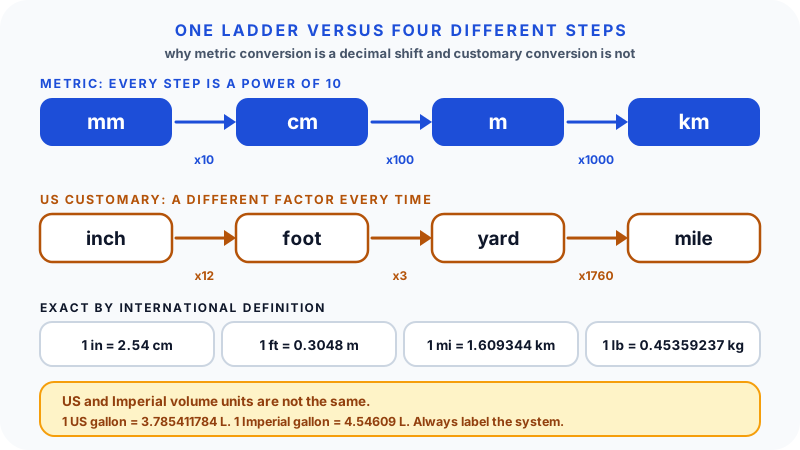
Metric scales by powers of ten, so converting between units means moving a decimal point.
| Prefix | Symbol | Factor |
|---|---|---|
| micro | u | 10^-6 |
| milli | m | 10^-3 |
| centi | c | 10^-2 |
| (base unit) | - | 1 |
| kilo | k | 10^3 |
| mega | M | 10^6 |
A kilometre is 1,000 metres. A millilitre is one thousandth of a litre. The prefixes are the same whether you attach them to metres, grams, litres or watts, so learning the ladder once covers every quantity.
US customary and Imperial units carry a different factor at every step, and the factors are not related to each other:
- 12 inches make a foot, 3 feet make a yard, 1,760 yards make a mile
- 16 ounces make a pound, 14 pounds make a stone, 2,000 pounds make a US short ton
- 8 fluid ounces make a US cup, 2 cups make a US pint, 2 pints make a quart, 4 quarts make a gallon
Nothing carries over between the three columns. That is the practical difference between the systems: one ladder versus a dozen unrelated ones.
Exact Conversion Anchors
These four are defined values, not measurements, so they are exact by international agreement rather than rounded:
- 1 inch = 2.54 cm exactly
- 1 foot = 0.3048 m exactly
- 1 mile = 1.609344 km exactly
- 1 pound = 0.45359237 kg exactly
Everything else in the length and mass tables follows from those. One yard is exactly 0.9144 m, one avoirdupois ounce is exactly 28.349523125 g, and a US short ton is exactly 907.18474 kg.
Length
| Unit | Metric equivalent | Reverse (approximate) |
|---|---|---|
| 1 inch | 2.54 cm (exact) | 1 cm = 0.3937 in |
| 1 foot | 30.48 cm (exact) | 1 m = 3.2808 ft |
| 1 yard | 0.9144 m (exact) | 1 m = 1.0936 yd |
| 1 mile | 1.609344 km (exact) | 1 km = 0.6214 mi |
Length is the easy case: inch, foot, yard and mile are identical in US customary and British Imperial.
Mass and Weight
| Unit | Metric equivalent | Reverse (approximate) |
|---|---|---|
| 1 ounce (avoirdupois) | 28.349523125 g (exact) | 1 g = 0.0353 oz |
| 1 pound | 0.45359237 kg (exact) | 1 kg = 2.2046 lb |
| 1 stone (UK, 14 lb) | 6.35029318 kg (exact) | 1 kg = 0.1575 stone |
| 1 short ton (US, 2,000 lb) | 907.18474 kg (exact) | 1 tonne = 1.1023 short tons |
| 1 long ton (UK, 2,240 lb) | 1,016.0469088 kg (exact) | 1 tonne = 0.9842 long tons |
The avoirdupois ounce and pound are the same in both systems, which is why weight rarely causes cross-Atlantic problems. Tons are the exception: a US short ton and a UK long ton differ by 240 pounds.
Volume: Where US and Imperial Diverge
This is the section that matters most, because the units share names and do not share sizes. Never convert a gallon, pint, quart, cup or fluid ounce without knowing which system it came from.
| Unit | US customary | British Imperial |
|---|---|---|
| 1 fluid ounce | 29.5735 mL | 28.4131 mL |
| 1 cup | 236.588 mL (8 US fl oz) | not a standard Imperial unit |
| 1 pint | 473.176 mL (16 US fl oz) | 568.261 mL (20 imp fl oz) |
| 1 quart | 946.353 mL | 1,136.523 mL |
| 1 gallon | 3.785411784 L (exact) | 4.54609 L (exact) |
An Imperial gallon is about 20% larger than a US gallon. An Imperial pint is about 20% larger than a US pint, and it takes 20 Imperial fluid ounces to fill it against 16 US fluid ounces for the US one. Curiously, the Imperial fluid ounce is the smaller of the two, because the Imperial pint divides into more of them.
Reverse figures, all US customary: 1 litre is about 33.81 US fl oz, 4.227 US cups, 2.113 US pints, 1.057 US quarts, or 0.264 US gallons. Against Imperial: 1 litre is about 35.20 Imperial fl oz, 1.760 Imperial pints, or 0.220 Imperial gallons.
Two more cup-shaped complications: US nutrition labelling uses a "legal cup" of exactly 240 mL rather than the customary 236.588 mL, and Australian recipes use a metric cup of 250 mL. If a recipe is precise enough for the difference to matter, weigh the ingredient instead.
Temperature
The two scales have different zero points and different degree sizes, so conversion needs both a shift and a scale factor:
degC = (degF - 32) x 5/9 degF = degC x 9/5 + 32
| Fahrenheit | Celsius |
|---|---|
| 0 | -17.8 |
| 32 | 0 (water freezes) |
| 50 | 10 |
| 68 | 20 |
| 98.6 | 37 (body temperature) |
| 100 | 37.8 |
| 212 | 100 (water boils at standard pressure) |
The rough field version, useful when precision does not matter: to go from Fahrenheit to Celsius, subtract 30 and halve. To go the other way, double and add 30. Both are approximate and drift at the extremes; the exact formulas are above.
Practical Sections
Cooking
Recipes are where unit confusion actually ruins something. A British recipe asking for a pint of milk wants 568 mL. Substituting two US cups gives 473 mL, roughly 17% short. Baking, where ratios drive the chemistry, is the least forgiving place to guess.
The reliable fix is to work in mass. Grams are unambiguous across every kitchen, and a scale removes the whole cup question along with the question of how tightly the flour was packed.
Note also that US recipes occasionally use dry measures, which are different units again: a US dry pint is about 550.6 mL against 473.2 mL for the liquid pint. Dry measures appear mostly on produce, so a "pint of blueberries" is not the same size as a pint of cream.
Travel
- Speed: 100 km/h is about 62 mph; 60 mph is about 96.6 km/h
- Distance: multiply kilometres by 0.62 for miles, or miles by 1.61 for kilometres
- Fuel: US and Imperial gallons differ, so a US mpg figure is roughly 0.83 of the same car's Imperial mpg figure
- Weather: 30 degC is a hot day at 86 degF; 0 degC is 32 degF
Construction and manufacturing
Timber and sheet goods are the classic trap. A "2 by 4" is a nominal name, not a measurement, and finished dimensions are smaller. Sheet materials sold as 4 ft by 8 ft are exactly 1.2192 m by 2.4384 m.
Area and volume compound the conversion factor, so they cannot be converted with the length factor:
- 1 inch = 2.54 cm, but 1 square inch = 6.4516 square cm
- 1 inch = 2.54 cm, but 1 cubic inch = 16.387064 cubic cm
International specifications
Engineering drawings, medical dosing, scientific papers and international shipping documents run on metric. If you are producing a spec that will cross a border, state the metric figure and give the customary one in brackets, not the other way round, and say which system any volume unit belongs to.
Conversion Context: Four Ways to Get It Wrong
Mass versus weight wording. A kilogram measures mass. A pound is used colloquially for mass but is defined as a unit in a system where force also gets measured in pounds. In everyday conversion the distinction rarely bites, but in physics and engineering it does, and the correct metric unit of force is the newton.
Dry versus liquid measures. US dry pints and quarts are larger than their liquid namesakes. Check which one a recipe or a produce label means.
US versus Imperial volume. Gallons, pints, quarts and fluid ounces all differ. Cups are a US convention and are not standard Imperial at all. Always label which system a volume figure came from.
Rounding too early. Convert once, at full precision, and round at the end. Rounding 2.54 to 2.5 and then multiplying across several steps compounds the error quickly, and it compounds faster still for areas and volumes where the factor is squared or cubed.
Where Each System Is Actually Used
The United States is the only large economy that uses customary units as its default for everyday measurement, and even there the picture is mixed: metric governs science, medicine, the military, pharmaceuticals and most international trade, while customary units hold everyday ground in cooking, weather, road distance and personal weight. The Metric Conversion Act of 1975 made metric the preferred system without requiring it.
The United Kingdom is officially metric but keeps Imperial in specific places: road distances in miles, draught beer and milk in pints, and body weight often in stones and pounds. Aviation worldwide still uses feet for altitude and nautical miles for distance, which are conventions of the industry rather than of either national system.
FAQ
What is the difference between metric and imperial units? Metric units scale by powers of ten with a single set of prefixes, so converting between them is a decimal shift. US customary and Imperial units use a different, unrelated factor at each step, such as 12 inches to a foot and 16 ounces to a pound, so every conversion needs its own number.
Are US and British Imperial units the same? For length and weight, effectively yes: the inch, foot, yard, mile, ounce and pound match. For volume they do not. An Imperial gallon is 4.54609 L and a US gallon is 3.785411784 L, and pints, quarts and fluid ounces differ to match.
How many litres are in a gallon? A US gallon is exactly 3.785411784 litres. An Imperial gallon is exactly 4.54609 litres. Which one applies depends entirely on the source of the figure.
How do I convert Fahrenheit to Celsius? Subtract 32, then multiply by 5/9. Going the other way, multiply by 9/5 and add 32. So 68 degF becomes (68 - 32) x 5/9 = 20 degC.
Why is one inch exactly 2.54 cm? The 1959 international yard and pound agreement defined the yard as exactly 0.9144 m and the pound as exactly 0.45359237 kg. Since a yard is 36 inches, that makes the inch exactly 2.54 cm by definition rather than by measurement.
Is a fluid ounce the same as an ounce? No. A fluid ounce measures volume and an ounce measures mass. They share a name and nothing else. They only line up numerically for water, and even then only approximately.
Related Tools
The Length Converter, Weight Converter, Volume Converter and Temperature Converter cover the four conversions in this guide. For squared and cubed units, where the length factor does not apply, use the Area Converter, and for travel figures use the Speed Converter.
Related Reading
- Cooking Measurement Conversions
- Cups, Grams, and Ounces Explained
- Celsius vs Fahrenheit: How the Temperature Scales Work
Final Thoughts
You do not need to memorise both systems. You need four exact anchors, the habit of asking which country a volume unit came from, and the discipline to round at the end rather than the beginning. Everything else is a converter away.