
Kitchen conversions look like one problem but are really three, and they behave completely differently. Getting them mixed up is what turns a French pastry recipe into a dense brick.
- Volume to volume (teaspoons to millilitres, cups to pints). Fixed ratios. Always exact.
- Weight to weight (ounces to grams, pounds to kilograms). Fixed ratios. Always exact.
- Volume to weight (cups to grams). Not fixed. The answer depends on what is in the cup.
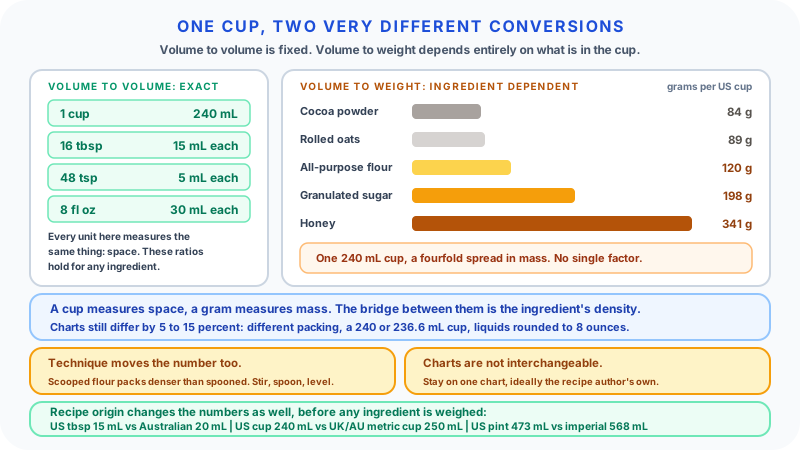
There is no universal number that turns cups into grams, because a cup measures space and a gram measures mass. A cup of flour and a cup of honey occupy the same space and differ by nearly three times in weight.
Key Takeaways
- Volume-to-volume conversions are exact: 1 tbsp = 3 tsp = 15 mL in the US system.
- Volume-to-weight conversions are ingredient-dependent. There is no single cups-to-grams factor.
- Published cups-to-grams charts disagree with each other by 5 to 15%, and for good reasons. Use one chart consistently rather than mixing them.
- Baking rewards weight; most savoury cooking tolerates volume.
- Oven temperatures: °F = °C × 9/5 + 32, but published oven settings are rounded to the dial, not to the decimal.
- US, UK imperial, and Australian measures differ. Recipe origin changes the numbers.
Volume Equivalents (US Standard)
These are exact relationships within the US system. US nutrition labelling defines the household measures used below: a teaspoon is 5 mL, a tablespoon 15 mL, a cup 240 mL, and a fluid ounce 30 mL.
| Unit | Equivalent |
|---|---|
| 1 tablespoon (tbsp) | 3 teaspoons (tsp) |
| 1 fluid ounce | 2 tbsp = 30 mL |
| 1/4 cup | 4 tbsp = 60 mL |
| 1/3 cup | 5 tbsp + 1 tsp = 80 mL |
| 1/2 cup | 8 tbsp = 120 mL |
| 1 cup | 16 tbsp = 240 mL |
| 1 pint (US liquid) | 2 cups = 473 mL |
| 1 quart (US liquid) | 4 cups = 946 mL |
| 1 gallon (US liquid) | 16 cups = 3.785 L |
One wrinkle worth knowing: there are two US cups. The legal cup used on nutrition labels is exactly 240 mL. The older customary cup, defined as 8 fluid ounces, is 236.6 mL. The difference is about 1.4%, which is invisible in a stew and irrelevant in most baking. Recipes and measuring cups use them interchangeably.
Volume Outside the US
This is where recipe origin starts to matter.
| Measure | US | UK / Imperial | Australia |
|---|---|---|---|
| Teaspoon | 5 mL | 5 mL | 5 mL |
| Tablespoon | 15 mL | 15 mL | 20 mL |
| Cup (metric) | 240 mL | 250 mL | 250 mL |
| Pint | 473 mL | 568 mL | - |
| Gallon | 3.785 L | 4.546 L | - |
| Fluid ounce | 29.6 mL | 28.4 mL | - |
Two traps live in that table. An Australian tablespoon is four teaspoons, not three, so an Australian recipe calling for 2 tbsp of baking powder means 40 mL where a US cook would measure 30 mL. And an imperial pint is 20% larger than a US pint, which matters enormously in older British recipes that measure liquids by the pint.
Volume to Weight: Why Charts Disagree
Ask three reputable sources how many grams are in a cup of flour and you will get three answers. This is not sloppiness. Volume-to-weight depends on:
- The ingredient's density. Sugar is roughly 1.6 times denser than all-purpose flour.
- How it was put in the cup. Flour scooped straight from the bag packs tighter than flour spooned in and levelled. The spread between the two is large enough to change a recipe.
- Which cup the chart assumed. 240 mL or 236.6 mL.
- Whether the chart rounds to whole ounces. Several well-known charts treat a cup of any thin liquid as 8 ounces by weight, or 227 g, even though 240 mL of water actually weighs about 240 g.
The practical rule: pick one chart and stay on it, ideally the one published by whoever wrote your recipe. Consistency matters more than which chart is theoretically correct.
Dry Ingredients, Grams per US Cup
These figures come from the King Arthur Baking ingredient weight chart, a widely used reference in US baking, and assume spooned-and-levelled measuring.
| Ingredient | Grams per cup |
|---|---|
| All-purpose flour | 120 |
| Bread flour | 120 |
| Cake flour | 120 |
| Whole wheat flour | 113 |
| Granulated sugar | 198 |
| Brown sugar, packed | 213 |
| Confectioners' (powdered) sugar | 113 |
| Unsweetened cocoa powder | 84 |
| Cornstarch | 112 |
| Rolled oats | 89 |
| Butter | 226 (2 sticks) |
Notice the range: 84 g to 226 g for the same volume. That spread is precisely why "cups to grams" has no single answer.
Liquids: Density Does the Work
For thin liquids, weight follows density directly. Water is about 1 g/mL, so a 240 mL cup of water weighs about 240 g. Syrups and oils differ:
| Liquid | Approx. density | Grams per 240 mL cup |
|---|---|---|
| Water | 1.00 g/mL | 240 |
| Milk (whole) | 1.03 g/mL | 247 |
| Vegetable oil | 0.92 g/mL | 221 |
| Maple syrup | 1.33 g/mL | 319 |
| Honey | 1.42 g/mL | 341 |
These are calculated from density, which is why they differ from charts that round a cup of liquid to 8 ounces (227 g). Neither is wrong; they answer slightly different questions. For a recipe, follow the recipe author's chart.
Oven Temperature Conversions
°C to °F: multiply by 9/5, then add 32. °F to °C: subtract 32, then multiply by 5/9.
Published oven tables round to the nearest usable dial setting rather than the exact arithmetic, which is why 350°F appears as 175°C or 180°C depending on the source. Both are fine; home ovens routinely swing 10 to 15°C around their set point anyway.
| °F | °C (dial) | Exact °C | Gas Mark | Typical use |
|---|---|---|---|---|
| 250 | 120 | 121 | 1/2 | Very low, slow roasting |
| 275 | 140 | 135 | 1 | Low, slow cooking |
| 325 | 160 | 163 | 3 | Moderate-low, rich cakes |
| 350 | 180 | 177 | 4 | Moderate, most baking |
| 375 | 190 | 191 | 5 | Moderate-high |
| 400 | 200 | 204 | 6 | High, roasting |
| 425 | 220 | 218 | 7 | Very high, bread |
| 450 | 230 | 232 | 8 | Very high, pizza |
| 475 | 240 | 246 | 9 | Hottest standard setting |
Fan and convection ovens move hot air across the food, so they cook faster at the same dial setting. The standard adjustment is to drop the temperature by about 25°F (about 15°C) or shorten the time by roughly a quarter, not both.
Why Baking Wants Weight
A cup of flour is not a fixed quantity. Scooping the cup directly into the bag compacts the flour; spooning it in loosely does not. Depending on technique and how settled the flour is, the same cup can hold noticeably different amounts, and in a recipe built on a flour-to-liquid ratio that is the difference between tender and dry.
If you are measuring flour by volume:
- Stir the flour in its container to loosen it.
- Spoon it lightly into the cup.
- Level the top with a straight edge.
Never scoop with the measuring cup unless the recipe explicitly says to, and never tap or pack the cup.
A digital scale removes the problem instead of managing it. Weigh 120 g and it is 120 g regardless of technique, humidity, or how long the bag has been sitting.
Scaling Recipes
Scale factor = desired servings / original servings
Multiply every ingredient quantity by the same factor. A recipe for 4 serving 6: scale factor 1.5.
Three things do not scale linearly:
- Cooking time. A doubled casserole is deeper, not twice as wide, so heat takes longer to reach the centre but nowhere near twice as long. Extend time, keep the temperature, and check doneness rather than the clock.
- Strong seasonings. Chilli heat, garlic, and salt in a brine tend to overshoot. Scale them to about 1.5x when doubling, then taste and adjust upward.
- Pan size. Doubling a cake batter into the same tin changes the depth, and therefore the bake. Scale the pan area, not just the batter.
Leavening, by contrast, does scale linearly. Double the recipe, double the baking powder.
Worked Example: Converting a French Recipe
A French chocolate cake:
- 200 g chocolate
- 150 g butter
- 4 eggs
- 100 g sugar
- 60 g flour
- Bake at 180°C for 25 minutes
For a US kitchen without a scale, using the chart above:
| Original | US volume equivalent | Working |
|---|---|---|
| 200 g chocolate | about 7 oz by weight | 200 / 28.35 = 7.05 oz |
| 150 g butter | 10.5 tbsp (1 stick + 2.5 tbsp) | 150 / 226 = 0.66 cup |
| 4 eggs | 4 large eggs | unchanged |
| 100 g sugar | 1/2 cup | 100 / 198 = 0.505 cup |
| 60 g flour | 1/2 cup | 60 / 120 = 0.50 cup |
| 180°C | 350°F | (180 x 9/5) + 32 = 356, dial to 350 |
Two notes on that table. The eggs need no conversion because eggs are already sold by weight: US Grade A large eggs are graded at a minimum 24 ounces per dozen, roughly 57 g each in the shell. And the two half-cup measurements are only as good as your flour technique. A scooped half cup of flour can run well over 60 g, which on a cake carrying just 60 g of flour is a meaningful change to the batter. This recipe is a good argument for a scale.
Common Mistakes
Assuming one cups-to-grams number exists. It does not. The factor is per ingredient, and charts disagree even then.
Confusing fluid ounces with ounces. A fluid ounce measures volume, an ounce measures weight. They coincide only for water, and only approximately.
Scooping flour with the measuring cup. This packs it and overshoots. Spoon and level.
Mixing charts mid-recipe. Flour from one source and sugar from another introduces errors in the ratio between them, which is what actually matters.
Ignoring recipe origin. An Australian tablespoon is 20 mL. An imperial pint is 568 mL. Both will quietly wreck a recipe.
Swapping baking soda and baking powder 1:1. Baking soda is roughly three to four times stronger, and needs an acid in the recipe to react with. They are not substitutes.
Applying both convection adjustments. Lower the temperature or shorten the time. Doing both undercooks the dish.
Practical Scenarios
A recipe says "1 stick of butter." One US stick = 1/2 cup = 8 tbsp = 4 oz = 113 g.
Halving a recipe. Multiply every ingredient by 0.5. Cooking time drops only slightly in a shallower pan; start checking well before the original time.
A bread recipe calls for "3 cups flour." Spooned and levelled at 120 g per cup, that is 360 g. Weigh 360 g once, note it on the recipe, and the loaf becomes repeatable.
A recipe says 220°C and your oven is in Fahrenheit. Exact is 428°F. Set 425°F and lose nothing.
Converting a syrup by weight. 1 cup of honey is about 341 g by density. Weighing it also saves scraping a sticky cup.
FAQ
How many grams are in a cup? That depends entirely on the ingredient. A cup of cocoa powder is about 84 g; a cup of honey is about 341 g. There is no universal conversion, because cups measure volume and grams measure mass.
Why does my baking come out differently each time? Most often, inconsistent flour measurement by volume. Oven temperature drift and altitude contribute, but flour technique is usually the largest single variable.
Is a US cup the same as a UK cup? No. A US cup is 240 mL (or 236.6 mL as the older customary cup). A UK or Australian metric cup is 250 mL, about 4% larger.
How many tablespoons in a cup? 16 US tablespoons fill a 240 mL US cup. An Australian 250 mL cup takes 12.5 Australian tablespoons, because those hold 20 mL each.
Can I weigh liquids instead of measuring them? Yes, and it is often easier. Water is about 1 g per mL. Denser liquids like honey weigh more per mL, so use a density figure or the recipe's own chart.
Why is baking more sensitive to measurement than cooking? Baking depends on ratios between flour, liquid, fat, and leavening to build structure. Change one and the chemistry changes. Most savoury cooking has no equivalent structural dependency, so it absorbs error.
What is the difference between a stick of butter and a cup? One stick is half a cup: 8 tablespoons, 4 ounces, about 113 g. Two sticks make a cup.
Do gas marks convert exactly? Not exactly. Gas marks are a stepped scale, roughly 25°F apart, so each one maps to a range rather than a single temperature. The table above gives the conventional pairings.
Related Tools
The Cooking Converter handles kitchen units in both directions, including ingredient-specific volume-to-weight. For general conversions, the Volume Converter, Weight Converter, and Temperature Converter cover the rest.
Related Articles
Sources
- US Food and Drug Administration, 21 CFR 101.9(b)(5)(viii) - the household measures used in US nutrition labelling: a teaspoon is 5 mL, a tablespoon 15 mL, a cup 240 mL, and 1 fluid ounce 30 mL.
- National Institute of Standards and Technology, NIST Handbook 44, Appendix C: General Tables of Units of Measurement - the exact US and imperial capacity relationships behind the pint, quart, gallon, and fluid ounce figures.
- King Arthur Baking, Ingredient Weight Chart - the grams-per-cup figures for dry ingredients quoted above.
- US Department of Agriculture, Agricultural Marketing Service, United States Standards, Grades, and Weight Classes for Shell Eggs - the 24 ounces per dozen minimum net weight that defines a large egg.
Liquid weights in this article were calculated from the densities shown and rounded for display.
Final Thoughts
Conversions are a translation layer, and like any translation they lose a little each time. Volume-to-volume loses nothing. Volume-to-weight loses whatever your scooping technique adds or removes, which is why the same recipe behaves differently in different hands. A kitchen scale does not make you a better cook, but it does make you a repeatable one: the loaf that worked last month works again, and when it does not, you know the reason is somewhere other than the flour.