
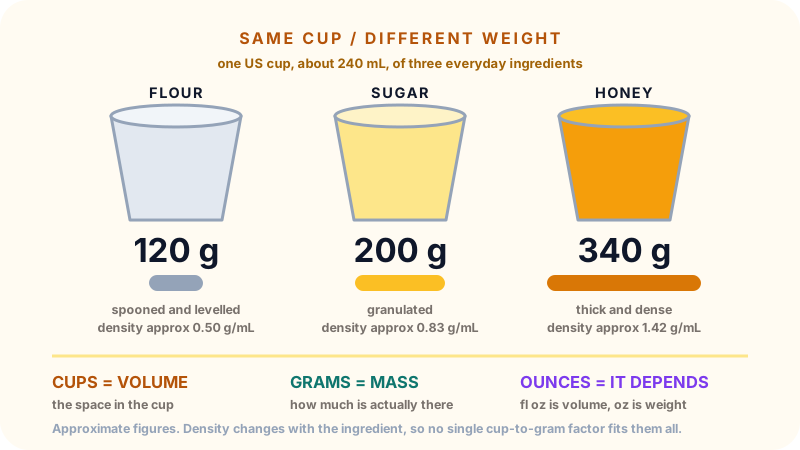
The short answer: a cup measures space, a gram measures mass, and the number that connects them changes with every ingredient. One cup of all-purpose flour is around 120 g. One cup of granulated sugar is around 200 g. One cup of honey is around 340 g. Same cup, nearly three times the weight.
That is why no single "cups to grams" number exists, and why a recipe that gives weights is easier to reproduce than one that gives cups.
Key Takeaways
- Cups measure volume. Grams measure mass. They are different quantities, not different units of the same thing.
- The bridge between them is density, and density is ingredient-specific.
- "Ounce" means two things: a fluid ounce is volume, an ounce is weight.
- Even one ingredient varies: flour is denser scooped than spooned or sifted.
- A cup is not one fixed size either: US customary about 237 mL, US legal 240 mL, metric and Australian 250 mL.
Volume, Mass, and the Thing That Connects Them
A cup is a container size. A gram is an amount of matter. Asking "how many grams in a cup" is like asking how many kilograms fit in a shoebox: it depends entirely on what you put in it.
The connection is density, which is simply mass per unit of volume:
density = mass / volume
mass    = density x volume
Flour is about 0.50 g/mL. Honey is about 1.42 g/mL. Pour each into the same 240 mL cup and you get 120 g and 340 g. Nothing is inconsistent; the cups are identical and the contents are not.
The Density Calculator works this relationship in any direction if you know two of the three values.
Approximate Weights of Common Ingredients
Figures below are for a 240 mL cup and are rounded. Treat them as good starting points, not exact constants.
| Ingredient | Approx. density (g/mL) | Approx. grams per cup |
|---|---|---|
| Water | 1.00 | 240 |
| Whole milk | 1.02 | 245 |
| Vegetable oil | 0.92 | 220 |
| Maple syrup | 1.33 | 320 |
| Honey | 1.42 | 340 |
| All-purpose flour (spooned) | 0.50 | 120 |
| Granulated sugar | 0.83 | 200 |
| Brown sugar (packed) | 0.92 | 220 |
| Table salt | 1.20 | 288 |
| White rice (uncooked) | 0.83 | 200 |
| Rolled oats | 0.38 | 90 |
| Butter | 0.95 | 227 |
The spread is the point. Rolled oats at roughly 0.38 g/mL against honey at roughly 1.42 g/mL is close to a four-fold difference in weight for the same cup. Butter is the one exception worth memorising because it is defined rather than measured: a US cup of butter is two 4 oz sticks, about 227 g.
Even a Single Ingredient Moves
Flour is the classic troublemaker, because the act of measuring changes the density.
How it is measured:
- Scooped straight from the bag, which compacts it: about 140 g per cup
- Spooned into the cup and levelled off, the usual recipe assumption: about 120 g
- Sifted first, then measured: about 100 g
That is a 40 g spread on the same "one cup", about a third of the spooned figure, before anyone has touched an oven.
Type of flour shifts it again: cake flour is lighter than all-purpose, and bread and whole wheat flours are heavier. Humidity nudges it too, since flour takes up moisture from the air.
None of this affects a scale reading. 120 g is 120 g whether it was sifted, scooped, or shaken.
Ounces: The Word That Means Two Things
This is the single most common source of confusion in US recipes.
- Fluid ounce (fl oz) is a volume. 1 US fl oz = 29.57 mL.
- Ounce (oz) is a weight. 1 oz = 28.35 g.
They are close in number for water and diverge for everything else. One US fluid ounce of water weighs about 29.6 g, which is about 1.04 oz, so even for water the two are near neighbours rather than the same thing.
In practice:
- "8 ounces of flour" almost always means weight, about 227 g.
- "8 ounces of milk" almost always means volume, about 237 mL, which weighs around 242 g.
When the label is ambiguous, read the rest of the ingredient list. If solids are given in cups, an ounce is probably fluid. If the recipe otherwise uses grams, an ounce is probably weight.
Which Cup? Regional Sizes Differ
"One cup" is not one number either:
- US customary cup: about 236.6 mL, the definition behind US measuring cups
- US legal cup: 240 mL, used on nutrition labels and in most published conversion tables
- Metric and Australian cup: 250 mL
- UK recipes: usually specify grams and millilitres rather than cups
The gap between a 237 mL and a 250 mL cup is about 6%. On one ingredient that is nothing. Across a whole bake, where flour, sugar, and liquid all shift together, it can be the difference between a batter that pours and one that sits.
This article uses 240 mL throughout, which is the convention most published cup-to-gram tables follow.
Converting Cups to Grams
When you know an ingredient's density, the arithmetic is one multiplication:
grams = cups x 240 x density- Flour: 240 x 0.50 = 120 g
- Sugar: 240 x 0.83 = 199 g, usually rounded to 200 g
- Butter: 240 x 0.95 = 228 g, commonly quoted as 227 g (two sticks)
In practice most people use a lookup table instead, because measured reference values for common ingredients are more reliable than a density estimate. The Cooking Converter handles the everyday kitchen conversions, and the Weight Converter moves between grams, ounces, and pounds once you have a weight to work with.
A conversion tool can only be as good as the relationship you feed it. Give it a known ingredient and it is accurate; ask it for a generic "cup to gram" number and no tool can answer honestly.
Worked Example: Translating a Recipe
A US recipe:
- 2 cups flour
- 1 cup granulated sugar
- 1/2 cup butter
- 1 cup milk
In grams:
- 2 x 120 = 240 g flour
- 1 x 200 = 200 g sugar
- 0.5 x 227 = 114 g butter
- 1 x 245 = 245 g milk
Same recipe, now portable, reproducible, and easy to scale. Halving it is arithmetic rather than a hunt for a quarter-cup measure.
Liquids Are the Easy Case
Water is 1 g/mL at ordinary kitchen temperatures, and most everyday liquids sit close to it:
- Milk: about 1.02 g/mL
- Cream: about 1.00 g/mL
- Vinegar: about 1.01 g/mL
- Vegetable oils: about 0.91 to 0.93 g/mL, which is why oil floats on water
For those, treating 1 mL as 1 g is a fine working approximation. The exceptions are the thick sweeteners: honey at about 1.42 g/mL and maple syrup at about 1.33 g/mL are dense enough that the shortcut is meaningfully wrong.
When a Scale Is the Better Tool
Reach for a scale when:
- You are baking. Bread, pastry, and anything with leavening depend on ratios that volume measuring blurs.
- The recipe is in grams already. Converting to cups adds error for no benefit.
- You are scaling a recipe up or down. Multiplying grams is exact; multiplying "3/4 cup plus 2 tablespoons" is not.
- You are repeating a recipe and want the same result twice.
- You want less washing up. Bowl on the scale, tare to zero, pour, tare, pour.
Cups remain perfectly good for everyday cooking. A slightly generous cup of stock or chopped onion changes nothing.
Bakers also work in weight because their formulas are weight ratios. Hydration of 70% means 70 g of water per 100 g of flour. That statement has no meaning in cups.
Common Mistakes
Treating "ounce" as one unit. Fluid ounces measure volume, ounces measure weight. Only for water are the numbers close.
Scooping flour with the measuring cup. It compacts the flour and can add 15 to 20% over the spooned-and-levelled figure most recipes assume.
Swapping sugars by volume. Packed brown sugar is denser than granulated: about 220 g per cup against about 200 g.
Measuring solids in fluid ounces. A "fluid ounce of flour" is not a meaningful quantity. Use cups for volume or grams for weight.
Assuming every cup is the same size. 237 mL, 240 mL, and 250 mL are all called a cup somewhere.
Forgetting to tare. Zero the scale with the bowl on it, or you are weighing the bowl.
Trusting one universal conversion factor. There isn't one. Any table that gives a single cups-to-grams number without naming the ingredient is wrong for most ingredients.
Practical Scenarios
Scenario 1: A French recipe with no cups. The recipe calls for 250 g of flour. Without a scale: 250 / 120 = about 2.08 cups, so 2 cups plus roughly 1.3 tablespoons. Workable, but a scale gets 250 g exactly, and this is precisely the situation where flour packing error compounds.
Scenario 2: Batter that changes every time. Thick one day, runny the next, same recipe. The likely culprit is flour: one day's cup weighed about 140 g, the next about 110 g. Weighing the flour removes the variable.
Scenario 3: Shopping by weight. A 500 g bag of uncooked rice is about 2.5 cups at roughly 200 g per cup. A recipe calling for 4 cups needs about 800 g, so one bag is not enough.
Scenario 4: Honey instead of sugar. A recipe uses 1 cup of granulated sugar, about 200 g. Honey is both denser and sweeter, so a common substitution is about 3/4 cup of honey, which is roughly 255 g, with a small reduction in the other liquids to compensate for the extra moisture. Treat it as a starting point rather than a fixed rule, since results vary by recipe.
FAQ
Are cups and grams the same thing? No. Cups measure volume, grams measure mass. The number that connects them depends on the ingredient's density.
How many grams in a cup of flour? About 120 g for spooned and levelled all-purpose flour. Scooped it can reach 140 g, sifted it can drop to 100 g.
How many grams in a cup of sugar? About 200 g for granulated. Packed brown sugar is denser, about 220 g.
Is 1 fluid ounce the same as 1 ounce? No. A fluid ounce is a volume (29.57 mL); an ounce is a weight (28.35 g). One fluid ounce of water weighs about 1.04 oz, and for anything other than water the two diverge further.
Why does my recipe come out differently each time? Volume-measured flour is the usual reason. The same "one cup" can vary by 40 g depending on how it was filled. Weighing removes that variation.
Should I use weight or volume? For everyday cooking, either. For baking, weight is meaningfully more consistent.
What is the easiest way to convert cups to grams? Use an ingredient-specific reference or a converter that asks which ingredient you mean. If you know the density, multiply cups by 240 and then by the density.
Related Tools
The Cooking Converter handles everyday kitchen volume and weight conversions for common ingredients. The Density Calculator works out density from a known mass and volume, which is useful for an ingredient no table covers. The Weight Converter moves between grams, ounces, and pounds.
Related Articles
Final Thoughts
The relationship between volume and weight in the kitchen is just density wearing an apron. Once you accept that a cup is a container rather than a quantity of food, the contradictions dissolve: of course a cup of oats and a cup of honey weigh different amounts, and of course a recipe that survives being scaled and repeated is one written in grams. For most cooking, cups are fine. For baking, a scale is the cheapest reliability upgrade in the kitchen.