
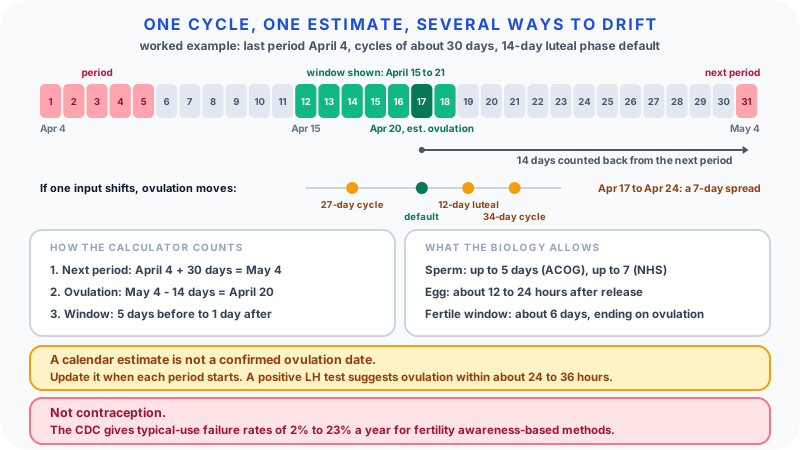
Cycle timing often feels clear only in hindsight. A period arrives, you count backward, and the pattern looks obvious. During the month itself, the dates are much less certain.
An ovulation calculator turns a few inputs into an estimated fertile window. That is useful for planning and for learning your own pattern, but it is still an estimate built on averages. It cannot confirm what happened in your body in a particular cycle.
BlinkCalc's Ovulation Calculator is a planning tool. This guide explains the assumptions behind its date range, what research says about the fertile window, and the limits worth keeping in mind.
Menstrual cycle basics
A menstrual cycle is counted from the first day of one period (day 1) to the day before the next period starts. The NHS describes regular cycles anywhere from 21 to 35 days as normal, with around 28 days as the average.
That "28 days" figure is an average, not a typical individual cycle. In a 2019 analysis of more than 600,000 cycles logged in a fertility app, the mean cycle length was 29.3 days and only about 13% of cycles were exactly 28 days long.
A cycle has two main phases either side of ovulation:
- The follicular phase runs from the start of a period to ovulation. This is the part that varies most, and it is why cycle length changes from month to month.
- The luteal phase runs from ovulation to the next period. It is more stable, but it is not fixed at 14 days for everyone.
What ovulation is
Ovulation is the release of an egg from an ovary. After release, the egg can be fertilised for only a short time, roughly 12 to 24 hours according to the American College of Obstetricians and Gynecologists (ACOG).
Sperm last much longer. ACOG notes sperm can survive up to 5 days in the reproductive tract, and the NHS says up to 7 days. That difference in lifespan is the whole reason a fertile window starts several days before ovulation rather than on the day itself.
How long the fertile window is
The most widely cited research comes from a study of couples trying to conceive, published in the New England Journal of Medicine in 1995. Pregnancies occurred only when intercourse took place within a six-day span ending on the estimated day of ovulation. The chance of conception was lowest at the start of that span and highest in the last two days. A later reanalysis of the data estimated the same six-day window and put the highest chance on the day before ovulation.
So the fertile window is usually described as about six days: the five days before ovulation plus ovulation day itself. The days are not equal, and none of them guarantees pregnancy.
How the calculator builds its estimate
Calendar calculators work backward from the next expected period, because the luteal phase is more predictable than the follicular phase. BlinkCalc's calculator follows three steps:
- Expected next period = first day of last period + average cycle length.
- Estimated ovulation = expected next period minus the luteal phase length (14 days by default, adjustable from 10 to 17).
- Fertile window shown = five days before estimated ovulation through one day after.
The extra day after ovulation is a buffer for estimate error, not a sign that the egg survives longer.
The luteal phase default is where estimates quietly drift. In the same large app study, the average luteal phase was 12.4 days, and most fell between 7 and 17 days. If your luteal phase is really 12 days and the calculator assumes 14, the estimated ovulation date will be two days early. If you know your own luteal phase from tracking, entering it improves the estimate.
Worked example
Elena's last period started on April 4. Her recent cycles have been about 30 days.
- Expected next period: April 4 + 30 days = May 4.
- Estimated ovulation, using the 14-day default: May 4 minus 14 days = April 20 (cycle day 17).
- Fertile window shown: April 15 to April 21.
Now change one assumption at a time:
- If this cycle runs to 34 days, the next period is May 8 and estimated ovulation moves to April 24.
- If it shortens to 27 days, the next period is May 1 and estimated ovulation moves to April 17.
- If Elena's luteal phase is actually 12 days, ovulation in a 30-day cycle is closer to April 22, and the most fertile days would fall at the very end of the window shown.
None of these is unusual. Together they show why the honest output of a calendar calculator is a range that deserves updating, not a date on a calendar.
Regular and irregular cycles
Calendar estimates work best when cycles are fairly consistent. If your cycles usually run 29 to 31 days, the predicted window is reasonably stable. If they range from 24 to 39 days, the calendar method cannot tell which kind of month this will be, so the likely fertile days spread across a much wider span.
Cycle length can shift with stress, illness, travel, sleep disruption, intense training, changes in weight or eating, breastfeeding and the months after birth, stopping hormonal contraception, and perimenopause. Conditions such as polycystic ovary syndrome (PCOS) and thyroid disorders can also affect ovulation. A calculator cannot tell ordinary variation apart from something that needs attention.
Keep your average current
An average cycle length should be updated as new cycles arrive. If the last six cycles were 29, 31, 30, 34, 28, and 30 days, the average is about 30.3 days. The 34-day cycle is also information: it shows that a 30-day estimate can be four days off in a given month.
After a clear change such as giving birth, stopping hormonal contraception, or a long period of illness, older cycle data may no longer describe your current pattern.
Signs that add detail to the calendar
A calendar estimate uses only dates. Body-based signs can show what is happening in the current cycle:
- Ovulation predictor kits detect the rise in luteinising hormone (LH) in urine. MedlinePlus notes a positive result means ovulation is expected in the next 24 to 36 hours, although this is not true for everyone. Starting tests a few days before the calculator's window helps avoid missing the surge.
- Cervical mucus typically becomes clearer, wetter, and more slippery in the days before ovulation.
- Basal body temperature rises slightly after ovulation. It confirms that ovulation probably happened, but only once the fertile window has mostly passed, so it is more useful for learning your pattern over several cycles than for timing the current one.
Keep each signal labelled when you record it. A calendar estimate, a test result, a mucus observation, and a temperature shift are different kinds of evidence. Seeing where they agree is useful. Blending them into one "certain" date is not.
Trying to conceive
For people trying to conceive, a fertile-window estimate can help with timing, but it cannot guarantee pregnancy. Age, sperm health, ovulation regularity, medical history, and chance all play a part. A well-timed cycle that does not lead to pregnancy does not mean the estimate was wrong.
It is also easy to become focused on a single highlighted day. ACOG suggests sex every day or every other day during the six-day window. The NHS takes a simpler line: more than 8 out of 10 couples in which the woman is under 40 conceive naturally within a year with regular unprotected sex every 2 or 3 days, a rhythm that covers the fertile window without needing to pinpoint it. If date tracking is adding stress, that broader approach may be more helpful.
When to seek advice
ACOG suggests talking to a doctor after 12 months of trying if you are under 35, after 6 months if you are 35 to 39, and sooner if you are 40 or older. The NHS gives similar advice to see a GP if you have not conceived after a year of trying, or sooner if you are 36 or over or already know of a possible fertility issue.
Speak to a clinician sooner, whatever your plans, if periods stop, become very irregular, very painful, or unusually heavy, or if you bleed between periods. A calculator can organise dates for that conversation. It cannot interpret symptoms or diagnose anything. Bringing a record of period start dates is still genuinely useful.
Not a contraception method
An ovulation calculator should not be used to avoid pregnancy. The same uncertainty that makes the fertile window a range makes calendar-only avoidance risky. The CDC lists typical-use failure rates for fertility awareness-based methods of 2% to 23% per year, and those methods involve structured training and daily observation, not a web calculator. For contraception choices, speak with a clinician or a sexual health service.
Calculators, apps, and different answers
Period apps and calculators often disagree by a day or two. That usually comes from different assumptions rather than an error: one may use your average cycle length, another your most recent cycle, and another a fixed 14-day luteal phase. Compare the inputs before assuming one tool is wrong.
An app that shows a neat ovulation date after months of irregular cycles has not made your cycle more predictable. It is still averaging.
Privacy on shared devices
Cycle information is sensitive. On a shared computer or phone, think about browser history, autofill, screenshots, and notifications. Privacy depends on the device and the accounts involved, so use tools in a way that fits your privacy needs and personal safety.
Related timing tools
The Period Calculator estimates future period dates and helps you work out an average cycle length, which is the most important input for an ovulation estimate.
The Pregnancy Calculator and Due Date Calculator answer different questions once a pregnancy is confirmed. Keeping the tools separate avoids mixing up planning estimates with pregnancy dating.
Common mistakes
Treating the estimated ovulation date as confirmed. A calendar estimate is not the same as an LH test, a temperature pattern, an ultrasound, or a clinical assessment.
Using 28 days by default. If your own cycles are longer or shorter, a 28-day assumption moves the whole window.
Never revisiting the luteal phase setting. A 14-day default is a convention. If tracking suggests yours is shorter or longer, adjust it.
Judging a pattern from one cycle. One unusual month does not redefine your pattern. Look for trends across several cycles.
Using the calculator as contraception. It is a planning estimate, not a method of avoiding pregnancy.
FAQ
How does an ovulation calculator estimate fertile window?
It adds your average cycle length to the first day of your last period to predict the next period, subtracts the luteal phase length (often 14 days) to estimate ovulation, and then highlights the days around that estimate. BlinkCalc shows five days before estimated ovulation through one day after.
What is ovulation?
Ovulation is the release of an egg from an ovary. The egg can be fertilised for roughly 12 to 24 hours, and ovulation timing can vary from cycle to cycle.
Can irregular cycles affect estimates?
Yes. The more your cycle length varies, the less reliable a calendar estimate becomes. Ovulation tests or other body signs can add detail, and very irregular cycles are worth discussing with a clinician.
Is an ovulation calculator contraception?
No. Calendar estimates are not reliable enough to prevent pregnancy and should not be used that way.
How long is the fertile window?
Research suggests about six days: the five days before ovulation and ovulation day itself, with the highest chance of conception in the last two or three of those days.
When should I use a period calculator too?
Use it first if you are unsure of your average cycle length. A better cycle-length estimate makes every ovulation estimate more useful.
Sources
- Periods and fertility in the menstrual cycle - NHS. Source for the 21 to 35 day range of normal cycles, the 28-day average, and sperm survival of up to 7 days.
- Trying to Get Pregnant? Here's When to Have Sex - American College of Obstetricians and Gynecologists. Source for the six-day fertile window, egg survival of about 12 to 24 hours, sperm survival of up to 5 days, the every-day or every-other-day advice, and when to seek help by age.
- Timing of sexual intercourse in relation to ovulation - Wilcox, Weinberg and Baird, New England Journal of Medicine, 1995. Source for the six-day fertile window ending on the day of ovulation.
- Day-specific probabilities of clinical pregnancy based on two studies with imperfect measures of ovulation - Dunson and colleagues, Human Reproduction, 1999. Source for the reanalysis confirming a six-day window with the highest probability the day before ovulation.
- Real-world menstrual cycle characteristics of more than 600,000 menstrual cycles - Bull and colleagues, npj Digital Medicine, 2019. Source for the 29.3-day mean cycle, the 12.4-day mean luteal phase, and the finding that 13% of cycles were exactly 28 days.
- Ovulation home test - MedlinePlus, US National Library of Medicine. Source for LH detection and ovulation typically following a positive result within 24 to 36 hours.
- Infertility - NHS. Source for the figure that more than 8 out of 10 couples in which the woman is under 40 conceive within a year with sex every 2 or 3 days, and for the advice on when to see a GP.
- Contraception and Birth Control Methods - Centers for Disease Control and Prevention. Source for the 2% to 23% typical-use failure range for fertility awareness-based methods.
Sources were checked in September 2026. Guidance is revised from time to time, so check current NHS and ACOG pages for the latest advice. The worked example is a BlinkCalc illustration and does not describe a real person.
Educational only. Not medical, fertility, contraception, or pregnancy advice. Please speak with a qualified professional for personal guidance.