
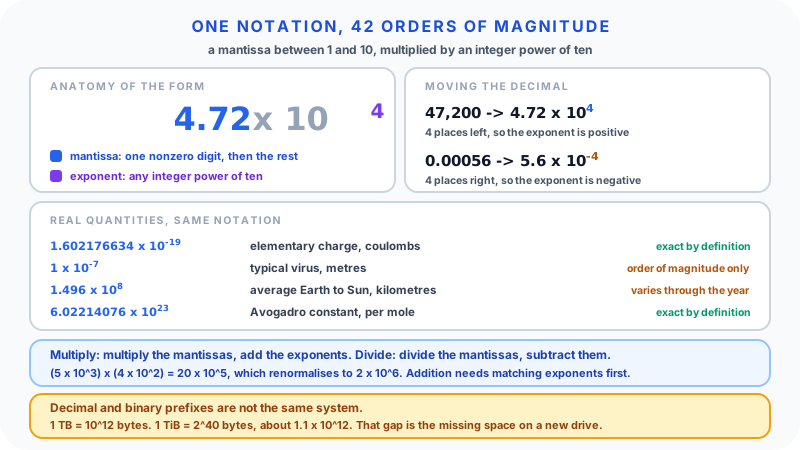
Scientific notation is a compact way to express extremely large or extremely small numbers. Instead of writing 0.000000000000003, scientists write 3 × 10⁻¹⁵. The notation is built around powers of 10 and a simple rule: one nonzero digit before the decimal, the rest after, followed by × 10 raised to an exponent.
Key Takeaways
- Scientific notation: a × 10ⁿ, where 1 ≤ |a| < 10 and n is an integer.
- A positive exponent scales up (large numbers); a negative exponent scales down (small numbers).
- To convert: count how many places the decimal moves to land in standard position.
- Engineering notation is a variant that uses exponents in multiples of 3, matching SI prefixes.
- Multiplying or dividing in scientific notation uses simple exponent rules.
The Format
A number in scientific notation has two parts:
- Mantissa (or coefficient): a number with absolute value between 1 (inclusive) and 10 (exclusive).
- Exponent: an integer power of 10.
Form: a × 10ⁿ
Examples:
- 3,500 = 3.5 × 10³
- 0.0042 = 4.2 × 10⁻³
- 1,000,000 = 1 × 10⁶
- 0.0000001 = 1 × 10⁻⁷
- 6.02214076 × 10²³ (the Avogadro constant, entities per mole, an exact defined value)
- 1.602176634 × 10⁻¹⁹ (the elementary charge in coulombs, also exact; an electron carries this magnitude with a negative sign)
If the mantissa is exactly 1, it is often dropped: 10⁶ instead of 1 × 10⁶.
Converting To and From Scientific Notation
Standard to scientific: count how many places the decimal must move to leave exactly one nonzero digit before the point.
- 47,200 → move decimal 4 places left → 4.72 × 10⁴
- 0.00056 → move decimal 4 places right → 5.6 × 10⁻⁴
Rule: moving the decimal left produces a positive exponent (the number is large). Moving right produces a negative exponent (the number is small).
Scientific to standard: move the decimal in the opposite direction by the exponent's magnitude.
- 3.14 × 10⁵ → move decimal 5 places right → 314,000
- 9.0 × 10⁻³ → move decimal 3 places left → 0.0090
Why It's Useful
Scientific notation matters in three situations:
- Numbers that are too long. Writing the mass of an electron (9.109 × 10⁻³¹ kg) is much more readable than 0.0000000000000000000000000000009109 kg.
- Numbers that exceed a display. Calculators and computers run out of digits. Floating-point formats use a mantissa-and-exponent representation internally for the same reason.
- Numbers that need clear significant figures. 1,200 is ambiguous: 2, 3, or 4 significant figures? 1.20 × 10³ explicitly shows 3 sig figs.
Operations in Scientific Notation
Multiplication: multiply the mantissas, add the exponents.
(3 × 10⁴) × (2 × 10⁵) = 6 × 10⁹
If the result mantissa goes outside the [1, 10) range, renormalize:
(5 × 10³) × (4 × 10²) = 20 × 10⁵ = 2 × 10⁶
Division: divide the mantissas, subtract the exponents.
(8 × 10⁷) / (2 × 10³) = 4 × 10⁴
Addition and subtraction: convert to the same exponent first.
(3 × 10⁴) + (2 × 10³) = (3 × 10⁴) + (0.2 × 10⁴) = 3.2 × 10⁴
Powers: raise the mantissa to the power, multiply the exponent by the power.
(2 × 10³)⁴ = 16 × 10¹² = 1.6 × 10¹³
These four rules cover almost every calculation you'll do in scientific notation. The Scientific Notation Calculator applies the same rules and renormalizes the result for you.
Engineering Notation
Engineering notation is a variant where the exponent is always a multiple of 3. This aligns with the SI prefixes (kilo = 10³, mega = 10⁶, giga = 10⁹, milli = 10⁻³, micro = 10⁻⁶, nano = 10⁻⁹), which since 2022 run from quecto at 10⁻³⁰ to quetta at 10³⁰.
Examples:
- 47,200 in scientific: 4.72 × 10⁴; in engineering: 47.2 × 10³
- 0.00056 in scientific: 5.6 × 10⁻⁴; in engineering: 560 × 10⁻⁶
Engineering notation reads more naturally for measurements: 47.2 kilohms rather than 4.72 × 10⁴ ohms, or 560 microfarads rather than 5.6 × 10⁻⁴ farads.
Worked Examples
Astronomy. The astronomical unit, the defined average Earth-Sun distance, is exactly 149,597,870,700 m, or about 1.496 × 10⁸ km. The actual distance varies over the year between roughly 1.471 × 10⁸ and 1.521 × 10⁸ km, so the compact form is an average rather than a fixed measurement.
Biology. A typical human cell is on the order of 1 × 10⁻⁵ m across, or 0.00001 m. A typical virus is on the order of 1 × 10⁻⁷ m, about 100 times smaller. Both are order-of-magnitude figures, since real cells and viruses span a wide range.
Computer storage. A drive marketed as 2 TB holds 2 × 10¹² bytes, because storage capacity uses the decimal SI prefix. That is not the same as 2 TiB, which is 2 × 2⁴⁰ ≈ 2.2 × 10¹² bytes. The roughly 10% gap between the two is why a 2 TB drive often shows as about 1.82 TB in an operating system that reports binary units under decimal labels.
Speed of light. Exactly 299,792,458 m/s by definition, usually rounded to 3.00 × 10⁸ m/s. The rounding is a choice about significant figures, not an approximation of an uncertain value.
Finance. Total US public debt outstanding is on the order of 4 × 10¹³ dollars, around $40 trillion in 2026. The Treasury publishes the figure daily, so any written number is out of date almost immediately; the order of magnitude is the durable part.
Significant Figures and Scientific Notation
Scientific notation makes significant figures explicit. The number 0.005600 has 4 significant figures (the trailing zeros count). In scientific notation: 5.600 × 10⁻³, exactly 4 sig figs, no ambiguity.
A common source of confusion: 1,500 could have 2, 3, or 4 sig figs depending on context.
- 1.5 × 10³ → 2 sig figs
- 1.50 × 10³ → 3 sig figs
- 1.500 × 10³ → 4 sig figs
When precision matters, write the number in scientific notation to remove the ambiguity.
Common Mistakes
Mantissa outside [1, 10). 25.4 × 10³ is not normalized scientific notation. Renormalize to 2.54 × 10⁴.
Wrong sign on the exponent. Large numbers → positive exponents. Small numbers → negative exponents. Mixing them up is the most common conversion error.
Forgetting to renormalize after multiplication. Results like 14 × 10⁵ should become 1.4 × 10⁶.
Misaligning exponents in addition. You cannot add (3 × 10⁴) + (2 × 10⁶) without first converting to the same exponent.
Reading E notation as Euler's number. In 3.5E6 the E means "times ten to the power"; it is unrelated to e ≈ 2.71828. Spreadsheets and calculators use E purely as display shorthand.
Confusing decimal and binary prefixes. Kilo, mega, giga and tera are powers of 10. Kibi, mebi, gibi and tebi are powers of 2. A "4.2 MB" photo may be 4.2 × 10⁶ bytes or 4.2 × 2²⁰ bytes depending on who wrote the label.
Truncating sig figs in conversion. Converting 5.678 × 10² to standard form gives 567.8, not 568. Don't lose precision.
Practical Scenarios
Scenario 1: Lab measurement. A reagent concentration is 2.5 × 10⁻⁴ mol/L. For 500 mL: moles = 2.5 × 10⁻⁴ × 0.5 = 1.25 × 10⁻⁴ mol.
Scenario 2: Computing storage. A photo at 4.2 MB and a drive at 1 TB, both in decimal units. Photos that fit: (1 × 10¹²) / (4.2 × 10⁶) ≈ 2.38 × 10⁵, so about 238,000 photos.
Scenario 3: Urban population math. The UN counted roughly 1.2 × 10⁴ cities worldwide in 2025, of which 96% had fewer than a million inhabitants. Cities of a million or more therefore number about 4% of 1.2 × 10⁴ = 4.8 × 10², roughly 480. Against a world population of 8.2 × 10⁹ this says nothing yet about how many people live in them, which is the useful lesson: dividing a count of cities by a count of people answers no sensible question. You need the populations themselves, not the city count.
Scenario 4: Pennies to tonnes. $1 trillion in US one-cent coins is 10¹² × 100 = 10¹⁴ coins. Each weighs 2.50 g, or 2.5 × 10⁻³ kg. Total mass: 10¹⁴ × 2.5 × 10⁻³ = 2.5 × 10¹¹ kg, which is 2.5 × 10⁸ metric tonnes, or 250 million tonnes. Scientific notation is what makes this tractable on paper.
FAQ
What is scientific notation used for? Expressing very large or very small numbers compactly, preserving significant figures, and making calculations easier in science, engineering, and finance.
How do I know which way to move the decimal? Aim for one nonzero digit before the decimal point. Count how many places you moved; that's the exponent. Moving left → positive exponent. Moving right → negative exponent.
Can scientific notation have a negative coefficient? Yes. −3.5 × 10⁴ is valid scientific notation for −35,000. The mantissa just needs |a| in the range [1, 10).
What's the difference between scientific and engineering notation? Scientific notation allows any integer exponent. Engineering notation restricts the exponent to multiples of 3, matching the SI prefixes.
How do I multiply numbers in scientific notation? Multiply the mantissas and add the exponents. Then renormalize if the resulting mantissa is outside [1, 10).
How do I add numbers in scientific notation? First convert both numbers to the same exponent, then add the mantissas, then renormalize.
Why does my calculator show 'E' instead of '× 10'? E notation is calculator and spreadsheet shorthand. 3.5E6 means 3.5 × 10⁶. Same meaning, different display, and nothing to do with Euler's number.
Sources
- Fundamental Physical Constants, complete listing - NIST, CODATA 2022 values. Source for the exact elementary charge (1.602176634 × 10⁻¹⁹ C), the exact Avogadro constant (6.02214076 × 10²³ mol⁻¹), the exact speed of light (299,792,458 m/s), and the electron mass (9.109383 7139 × 10⁻³¹ kg).
- Metric (SI) Prefixes - NIST Office of Weights and Measures. Source for the 24 SI prefixes and the 2022 addition of ronna, quetta, ronto, and quecto, which set the 10⁻³⁰ to 10³⁰ range used in the engineering notation section.
- Prefixes for binary multiples - NIST. Source for the kibi / mebi / gibi / tebi prefixes, standardised by the IEC in 1998, and for the point that these binary prefixes are not part of the SI.
- Coin Specifications - United States Mint. Source for the one-cent coin's weight of 2.50 g used in the pennies-to-tonnes scenario.
- Debt to the Penny - US Treasury Fiscal Data. The authoritative daily figure for total US public debt outstanding, which is why the article gives only its order of magnitude.
- World Urbanization Prospects 2025, summary of results - UN Department of Economic and Social Affairs. Source for the roughly 12,000 cities counted in 2025 and the finding that 96% of them have fewer than one million inhabitants.
Related Tools
The Scientific Notation Calculator handles conversions, engineering notation, and the four operations. The Exponent Calculator works with general powers, and the Significant Figures Calculator handles precision-related rounding.
Related Articles
Final Thoughts
Scientific notation is one of those small conventions that quietly underlies a large amount of technical work. Once you can convert in both directions and apply the four operation rules, it stops feeling like a separate skill and becomes what it was designed to be: a more compact way to write numbers, with the added benefit of saying exactly how many digits you actually measured.