
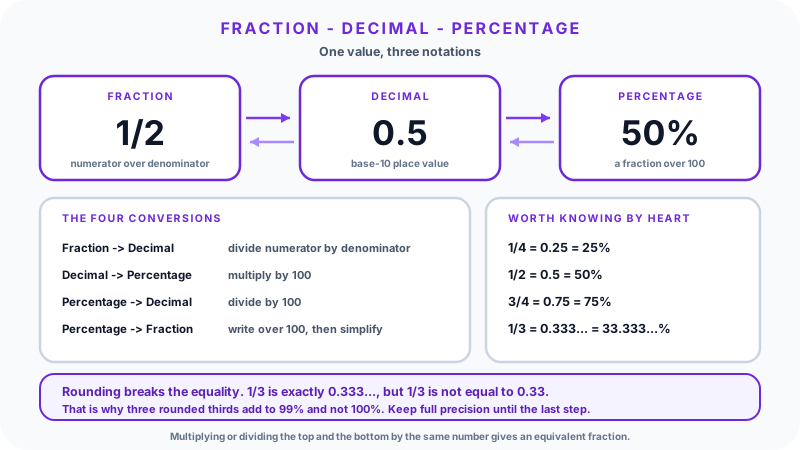
Fractions, decimals, and percentages are three notations for the same idea: a part of a whole. Each form has situations where it is the cleanest tool. Recipes lean on fractions, finance leans on decimals, statistics and pricing lean on percentages. Knowing how to move fluidly between them is one of the most leveraged math skills you can build.
Key Takeaways
- A fraction expresses a part as numerator over denominator (3/4).
- A decimal uses base-10 place value (0.75).
- A percentage is a fraction with denominator 100 (75%).
- Conversions: fraction to decimal by division; decimal to percentage by multiplying by 100; the reverse paths reverse the operations.
- Rounding breaks exact equality. A rounded decimal or percentage is close to the fraction, not identical to it.
What Each Form Actually Says
A fraction names how many parts, out of how many
Write a fraction as one number over another:
numerator / denominator
The denominator is the bottom number. It tells you how many equal parts the whole was divided into. The numerator is the top number. It tells you how many of those parts you are talking about.
So 3/4 means: cut the whole into 4 equal pieces, then take 3 of them. The denominator sets the size of each piece, and the numerator counts them. That is why a larger denominator makes each piece smaller: 1/8 is less than 1/4, even though 8 is bigger than 4, because eighths are smaller pieces than quarters.
A fraction is also a division waiting to happen. The bar means "divided by", which is what makes the conversion to a decimal so direct.
A decimal names the same part using place value
A decimal writes the part using base-10 places to the right of the point: tenths, hundredths, thousandths, and so on. In 0.75, the 7 sits in the tenths place and the 5 in the hundredths, so the value is 7/10 + 5/100, which is 75/100.
Decimals are convenient because they line up for comparison and feed straight into arithmetic. Their limitation is that not every fraction lands on a finite string of digits.
A percentage is a fraction with the denominator fixed at 100
Percent means "per hundred". Writing 75% is the same as writing 75/100. Fixing the denominator is what makes percentages easy to compare: 63% against 71% is an immediate read, where 17/27 against 22/31 is not.
Because the denominator is fixed, a percentage is really a rescaled fraction, which is why every conversion in this article is just multiplying or dividing by 100.
The Three Forms Side by Side
| Fraction | Decimal | Percentage |
|---|---|---|
| 1/2 | 0.5 | 50% |
| 1/4 | 0.25 | 25% |
| 3/4 | 0.75 | 75% |
| 1/5 | 0.2 | 20% |
| 1/8 | 0.125 | 12.5% |
| 3/8 | 0.375 | 37.5% |
| 1/10 | 0.1 | 10% |
| 1/100 | 0.01 | 1% |
| 1/3 | 0.333... | 33.333...% |
| 2/3 | 0.666... | 66.666...% |
Every row above is an exact equality, including the last two, because the ellipsis means the digits continue forever. Rounded versions such as 0.67 or 66.7% are a separate thing, covered below.
Memorizing the top of this table makes most percentage problems doable in your head, because real numbers are rarely far from these reference points.
Conversion Mechanics
Fraction to decimal. Divide the numerator by the denominator.
3/8 = 3 / 8 = 0.375
Decimal to percentage. Multiply by 100, or shift the decimal point two places right.
0.375 = 37.5%
Percentage to decimal. Divide by 100, or shift the decimal point two places left.
37.5% = 0.375
Percentage to fraction. Write the number over 100, then simplify.
60% = 60/100 = 3/5
If the percentage has decimals, clear them first by scaling top and bottom:
37.5% = 37.5/100 = 375/1000 = 3/8
Decimal to fraction. Place the digits over the matching power of 10, then simplify.
0.375 = 375/1000 = 3/8
Fraction to percentage. Convert to a decimal, then multiply by 100.
3/8 = 0.375 = 37.5%
Simplifying Fractions
Two fractions are equivalent when they name the same value. Multiplying or dividing both the numerator and the denominator by the same non-zero number never changes the value, because you are scaling the count of pieces and the size of the pieces together:
1/2 = 2/4 = 3/6 = 50/100
Simplifying means running that in reverse until no common factor is left. Divide the top and the bottom by their greatest common divisor.
Take 18/24. Both are divisible by 6, and 6 is the largest number that divides both:
18/24 = (18 / 6) / (24 / 6) = 3/4
If you cannot see the greatest common divisor at once, chip away at it. 18/24 divided by 2 gives 9/12; divided by 3 gives 3/4. Same destination, more steps.
A fraction is in lowest terms when the only number dividing both parts is 1. It is worth reaching, because 3/4 is instantly recognisable as 0.75 and 75%, while 18/24 is not. Simplifying changes the notation and leaves the value untouched, which is the whole point of equivalence.
The Fraction Calculator simplifies automatically, which is handy for checking a result you worked out by hand.
Repeating Decimals and Rounding
Some fractions convert to a decimal that terminates. Others never do.
The rule behind this is worth knowing: in lowest terms, a fraction terminates exactly when its denominator's only prime factors are 2 and 5, the factors of 10. That is why halves, quarters, fifths, eighths, tenths, and twentieths all end cleanly, and why thirds, sixths, sevenths, and ninths repeat forever.
| Fraction | Exact decimal | Rounded to 2 places |
|---|---|---|
| 1/3 | 0.333... | 0.33 |
| 2/3 | 0.666... | 0.67 |
| 1/6 | 0.1666... | 0.17 |
| 1/7 | 0.142857142857... | 0.14 |
| 1/9 | 0.111... | 0.11 |
Rounding breaks the equality
This is the point people skip, and it causes real errors. The exact decimal and the fraction are the same number. The rounded decimal is not.
1/3 = 0.333... exactly. But 1/3 does not equal 0.33. The difference is small, roughly 0.00333, and it does not vanish; it gets multiplied along with everything else.
Multiply by 3 and watch what happens. Three exact thirds make exactly 1. Three copies of 0.33 make 0.99. The missing hundredth was created by the rounding, not by the arithmetic.
The same applies to percentages. 1/3 is exactly 33.333...%, and writing it as 33.3% is an approximation. Three shares of 33.3% total 99.9%, which is why rounded percentage breakdowns in reports so often fail to add to 100.
A money example makes it concrete. Split 100 dollars three ways and each share is exactly 33 dollars and 33.333... cents. Rounded to real currency, each person gets 33.33 dollars, and 3 x 33.33 = 99.99. One cent is unaccounted for. Payment systems handle this deliberately, usually by giving the leftover cent to one party, because the rounding has to land somewhere.
The practical rule: carry fractions or full precision through a multi-step calculation and round only at the point of display. Rounding early lets small errors compound.
Worked Examples
Recipe scaling. A recipe calls for 3/4 cup of flour for 4 servings. Scaling to 6 servings means multiplying by 6/4, which simplifies to 3/2:
3/4 x 3/2 = 9/8 = 1 1/8 cups
In decimal form: 0.75 x 1.5 = 1.125 cups. As a percentage: 112.5% of one cup. All three agree; the fraction is the most useful in a kitchen, because measuring cups are marked in eighths.
Test score. You answered 27 of 35 questions correctly.
- Fraction: 27/35 (already in lowest terms)
- Decimal: 27 / 35 = 0.771428... (repeating)
- Percentage: about 77.1%
The fraction is the raw data, the decimal is the calculation input, the rounded percentage is the grade. Note that the grade is an approximation of the score, not a restatement of it.
Sale tag. "1/3 off" means you pay 2/3 of the price. On a 90 dollar item: 90 x 2/3 = 60 dollars. Working in fractions here avoids the rounding you would introduce by calling it 33.3% off and computing 90 x 0.667 = 60.03.
Probability. A bag holds 3 red counters and 17 blue. The chance of drawing red is 3/20 = 0.15 = 15%. The fraction shows the structure (3 out of 20), the decimal is what you multiply with, and the percentage is what you would say out loud.
When Each Form Is the Right Tool
Use fractions when:
- Working with parts of physical things (cups, pizzas, hours)
- The denominator has meaningful structure (3/4 of a day is 18 hours)
- Exactness matters (1/3 + 1/3 + 1/3 is exactly 1)
- Following a recipe or a measurement scale with natural divisions
Use decimals when:
- Feeding values into a calculator or a spreadsheet
- Working with money or precise measurements
- Comparing values quickly (0.65 against 0.72 beats 13/20 against 18/25)
- Storing or transmitting numerical data
Use percentages when:
- Communicating relative change or comparison
- Working with rates, interest, taxes, and discounts
- Reporting statistics or survey results
- Pricing and margin analysis
Common Mistakes
Treating 1/2% as 50%. 1/2% is 0.5%, which is 0.005. The fraction and the percent sign stack; they do not cancel.
Confusing percent with per mille. Per mille is per thousand. 25 per mille is 2.5%, not 25%.
Rounding too early. 0.33 is fine for display. Used inside a multi-step calculation it produces drift that grows with every operation.
Assuming a rounded percentage is the value. 66.7% is a display of 2/3, not an equal of it.
Mixing improper and mixed forms inconsistently. 1 1/2 and 3/2 are the same number; pick one form for the length of a calculation.
Ignoring the leading zero. 0.07 is smaller than 0.7, even though "07" has more characters than "7".
Adding denominators. 1/2 + 1/3 is not 2/5. Convert to a common denominator first: 3/6 + 2/6 = 5/6.
Quick Mental-Math Reference
- 50%: halve
- 25%: divide by 4
- 20%: divide by 5
- 10%: move the decimal one place left
- 5%: half of 10%
- 1%: move the decimal two places left
- 33.3%: divide by 3
- 12.5%: divide by 8
A useful trick: percentages commute. 18% of 50 equals 50% of 18, which is 9. Reorder the calculation so the easy side is the one you compute.
FAQ
How do I convert a fraction to a decimal? Divide the numerator by the denominator. 3/8 = 3 / 8 = 0.375.
How do I convert a decimal to a percentage? Multiply by 100, or move the decimal point two places right. 0.42 = 42%.
How do I convert a percentage to a fraction? Write it over 100 and simplify. 60% = 60/100 = 3/5.
What do the numerator and denominator mean? The denominator says how many equal parts the whole was split into; the numerator says how many of those parts you have. In 3/4, the whole is in 4 parts and you have 3.
Are repeating decimals exact? The repeating form is exact: 1/3 = 0.333... with the digits continuing forever. Any truncated or rounded version, such as 0.33 or 0.333, is an approximation and is not equal to 1/3.
Why do rounded percentages sometimes not add to 100? Because each one was rounded independently. Three exact thirds are 100%; three copies of 33.3% are 99.9%.
What is a mixed number? A whole number next to a fraction, like 2 3/4. As an improper fraction that is 11/4, and as a decimal 2.75.
Is 0.5 the same as 1/2? Yes. Both name one half, as do 50% and 5/10. They are different notations for one value.
Related Tools
The Fraction Calculator adds, subtracts, multiplies, and divides fractions and returns the result in lowest terms. The Fraction to Decimal Converter turns fractions and mixed numbers into decimals and percentages, and the Percentage Calculator handles percentage-specific operations such as finding a part, a whole, or a change.
Related Articles
Final Thoughts
Fractions, decimals, and percentages are not three concepts. They are three alphabets for one idea, and fluency means picking the cleanest one for the job: fractions for natural divisions and exact work, decimals for computation, percentages for communication. Learn the small reference table, keep full precision until the last step, and most everyday math turns into a translation exercise rather than a calculation problem.