
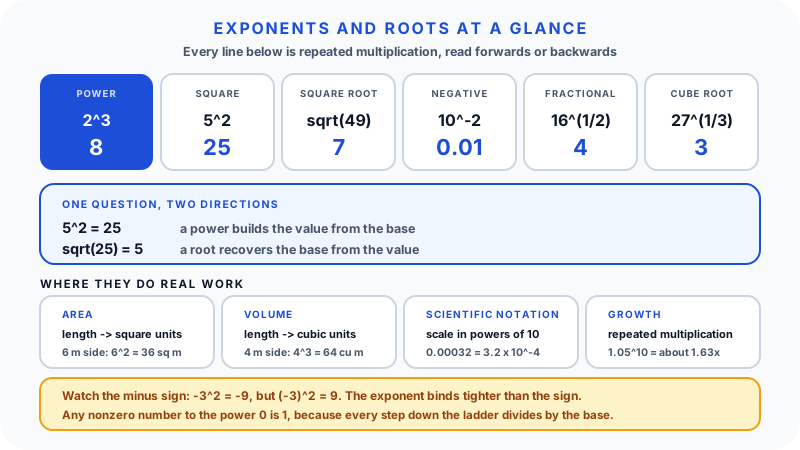
The number 2 does not look dramatic. Double it and you get 4. Double it again and you get 8.
Keep going. After 10 doublings you have 1,024. After 20, more than a million. After 30, more than a billion. Nothing unusual happened at any single step; the same multiplication just kept being applied to a result that kept getting larger.
That is the whole idea behind exponents. They are shorthand for repeated multiplication.
2^3 means 2 x 2 x 2, which is 8. The base is the number being multiplied. The exponent is how many times it appears in the multiplication. The result is called a power of the base.
Once that is settled, the rest of the topic is one idea applied in different directions: what happens when the exponent counts down to zero, what happens when it goes negative, what happens when it is a fraction, and what happens when you run the whole thing backwards with a root.
Use the Exponent Calculator when you want a value quickly. The point of this article is what the value means.
The whole notation on one page
| Expression | Says | Equals |
|---|---|---|
2^3 | 2 x 2 x 2 | 8 |
5^2 | 5 x 5, a square | 25 |
4^3 | 4 x 4 x 4, a cube | 64 |
7^1 | one 7 | 7 |
9^0 | anything to the zero | 1 |
sqrt(49) | what squared gives 49 | 7 |
cube root of 27 | what cubed gives 27 | 3 |
16^(1/2) | the square root of 16 | 4 |
27^(1/3) | the cube root of 27 | 3 |
10^-2 | 1 divided by 10^2 | 0.01 |
2^-3 | 1 divided by 2^3 | 0.125 |
10^6 | 1 followed by six zeros | 1,000,000 |
Everything below explains why those lines are true rather than asking you to remember them.
Squares and cubes are literally shapes
Start with 5^2. It means 5 times 5, and you can draw it: a square grid 5 units wide and 5 units tall. The result, 25, is the area. That is why the second power is called squaring, and why area is measured in square units.
Now 4^3. That is 4 x 4 x 4 = 64, and it is a cube 4 units on every side. The result is the volume, measured in cubic units. Hence cubing.
The exponent is counting dimensions of multiplication. That picture stops working past the third power, and it does not extend naturally to negative or fractional exponents, but it gives the right instinct at the start: powers build size by repeating structure.
Watch what happens as the exponent climbs with a fixed base:
| Expression | Meaning | Result |
|---|---|---|
3^1 | 3 | 3 |
3^2 | 3 x 3 | 9 |
3^3 | 3 x 3 x 3 | 27 |
3^4 | 3 x 3 x 3 x 3 | 81 |
3^5 | 3 x 3 x 3 x 3 x 3 | 243 |
The base never changed. Adding one to the exponent multiplied the result by 3 every time, which is why small changes in an exponent produce large changes in an answer.
Why anything to the power of zero is 1
9^0 = 1 looks like a rule invented to plug a hole. It is easier to accept read downwards.
Going up the list of powers multiplies by the base each step. Going down divides by it:
3^4 = 81
3^3 = 81 / 3 = 27
3^2 = 27 / 3 = 9
3^1 =  9 / 3 = 3
3^0 =  3 / 3 = 1
Zero is just the next step in a pattern that was already running. It also keeps the division rule consistent: 3^2 / 3^2 is obviously 1, and subtracting exponents gives 3^0, so 3^0 has to be 1 for both routes to agree. The one exception is 0^0, which is left undefined in most contexts because the patterns that justify the rule disagree there.
Negative exponents mean reciprocals, not negative answers
A negative exponent does not make the result negative. It moves the power into the denominator.
10^-2 = 1 / 10^2 = 1 / 100 = 0.01
2^-3  = 1 / 2^3  = 1 / 8   = 0.125
5^-2  = 1 / 5^2  = 1 / 25  = 0.04
Continue the countdown from the previous section and it falls out on its own: after 3^0 = 1 comes 3^-1 = 1/3, then 3^-2 = 1/9. The same "divide by the base" step just keeps going.
This is why negative powers turn up wherever quantities are small. Writing 10^-6 instead of 0.000001 keeps the scale visible: the sign of the exponent points to which side of 1 you are on, and the size of the exponent says how far.
Roots run the question backwards
A power asks: what do I get if I multiply this number by itself a set number of times? A root asks the reverse: what number, multiplied by itself that many times, produces this?
7^2 = 49   so   sqrt(49) = 7
3^3 = 27   so   the cube root of 27 = 3
That reversal is exactly how measurement works in practice. If a square patio covers 49 square metres, its side is the square root of 49, so 7 metres. If a cubic tank holds 27 cubic metres, each edge is the cube root of 27, so 3 metres. You know the built result and want the ingredient back.
One detail worth pinning down: every positive number has two square roots, because 7 x 7 and (-7) x (-7) both give 49. The sqrt symbol conventionally means the positive one, which is why sqrt(49) is 7 rather than plus-or-minus 7. Cube roots have no such ambiguity, since the cube root of a negative number is simply negative: (-3)^3 = -27, so the cube root of -27 is -3.
Fractional exponents are roots written another way
Fractional exponents are not a separate topic. They are the same roots in exponent notation.
16^(1/2) = sqrt(16)         = 4
27^(1/3) = cube root of 27  = 3
81^(1/4) = fourth root of 81 = 3
The denominator of the fraction says which root. The numerator says which power to apply as well:
16^(3/2) = (sqrt(16))^3 = 4^3 = 64For positive bases you can do those two steps in either order and get the same answer, though taking the root first usually keeps the numbers small enough to handle mentally.
The reason this notation exists is consistency. Once roots are written as exponents, the ordinary exponent rules cover them too, so sqrt(x) x sqrt(x) becomes x^(1/2) x x^(1/2) = x^1 = x without needing a separate rule for radicals. That single notation is a large part of why scientific and engineering formulas are as compact as they are.
The Scientific Calculator lets you check root notation and fractional exponent notation against each other.
Order of operations, and the minus sign trap
Exponents are evaluated before multiplication and division, which are evaluated before addition and subtraction. Anything in parentheses goes first.
2 + 3 x 4^2  =  2 + 3 x 16  =  2 + 48  =  50
(2 + 3) x 4^2 =  5 x 16      =  80
The most common trap in the whole topic is the minus sign:
-3^2   = -(3 x 3)   = -9
(-3)^2 = (-3) x (-3) = 9
In -3^2 the exponent binds tighter than the minus sign, so you square 3 and then negate the result. In (-3)^2 the parentheses make -3 the base, and multiplying two negatives gives a positive. Most calculators and spreadsheet formulas follow the first convention, so -3^2 returns -9 unless you add the parentheses yourself. When in doubt, write the parentheses; they cost nothing and remove the ambiguity.
The same care applies to a product inside a power. (2 x 5)^3 means three copies of the whole product, which equals 2^3 x 5^3 = 8 x 125 = 1000. Dropping the parentheses changes what is being cubed.
The exponent rules are just bookkeeping
Once exponents are counts of repeated factors, the rules stop needing to be memorised.
| Rule | Why |
|---|---|
2^3 x 2^4 = 2^7 | Three 2s and four more 2s make seven 2s |
2^4 / 2^2 = 2^2 | Two of the 2s cancel top and bottom |
(2^3)^4 = 2^12 | Four copies of a group of three 2s |
(2 x 5)^3 = 2^3 x 5^3 | The exponent applies to everything inside |
2^-3 = 1 / 2^3 | The countdown continues past zero |
The one condition that trips people up: the bases must match. 2^3 x 2^4 collapses to 2^7 because both are counts of the same factor. 2^3 x 5^4 cannot be simplified that way, because there is no single repeated factor to count.
Why exponential growth is not just fast growth
Linear growth adds a fixed amount each step. Exponential growth multiplies by a fixed factor each step. The distinction matters more than the speed.
Two savings jars:
- Jar A gains
$10every day. - Jar B starts at
$1and doubles every day.
| Day | Jar A (adds $10) | Jar B (doubles) |
|---|---|---|
| 5 | $50 | $32 |
| 10 | $100 | $1,024 |
| 15 | $150 | $32,768 |
| 20 | $200 | $1,048,576 |
For the first week the boring jar is ahead, which is precisely why exponential change is so easy to underestimate. Each doubling operates on everything accumulated so far, so the increments themselves grow.
Compound interest is the everyday version. $1,000 growing 5% a year for 10 years is:
1000 x 1.05^10 = about $1,629The growth factor 1.05 is the base; the number of years is the exponent. This is also why a 4% annual rise over ten years is not the same as a single 40% rise: the repeated version compounds on itself and comes to roughly 48%.
The same structure runs in reverse. If something loses half its quantity each period, then after one period half remains, after two a quarter, after three an eighth. Each step takes a fraction of what is left, so the absolute decrease shrinks even as the pattern continues. That is the shape behind half-life, drug clearance from the body, cooling, and depreciation schedules, though in each case the real system has its own complications and limits.
Where powers and roots actually turn up
Area and volume. Doubling the side of a square gives four times the area, because area scales with the square of length. Doubling the side of a cube gives eight times the volume. A tank with all dimensions doubled does not hold twice as much; it holds eight times as much. Asking "is this length, area, or volume?" before calculating prevents a large share of practical mistakes.
Scientific notation. Numbers are written as a coefficient times a power of 10, with the exponent carrying the scale:
4,700,000 = 4.7 x 10^6
0.00032   = 3.2 x 10^-4
The exponent counts how far the decimal point moved, positive for large numbers and negative for small. It is what makes it possible to write the distance to the Sun (about 1.5 x 10^8 km) and the width of a red blood cell (about 7 x 10^-6 m) in the same sentence without counting zeros.
Counting possibilities. Computers store data as two-state switches, so combinations grow as powers of 2. One bit has 2 states, two bits have 2^2 = 4, eight bits have 2^8 = 256, which is why a byte represents 256 distinct values. Adding a single bit doubles the possibilities. The same logic applies to passwords: each extra character multiplies the number of possible combinations by the size of the character set, which is why length affects the count far more than complexity rules do.
Inverse-square relationships. Some quantities spread out over the surface of an expanding sphere, and a sphere's surface area grows with the square of its radius. When that assumption holds, doubling the distance spreads the same amount over four times the area, so the intensity at any point falls to a quarter. Light from a small source in open space and gravitational attraction between two bodies are the standard examples. The caveat matters: real settings rarely match the ideal. Indoor lighting bounces off walls, ceilings, and floors, so measured brightness does not follow the clean inverse-square curve; sources that are large relative to the distance do not behave like points either. Treat it as a model that applies under specific conditions, not a law of everyday rooms.
Common mistakes
Reading 3^4 as 3 x 4. It is 3 x 3 x 3 x 3 = 81, not 12.
Assuming a negative exponent gives a negative answer. 5^-2 is 1/25, which is positive.
Writing -3^2 when you mean (-3)^2. The first is -9, the second is 9.
Adding exponents with different bases. 2^3 x 5^4 does not simplify by adding exponents.
Scaling area or volume as if it were length. Twice as long and twice as wide is four times the area.
Treating exponential growth as steep linear growth. It is multiplicative, so the increments themselves grow.
Applying a percentage change once when it repeats. Ten years of 4% is not 40%.
When logarithms take over
Roots reverse a power when you know the exponent and want the base. Logarithms reverse it when you know the base and want the exponent.
2^x = 32 asks how many 2s multiply together to make 32. The answer is 5, and a logarithm is the tool that finds it: log base 2 of 32 = 5.
So the two unknowns split cleanly. When you are missing the result, use a power. When you are missing the base, use a root. When you are missing the exponent, use a logarithm. The Logarithm Calculator handles the third case, which is what you need for questions like how many years of repeated growth it takes to reach a target.
FAQs
What is an exponent in simple terms?
It is a count of how many times a number is used as a factor in a multiplication. 5^3 means 5 x 5 x 5 = 125.
Why does any number to the power of zero equal 1?
Because each step down the exponent ladder divides by the base: 3^2 = 9, 3^1 = 3, 3^0 = 3 / 3 = 1. It also keeps the division rule consistent, since 3^2 / 3^2 is 1 and subtracting the exponents gives 3^0. 0^0 is the exception and is normally left undefined.
What is the difference between a power and a root?
A power multiplies a number by itself a set number of times. A root asks which number was multiplied to produce a given result. 7^2 = 49, so sqrt(49) = 7.
What does a negative exponent mean?
A reciprocal, not a negative result. 10^-2 is 1 / 10^2 = 0.01, and 2^-3 is 1 / 8 = 0.125.
What does a fractional exponent mean?
A root. The denominator says which root to take: 16^(1/2) = 4 is the square root, and 27^(1/3) = 3 is the cube root. A numerator above 1 adds a power, so 16^(3/2) is the square root of 16 cubed, which is 64.
Why is -3^2 different from (-3)^2?
Exponents are applied before the minus sign, so -3^2 squares 3 and then negates it, giving -9. The parentheses in (-3)^2 make -3 the base, and two negatives multiply to a positive, giving 9.
How are exponents related to scientific notation?
Scientific notation carries the scale of a number in a power of 10. Large numbers use positive exponents, as in 4.7 x 10^6, and small numbers use negative ones, as in 3.2 x 10^-4.
How do logarithms connect to exponents?
A logarithm answers the exponent question in reverse. If 10^3 = 1000, then log base 10 of 1000 = 3. Use powers when the result is unknown and logarithms when the exponent is unknown.
The one idea to keep
Exponents are the grammar of repeated multiplication, and roots are the same sentence read backwards. The zero exponent is where the countdown lands, negative exponents are what happens when it keeps going, and fractional exponents are roots wearing the same notation as everything else. Get the repeated-multiplication picture straight and the rules stop being things to memorise.