
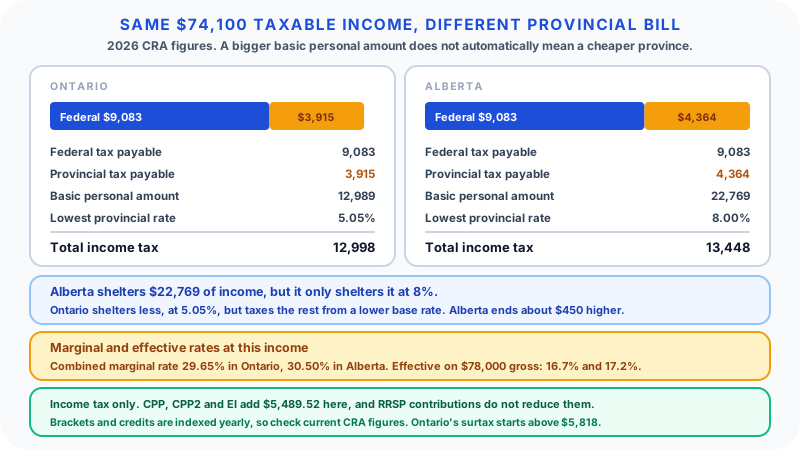
Compare the same job offer in Toronto and Calgary and you will find the take-home figures differ, because a meaningful slice of a Canadian tax bill is set by the province rather than by Ottawa. What surprises people is that the direction of the gap is not fixed. Alberta spent years as the obvious low-tax answer, but Alberta added a new 8% bottom bracket starting in the 2025 tax year, and at a middle income in 2026 an Alberta resident can now owe slightly more provincial tax than an Ontario resident on the same taxable income. The worked example below shows exactly that.
This guide walks through how a Canadian salary becomes a deposited paycheque: federal brackets, provincial brackets, credits, and the payroll deductions sitting next to all of it. For a quick number, the Canada Income Tax Calculator handles the headline federal-plus-provincial calculation; the rest of this article is what that calculation is doing under the hood, plus the pieces the calculator deliberately leaves out.
All figures below are Canada Revenue Agency figures for the 2026 tax year. Brackets and credit amounts are indexed to inflation, so they move every year. Sources are listed at the end.
Federal and provincial: two systems on the same paycheque
Canada has two income tax systems running in parallel on the same employment income.
Federal income tax is set by the Government of Canada and applies the same way everywhere, with the same federal brackets and the same federal credits.
Provincial or territorial income tax is set by each province and territory. Brackets, rates, credits, and surtaxes differ across the country. Quebec runs its own system end to end, including its own return, while the other provinces and territories rely on the CRA to administer provincial income tax alongside federal.
Your gross employment income passes through one calculation that produces federal tax and another that produces provincial tax. The two results are added together, then CPP and EI come off as well, and what remains is your paycheque. That is why two people with identical jobs at identical salaries can take home different amounts.
Federal brackets for 2026
Federal income tax is marginal and progressive. There are five federal brackets:
| Taxable income | Federal rate |
|---|---|
| First $58,523 | 14% |
| $58,523 to $117,045 | 20.5% |
| $117,045 to $181,440 | 26% |
| $181,440 to $258,482 | 29% |
| Over $258,482 | 33% |
Note the bottom rate. It was 15% for years, was reduced to 14% effective 1 July 2025 (which produced a blended 14.5% rate for the 2025 tax year), and is 14% for the whole of 2026. Older guides and older spreadsheets still using 15% will overstate federal tax at every income level, and will also overstate the value of every credit calculated at the lowest rate.
Marginal means the higher rate applies only to the income inside that bracket. The rate that matches your top bracket is your marginal rate, the rate on your next dollar. The average rate across all your income is your effective rate, and it is always lower.
The federal basic personal amount (BPA) is a credit, not a tax-free band. For 2026 the maximum federal BPA is $16,452. It tapers down to $14,829 for high earners, phasing out across the same net income range as the fourth bracket ($181,440 to $258,482). Because it is claimed at the lowest federal rate, the maximum federal BPA is worth $16,452 x 14% = $2,303 off federal tax payable.
Provincial brackets: same idea, different numbers
Every province and territory sets its own brackets, its own basic personal amount, and in some cases a surtax. Two 2026 examples, because they are the pair people most often compare:
| Taxable income | Ontario rate | Taxable income | Alberta rate |
|---|---|---|---|
| First $53,891 | 5.05% | First $61,200 | 8% |
| to $107,785 | 9.15% | to $154,259 | 10% |
| to $150,000 | 11.16% | to $185,111 | 12% |
| to $220,000 | 12.16% | to $246,813 | 13% |
| Over $220,000 | 13.16% | to $370,220 | 14% |
| Over $370,220 | 15% |
Their basic personal amounts differ sharply: $12,989 in Ontario, $22,769 in Alberta for 2026. Alberta shelters far more income but taxes the rest from a higher starting rate. Which structure wins depends on where your income sits, which is the point of the worked example below.
A few structural notes worth carrying:
- Ontario adds a surtax on top of provincial tax payable: 20% of provincial tax above $5,818, plus a further 36% of provincial tax above $7,446. The headline Ontario rates understate the real cost at higher incomes.
- Alberta is no longer the near-flat system it was for much of the 2010s. It now has six brackets, and since the 2025 tax year the first one is 8% rather than 10%.
- Quebec runs an independent system with its own brackets, deductions, credits, and a separate return filed with Revenu Quebec.
- British Columbia, Nova Scotia, and PEI each have their own quirks, and Nova Scotia and PEI also levy surtaxes or health premiums that generic calculators often skip.
The Tax Bracket Calculator shows how much income falls into each band. The Canada Income Tax Calculator handles the combined federal-plus-provincial bill once you choose your province.
Two payroll deductions sitting beside the tax
Canadian paystubs include two non-tax deductions almost everyone sees. These are not income tax, they are separate contributory programs, and for 2026 their maximums are specific and knowable:
Canada Pension Plan (CPP), or the Quebec Pension Plan (QPP) if you work in Quebec. For 2026 the employee rate is 5.95% of pensionable earnings between the $3,500 basic exemption and the $74,600 year's maximum pensionable earnings, capping the base contribution at $4,230.45. Above that there is a second tier, CPP2, at 4% on earnings between $74,600 and the $85,000 additional maximum, capping at $416. An employee earning $85,000 or more therefore pays $4,646.45 in total CPP for the year and not a dollar more.
Employment Insurance (EI) premiums are 1.63% of insurable earnings up to a $68,900 maximum for 2026, capping the employee premium at $1,123.07. Quebec workers pay a reduced EI rate of 1.30%, capping at $895.70, because Quebec runs its own parental insurance plan separately.
So the absolute 2026 ceiling on CPP plus CPP2 plus EI for an employee outside Quebec is $5,769.52. That number matters for a reason people often miss: unlike income tax, these deductions stop growing once you hit the caps, and unlike income tax, they are not reduced by RRSP contributions. An RRSP contribution lowers your income tax and leaves your CPP and EI untouched.
Note that BlinkCalc's Canada Income Tax Calculator reports federal and provincial income tax only. It does not model CPP, EI, surtaxes, or the Quebec abatement, so add those separately when you are building a full take-home figure.
A worked example: $78,000 in Ontario and Alberta
Take the same job in Toronto and Calgary paying $78,000, with a 5% RRSP contribution through payroll and no other adjustments.
Gross income: $78,000 RRSP deduction: $3,900 Taxable income: $74,100
Federal tax, identical in both provinces:
- 14% on the first $58,523 = $8,193
- 20.5% on the remaining $15,577 = $3,193
- Federal tax before credits = $11,387
- Less the federal BPA credit ($16,452 x 14%) = $2,303
- Federal tax payable = $9,083
Ontario provincial tax:
- 5.05% on the first $53,891 = $2,721
- 9.15% on the remaining $20,209 = $1,849
- Provincial tax before credits = $4,571
- Less the Ontario BPA credit ($12,989 x 5.05%) = $656
- Provincial tax payable = $3,915, which is below the $5,818 surtax threshold, so no Ontario surtax applies
- Ontario total income tax = $12,998
Alberta provincial tax:
- 8% on the first $61,200 = $4,896
- 10% on the remaining $12,900 = $1,290
- Provincial tax before credits = $6,186
- Less the Alberta BPA credit ($22,769 x 8%) = $1,822
- Provincial tax payable = $4,364
- Alberta total income tax = $13,448
Alberta costs about $450 a year more than Ontario at this income in 2026. Alberta's much larger basic personal amount shelters $22,769 of income, but it only shelters it at 8%, and every dollar above that is taxed from a higher starting rate than Ontario's 5.05%. The effective rate on the full $78,000 gross is 16.7% in Ontario and 17.2% in Alberta. Combined marginal rates at this point are 29.65% in Ontario (20.5 + 9.15) and 30.5% in Alberta (20.5 + 10).
The comparison flips at higher incomes, where Ontario's surtax and steeper upper bands overtake Alberta. The honest conclusion is not "Alberta is cheaper" or "Ontario is cheaper" but that the ranking depends on the income level, which is why it is worth running your own number rather than relying on a reputation.
CPP and EI are the same in both provinces here: $4,230.45 of CPP, $136.00 of CPP2 on the slice of earnings above $74,600, and $1,123.07 of EI, totalling $5,489.52. The $3,900 RRSP contribution is savings rather than a cost, so it is not lost from your net worth even though it leaves your chequing account.
The Salary Calculator helps when offers are expressed differently (hourly, weekly, annual). The Paycheck Calculator gives the per-paycheque view. Neither replaces the CRA calculation, but both are useful for the back-of-envelope stage of a job decision.
Credits, deductions, and why they are not interchangeable
The Canadian system relies heavily on non-refundable credits at both levels. A credit reduces tax payable by a fixed percentage of the eligible amount, usually the lowest bracket rate.
A deduction reduces taxable income before brackets apply. RRSP contributions are the most familiar example, and they are worth more to higher-bracket filers because they save tax at your marginal rate.
The arithmetic difference is the whole point. A $1,000 deduction at a 40% combined marginal rate saves $400. A $1,000 credit claimed at the 14% federal lowest rate saves $140, regardless of your marginal rate. That is why RRSP room is more valuable to high earners and why credits are more egalitarian by design. If you have seen this comparison written with $150 rather than $140, it predates the drop in the lowest federal rate.
Credits that come up regularly include the Canada workers benefit, the medical expense credit (which applies only above a percentage-of-income threshold), the disability tax credit, the caregiver credit, the charitable donations credit (at a higher rate above the first $200 of annual donations), the first-time home buyers' credit, and assorted provincial credits for rent, property tax, or children.
A common surprise is that some credits are refundable and some are not. A non-refundable credit can reduce tax payable to zero but no further. A refundable credit can produce a payment even if you owed no tax. The Canada workers benefit, the GST/HST credit, and several provincial low-income credits are refundable.
Common mistakes
Treating the federal marginal rate as the whole marginal rate. Federal alone undersells your real marginal rate by the provincial portion. Stack them before deciding whether a bonus or side income is worth it.
Trusting a province's reputation instead of its current brackets. Alberta's 2025 addition of an 8% bottom bracket changed the middle-income comparison. Provincial tax policy moves, and it moves independently in thirteen places.
Forgetting surtaxes. Ontario's 20% and 36% surtaxes sit on top of provincial tax payable. Nova Scotia and PEI have their own additions. The headline provincial rate is not the full picture.
Assuming CPP and EI behave like income tax. They cap out at annual maximums, and RRSP contributions do not reduce them.
Treating Quebec as just another province. Quebec administers its own income tax in parallel with the CRA, and Quebec residents file two returns.
Comparing take-home across provinces without comparing what the money buys. Childcare, tuition, transit, and insurance costs differ widely. The useful comparison is total household cost, not tax alone.
A few realistic scenarios
A new graduate earning $52,000 in Halifax with no RRSP contributions sits entirely within the lowest federal bracket and Nova Scotia's lower bands, so the federal BPA and provincial BPA do a lot of proportional work at that income. Carried-forward tuition credits can reduce provincial tax payable substantially in the first working years.
A two-earner household in Vancouver earning $95,000 each faces a combined federal-plus-provincial marginal rate in the low 30s on additional income, because each earner has individually filled the lower bands. Spousal RRSP planning matters more here than in a single-earner household at the same total income.
A Quebec resident earning $110,000 pays Quebec provincial tax under Quebec's own brackets, which start at 14% and reach 25.75%, and pays federal tax reduced by the 16.5% Quebec abatement in exchange for Quebec running programs the federal government runs elsewhere. Generic Canadian calculators that omit the abatement will overstate a Quebec resident's federal tax by a sixth, so use Quebec-specific tools or the Revenu Quebec figures directly.
FAQs
Why do two people with the same salary in Canada take home different amounts? The federal portion is identical nationwide, but each province and territory sets its own brackets, rates, basic personal amount, and surtaxes, so the provincial half of the bill differs.
Are federal and provincial brackets the same? No. They are independent. Both apply to the same taxable income but produce two separate amounts that are added together.
What is the difference between a deduction and a credit in Canada? A deduction reduces taxable income before brackets apply, so it saves tax at your marginal rate. A non-refundable credit reduces tax payable at a fixed percentage, usually the lowest bracket rate, and can take tax to zero but no further. A refundable credit can pay out even if you owed nothing.
How do CPP and EI fit into my take-home? They are separate from income tax, with their own rates and annual caps. For 2026 an employee outside Quebec pays at most $4,230.45 of CPP, $416 of CPP2, and $1,123.07 of EI, so $5,769.52 in total. RRSP contributions do not reduce them.
Does moving provinces change my tax for the whole year? Provincial tax is generally based on your province of residence on 31 December, so a mid-year move usually means the full year is calculated under the rules of the province you finish the year in.
How does Quebec differ from the rest of Canada? Quebec administers its own provincial income tax in parallel with the federal system, so residents file both a federal return and a Quebec return. A 16.5% federal abatement reduces federal tax payable to offset the larger Quebec provincial bill.
Is Alberta always cheaper than Ontario for income tax? No. At a taxable income of $74,100 in 2026, Alberta's provincial tax is roughly $450 higher than Ontario's, because Alberta's bottom rate of 8% exceeds Ontario's 5.05% by more than Alberta's larger basic personal amount makes back. Ontario becomes the more expensive of the two at higher incomes, where its surtax applies.
Sources
- Canada's tax rates and income brackets for individuals, current year - Canada Revenue Agency. Source for all 2026 federal bracket thresholds and rates, and for the 2026 Ontario and Alberta provincial brackets quoted above.
- Payroll Deductions Tables, CPP, EI, and income tax deductions - Canada Revenue Agency, T4032 for 2026. Source for the maximum federal basic personal amount of $16,452 and the minimum of $14,829.
- Payroll Deductions Tables for Ontario, general information - Canada Revenue Agency. Source for the 2026 Ontario surtax thresholds of $5,818 and $7,446 at 20% and 36%, and the Ontario basic personal amount of $12,989.
- CPP contribution rates, maximums and exemptions - Canada Revenue Agency. Source for the 2026 employee CPP rate of 5.95%, the $74,600 maximum pensionable earnings, the $3,500 basic exemption, and the $4,230.45 maximum employee contribution.
- Second additional CPP (CPP2) contribution rates and maximums - Canada Revenue Agency. Source for the 2026 CPP2 rate of 4%, the $85,000 additional maximum pensionable earnings, and the $416 maximum employee contribution.
- EI premium rates and maximums - Canada Revenue Agency. Source for the 2026 EI employee rate of 1.63%, the $68,900 maximum insurable earnings, the $1,123.07 maximum premium, and the reduced Quebec rate of 1.30%.
- Revenu Quebec: income tax rates - Revenu Quebec. Authoritative source for Quebec's own brackets, which run from 14% to 25.75%, and for Quebec-specific credits the federal tables do not cover.
Related guides
This article is educational and uses 2026 figures. Canadian tax rules change every year at both the federal and provincial level. Personal situations, especially Quebec-specific rules, equity compensation, self-employment, and capital gains, can change the result. The CRA and Revenu Quebec are the authoritative sources. For decisions, consult a qualified Canadian tax professional.