
The first time you compare an offer letter ($85,000) to a real paycheck ($2,580 every two weeks), the math feels off. Twenty-six pay periods at $2,580 is $67,080. Where did the other $17,920 go?
The short answer: federal income tax, two payroll taxes, state income tax in most states, and any pre-tax deductions you opted into. The longer answer is what this guide covers. It is not a filing guide. It explains how a salary turns into a take-home number, and why two people earning the same gross pay can end the year owing very different amounts.
All federal figures below are for the 2026 tax year, meaning income earned from January to December 2026 and reported on returns filed in 2027. They come from the IRS and the Social Security Administration and are listed in the Sources section.
If you want to skip the explanation and see a number, the US Income Tax Calculator gives an estimate based on your filing status and income. For the paycheck-by-paycheck view, the Paycheck Calculator mirrors what shows up on a pay stub.
Gross, taxable, and net are three different numbers
Three terms get used interchangeably and shouldn't be.
Gross income is what your offer letter says: total compensation before anything is taken out.
Taxable income is what remains after pre-tax payroll deductions, any adjustments you qualify for, and either the standard deduction or your itemized deductions. The federal brackets apply to this number, not to your gross.
Net income (take-home pay) is what reaches your bank account after federal income tax, Social Security, Medicare, any state and local income tax, and any after-tax deductions such as Roth 401(k) contributions.
The chain runs like this: gross pay, minus pre-tax deductions, minus the standard or itemized deduction, gives taxable income. The brackets turn taxable income into federal tax. Payroll taxes and state tax run on their own tracks alongside it. Whatever is left is net pay.
Pre-tax deductions come out first
Some money leaves your pay before federal income tax is even calculated, and it is worth knowing which taxes each item actually reduces.
- Traditional 401(k) or 403(b) contributions reduce the wages subject to federal income tax. They do not reduce Social Security or Medicare tax.
- Health, dental, and vision premiums paid through an employer cafeteria plan, and HSA contributions made through payroll, generally reduce both federal income tax and Social Security and Medicare tax.
- Roth 401(k) contributions are made with after-tax money, so they reduce take-home pay without reducing current tax.
That difference is why a pay stub can show one "federal taxable wages" figure and a different, larger "Social Security wages" figure.
Separately, a few adjustments to income are claimed on the tax return rather than through payroll, such as deductible traditional IRA contributions, HSA contributions you make directly, and half of self-employment tax. They reduce taxable income in the same way, but you usually see the benefit when you file rather than in each paycheck.
The standard deduction does most of the work
Most filers do not itemize. They take the standard deduction, a flat amount subtracted before the brackets apply. For 2026 it is:
| Filing status | 2026 standard deduction |
|---|---|
| Single or married filing separately | $16,100 |
| Married filing jointly | $32,200 |
| Head of household | $24,150 |
If you are single with $68,400 of federal taxable wages, you don't pay federal income tax on the full $68,400. You subtract $16,100 first, and the brackets apply to the remaining $52,300.
Itemizing means claiming the actual total of deductions such as mortgage interest, state and local taxes (subject to a cap), charitable gifts, and medical expenses above a threshold. It only helps when those items add up to more than your standard deduction. With the standard deduction at its current level, most renters and many homeowners come out ahead without itemizing.
Newer deductions you can claim without itemizing
The One, Big, Beautiful Bill Act, signed in July 2025, added several temporary deductions for tax years 2025 through 2028. The IRS says they are available whether or not you itemize:
- Qualified tips: up to $25,000.
- Qualified overtime: up to $12,500 ($25,000 for joint filers), covering only the premium portion of overtime pay above your regular rate, such as the extra "half" in time-and-a-half.
- Age 65 and older: an additional $6,000 per eligible person.
- Qualified passenger vehicle loan interest: up to $10,000.
Each one has eligibility rules and phases out at higher incomes: from $150,000 of modified adjusted gross income ($300,000 joint) for tips and overtime, $75,000 ($150,000 joint) for the senior deduction, and $100,000 ($200,000 joint) for car loan interest. They reduce federal income tax only. Tips and overtime are still wages for Social Security and Medicare purposes.
How marginal brackets actually work
This is the part that trips most people up.
US federal income tax is progressive and marginal. There are seven rates: 10%, 12%, 22%, 24%, 32%, 35%, and 37%. The 2025 legislation kept that seven-rate structure, and the dollar thresholds are adjusted for inflation each year. For 2026:
| Rate | Single filers, taxable income | Married filing jointly, taxable income |
|---|---|---|
| 10% | Up to $12,400 | Up to $24,800 |
| 12% | $12,401 to $50,400 | $24,801 to $100,800 |
| 22% | $50,401 to $105,700 | $100,801 to $211,400 |
| 24% | $105,701 to $201,775 | $211,401 to $403,550 |
| 32% | $201,776 to $256,225 | $403,551 to $512,450 |
| 35% | $256,226 to $640,600 | $512,451 to $768,700 |
| 37% | Over $640,600 | Over $768,700 |
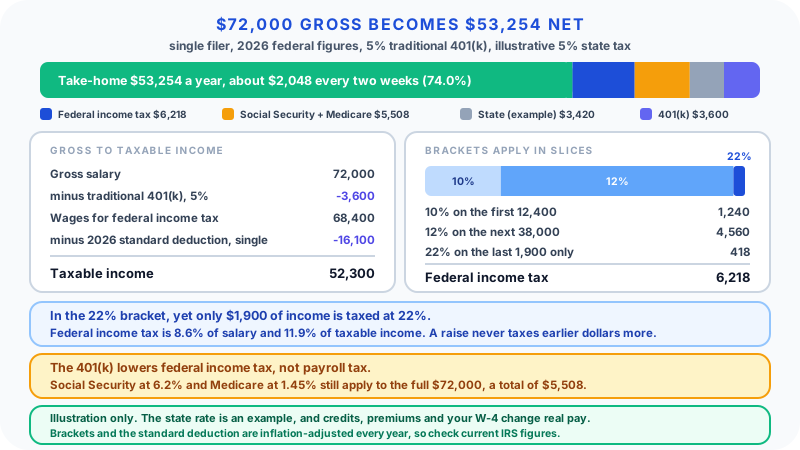
"Marginal" means each rate applies only to the slice of income inside its bracket. A single filer with $52,300 of taxable income pays:
- 10% on the first $12,400 = $1,240
- 12% on the next $38,000 (from $12,400 to $50,400) = $4,560
- 22% on the last $1,900 (from $50,400 to $52,300) = $418
- Total federal income tax = $6,218
That person is "in the 22% bracket", yet only $1,900 of their income was taxed at 22%. Moving into a higher bracket never makes your whole income more expensive. Only the dollars above the threshold are taxed at the higher rate.
The Tax Bracket Calculator shows which brackets a given taxable income touches and how much falls into each. It is a useful sanity check before any conversation about a raise or side income.
Marginal versus effective rate
Two numbers describe how much tax you pay, and they tell different stories.
The marginal rate is the rate on your next dollar of taxable income. It matters when you are weighing a raise, a bonus, or extra hours.
The effective rate is your total federal income tax divided by your income. Sources differ on whether they divide by taxable income or by gross income, so check which one a figure uses. In the example above, $6,218 is about 11.9% of $52,300 of taxable income, or about 8.6% of a $72,000 salary. The marginal rate is 22%.
For most middle-income households, the effective rate sits well below the marginal rate. A single filer with $90,000 of taxable income in 2026 is in the 22% bracket but pays about $14,512, an effective rate of roughly 16%, because the 10% and 12% brackets cover the first $50,400.
Payroll taxes run on a separate track
Two payroll taxes also come out of each paycheck, together known as FICA.
Social Security tax is 6.2% of wages, up to an annual wage base. For 2026 the wage base is $184,500. Once your year-to-date wages pass that figure, Social Security tax stops for the rest of the year. If you have two employers in the same year, each one withholds up to the cap separately, and any excess is credited back when you file.
Medicare tax is 1.45% of all wages, with no cap. An Additional Medicare Tax of 0.9% applies to wages above $200,000 for single filers, $250,000 for married couples filing jointly, and $125,000 for married filing separately. Your employer starts withholding it once your wages from that job pass $200,000 in the year, regardless of filing status, and the final amount is settled on your return.
Your employer pays a matching 6.2% and 1.45% that never appears on your stub. If you are self-employed, you pay both halves yourself as self-employment tax, and you can deduct half of it as an adjustment to income.
Most states also levy their own income tax, and several do not. That alone can move take-home pay by thousands of dollars between two people with identical salaries. State rules differ in what they allow as deductions, so this guide uses only a simple illustrative state rate.
A worked paycheck example
Take a single filer earning $72,000 a year in 2026, contributing 5% of pay to a traditional 401(k), taking the standard deduction, with no other adjustments or credits. To keep the example general, assume a flat 5% state income tax applied to the same $68,400. That state rate is an illustration, not any particular state's rule.
| Step | Amount |
|---|---|
| Gross salary | $72,000 |
| Traditional 401(k), 5% | minus $3,600 |
| Wages subject to federal income tax | $68,400 |
| 2026 standard deduction (single) | minus $16,100 |
| Taxable income | $52,300 |
| Federal income tax (bracket math above) | $6,218 |
| Social Security, 6.2% of $72,000 | $4,464 |
| Medicare, 1.45% of $72,000 | $1,044 |
| Illustrative state tax, 5% of $68,400 | $3,420 |
Estimated annual take-home: $72,000 minus $3,600, $6,218, $4,464, $1,044, and $3,420 leaves $53,254, or about $2,048 every two weeks across 26 paychecks.
Notice that the 401(k) contribution lowered federal taxable income but not Social Security or Medicare, which are still calculated on the full $72,000. Also notice that $3,600 of the "missing" money is not gone; it is sitting in a retirement account.
Real paychecks will differ. Health premiums, a different state, local taxes, credits, and the way your W-4 is completed all change the per-paycheck figure. The point is the structure, which stays the same.
The US Income Tax Calculator handles the federal piece. The Paycheck Calculator gives a per-paycheck breakdown with FICA and a simplified state estimate. The Salary Calculator helps when you are comparing offers or converting between hourly, weekly, and annual figures before any tax calculation.
Withholding versus your actual tax
A surprise at filing time, whether a big refund or an unexpected bill, usually comes from a mismatch between what your employer withheld and what your return calculates.
Your employer estimates withholding from the Form W-4 you completed and the IRS withholding tables. It is an estimate. A side business, a second job, a working spouse, investment income, or a major life change can make it too high or too low. A large refund means you over-withheld during the year. A bill means you under-withheld, and if the shortfall is large enough the IRS can charge an underpayment penalty.
The W-4 no longer uses "allowances". It asks directly about multiple jobs, dependents, other income, and deductions. The IRS Tax Withholding Estimator walks through the same questions and suggests what to enter. Revisiting it after a job change, marriage, divorce, a new child, a large raise, or new side income prevents most surprises. If you expect to claim one of the newer deductions, the estimator can also help you decide whether to adjust withholding rather than waiting for a refund.
What a calculator can and cannot do
A general income tax calculator is good at estimating federal tax on straightforward W-2 wages. It is much less reliable for:
- Multiple jobs, each with its own withholding
- Significant self-employment or 1099 income
- Equity compensation such as RSUs, ISOs, and NSOs
- Capital gains and qualified dividends, which use their own rate schedule
- Itemized deductions and the newer tips, overtime, senior, and car loan deductions, each with its own eligibility rules
- Tax credits such as the Child Tax Credit, the Earned Income Tax Credit, education credits, and the Saver's Credit
- Alternative Minimum Tax, which mainly affects some higher-income or equity-heavy situations
- State and local income tax detail
In those cases a calculator gives a starting estimate at best. Tax software or a qualified tax professional is the right next step.
Common mistakes
Confusing the bracket with the rate. Being "in the 24% bracket" does not mean 24% of your income went to federal tax. The effective rate is almost always lower.
Fearing a raise will push you into a worse position. A higher bracket applies only to the income above the threshold. Your take-home pay still rises, although some means-tested credits and deductions can phase out as income grows.
Treating pre-tax contributions as free money. A traditional 401(k) reduces taxable income today, but withdrawals are taxed later. Roth contributions use after-tax money, and qualified withdrawals are tax-free. They are trade-offs, not freebies.
Assuming a bonus is taxed at a higher rate. Employers often withhold federal tax on bonuses and commissions at a flat supplemental rate of 22%, which can look high. Your actual liability is worked out on your total income for the year. Too much withholding comes back as a refund; too little shows up as a balance due.
Forgetting state tax. Two people with the same gross income can take home thousands of dollars apart depending on their state.
Using last year's numbers. The standard deduction, bracket thresholds, and Social Security wage base change every year. An old calculator or an old article can quietly understate your deduction or misplace a bracket.
Treating a calculator as a tax return. A calculator estimates. The return reconciles everything, including credits, deductions, and investment income. Use one to plan and the other to file.
Practical scenarios
These are simplified illustrations using 2026 federal figures, the standard deduction, and no other adjustments. Real outcomes depend on individual circumstances.
A recent graduate earning $48,000, single, with no retirement contributions. Taxable income is $31,900 and federal income tax comes to about $3,580. Social Security and Medicare take $3,672. At this income, payroll taxes are roughly as large as federal income tax, and the federal effective rate is about 7.5% of gross.
A married couple earning $185,000 combined with two qualifying children. Taxable income is $152,800, and bracket math gives about $23,040 of federal income tax. The Child Tax Credit, worth up to $2,200 per qualifying child and fully available below $400,000 of income for joint filers, reduces that by $4,400 to about $18,640. That is roughly 10% of gross income. Credits change the picture more than people expect.
A single high earner with $240,000 of salary plus $40,000 of vested RSUs. RSUs are generally taxed as ordinary wages when they vest, so they stack on top of salary in the brackets. Total wages of $280,000 also pass both the $184,500 Social Security wage base and the $200,000 Additional Medicare Tax threshold. Default withholding on RSU income is often too low for someone at this level, so an estimate based only on salary will undershoot.
FAQs
Why is my paycheck smaller than my salary divided by twelve? Federal income tax, Social Security and Medicare, state income tax in most states, and any pre-tax or after-tax deductions you signed up for. Also check how often you are paid: 26 biweekly paychecks divide an annual salary differently from 12 monthly ones.
Does being in the 24% bracket mean I pay 24% on everything? No. Brackets are marginal. Only taxable income above the 24% threshold is taxed at 24%. The lower brackets still apply to the lower slices of income.
What is the difference between a deduction and a tax credit? A deduction reduces taxable income, so it saves tax at your marginal rate. A $1,000 deduction saves $220 for someone in the 22% bracket. A credit reduces tax owed dollar for dollar, so a $1,000 credit saves $1,000.
Are payroll taxes the same as federal income tax? No. Social Security and Medicare taxes are separate from federal income tax. Both come out of the paycheck, but they fund different programs and follow different rules, including a wage cap for Social Security.
Do the new tips and overtime deductions lower my payroll taxes? No. They are federal income tax deductions for 2025 through 2028, available whether or not you itemize, and they phase out at higher incomes. Tips and overtime pay are still subject to Social Security and Medicare tax.
Why is my withholding different from my final tax bill? Withholding is an estimate based on your W-4 and the IRS tables. The final bill is what your return calculates. The IRS Tax Withholding Estimator can help keep the two close after income or life changes.
Should I itemize or take the standard deduction? Whichever is larger. Most filers come out ahead with the standard deduction. People with large mortgage interest, significant state and local taxes, substantial charitable giving, or major medical expenses are the most likely to benefit from itemizing.
Sources
- IRS releases tax inflation adjustments for tax year 2026, including amendments from the One, Big, Beautiful Bill - IRS news release IR-2025-103, 9 October 2025. Source for the 2026 standard deduction amounts and all 2026 bracket thresholds for single and joint filers.
- New and enhanced deductions for individuals - IRS. Source for the maximum tips, overtime, senior, and vehicle loan interest deductions and their availability to non-itemizers.
- Working Families Tax Cuts: Tax deductions for working Americans and seniors - IRS. Source for the 2025 to 2028 effective years, the income phase-out starting points, and the premium-only treatment of overtime.
- Contribution and Benefit Base - Social Security Administration. Source for the 2026 Social Security wage base of $184,500.
- Topic no. 560, Additional Medicare Tax - IRS. Source for the 0.9% rate, the thresholds by filing status, and the employer withholding rule at $200,000.
- Child Tax Credit - IRS. Source for the credit of up to $2,200 per qualifying child and the $200,000 and $400,000 income limits for the full credit.
- Tax Withholding Estimator - IRS. The official tool for checking whether your W-4 withholding matches your expected tax.
Figures were checked against IRS and SSA pages in September 2026. Federal thresholds are updated every year, usually in the autumn for the following tax year, so confirm current numbers before relying on them. All worked examples are BlinkCalc illustrations, not predictions of any individual's tax bill.
Related guides
- UK Income Tax Explained: PAYE, National Insurance, and Real Take-Home Pay
- Canada Income Tax Explained: Federal, Provincial, and Take-Home Pay Basics
- India Income Tax Explained: Old Regime vs New Regime in Simple Terms
This article is educational. Tax law and bracket thresholds change every year, and individual situations vary widely by state, filing status, deductions, credits, and income type. The IRS website is the authoritative source for current federal rules. For decisions about your own taxes, talk to a qualified tax professional.