
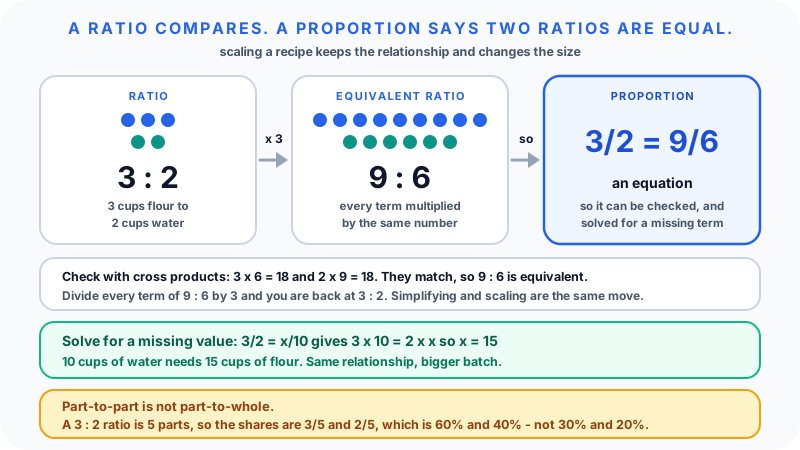
The two words get used interchangeably and they are not the same thing.
A ratio is a comparison. It is a description of how two or more quantities relate in size: 3 to 2, 1 to 50,000, 16 to 9. On its own it is neither true nor false, in the same way that the number 7 is neither true nor false.
A proportion is a statement that two ratios are equal. It is a claim, an equation, and it can be checked. "3 to 2 is the same relationship as 15 to 10" is a proportion, and it happens to be true. "3 to 2 is the same relationship as 15 to 12" is also a proportion, and it is false.
That difference is the whole reason proportions are useful. Because a proportion is an equation, you can leave one value unknown and solve for it. That single move handles recipe scaling, map distances, dilutions, exchange rates, image resizing and unit conversions.
The Short Version
- A ratio compares quantities:
3 : 2,3/2, or 1.5. - A proportion is an equation between two ratios:
a/b = c/d. - Two ratios are equivalent when their cross products match:
a x d = b x c. - Simplify by dividing every term by the greatest common factor. Scale by multiplying every term by the same number.
- A unit rate is a ratio rewritten with a denominator of 1, which is what makes unlike things comparable.
- Proportional reasoning assumes a constant ratio. Plenty of real quantities do not have one.
What a Ratio Is
A ratio expresses relative size. Four notations are common, and they carry slightly different tones:
| Notation | Example | Typical use |
|---|---|---|
| Colon | 3 : 2 | Recipes, mixes, plans, odds |
| Fraction | 3/2 | Algebra and calculation |
| Decimal | 1.5 | Direct comparison of two ratios |
| Percentage | 150% | Reporting and finance |
A shelter with cats and dogs in a 3 : 2 ratio has three cats for every two dogs. The actual counts might be 6 and 4, 15 and 10, or 60 and 40. Every one of those is the same ratio, described at a different scale.
Ratios are not limited to two terms. A concrete mix of 4 : 3 : 2 sand to gravel to cement follows exactly the same rules, and so does a 60 : 30 : 10 portfolio split.
One thing a ratio deliberately throws away is the absolute size. 3 : 2 tells you nothing about whether the shelter holds five animals or five hundred. That is a feature when you want to compare relationships and a problem when someone quotes a ratio to imply a scale it does not contain.
Simplifying and Scaling
Simplify by dividing every term by the greatest common factor of all of them:
12 : 18divided by 6 gives2 : 315 : 25 : 35divided by 5 gives3 : 5 : 70.6 : 0.4multiplied by 10 gives6 : 4, then divided by 2 gives3 : 2
Scale by multiplying every term by the same number. 2 : 3 becomes 8 : 12 at a factor of 4.
The rule underneath both is the same one: whatever you do, do it to every term. Multiplying one side of a ratio and not the other produces a different ratio, which is exactly the mistake that ruins a doubled recipe when someone doubles the flour and forgets the water.
Ratios produced this way are equivalent ratios. 2 : 3, 4 : 6, 8 : 12 and 200 : 300 all describe the same relationship, and each one converts to the same decimal, 0.667.
What a Proportion Is
A proportion sets two ratios equal:
a / b = c / d, also written a : b = c : d
To test whether a given pair of ratios really is a proportion, compare the cross products:
- Is
3 : 4equivalent to9 : 12? Cross products: 3 x 12 = 36 and 4 x 9 = 36. Equal, so yes. - Is
3 : 4equivalent to9 : 16? Cross products: 3 x 16 = 48 and 4 x 9 = 36. Not equal, so no.
Cross multiplication is not a trick. Starting from a/b = c/d and multiplying both sides by b x d gives a x d = b x c, because the b cancels on the left and the d cancels on the right. It is ordinary algebra, packaged so you do not have to redo it each time.
Solving Proportions Two Ways
Find the missing value in 3/4 = x/20.
Method 1: cross multiplication.
- 3 x 20 = 4 x x
- 60 = 4*x*
- x = 15
Method 2: find the scale factor. Look for the multiplier that turns one known pair into the other. Here 4 becomes 20, so the factor is 5. Apply it to the other term: 3 x 5 = 15.
Both give 3 : 4 = 15 : 20, and both ratios equal 0.75.
Cross multiplication always works. The scale factor method is faster when the factor is a clean number and it makes the answer easier to sanity-check, because you can see the relationship rather than just the arithmetic.
A worded example. Six cups of flour make 24 cookies. How many cups for 60 cookies?
- Set it up keeping like with like:
6/24 = x/60 - Cross multiply: 6 x 60 = 24 x x*, so *x = 360 / 24 = 15 cups
- Or by scale factor: 60 / 24 = 2.5, and 6 x 2.5 = 15 cups
The one setup rule that prevents most errors: keep the same quantity on the same side of both fractions. Cups over cookies on the left means cups over cookies on the right. Cups over cookies equalling cookies over cups is the single most common way a proportion comes out inverted.
Unit Rates
A unit rate is a ratio rewritten so the second term is 1. It is the most practically useful form of a ratio, because it turns a comparison into a single number you can put beside another single number.
- 240 km in 3 hours is
240 : 3, or 80 km per hour - 12 dollars for 4 kg is
12 : 4, or 3 dollars per kg - 500 words in 20 minutes is 25 words per minute
The reason this matters at the supermarket: package sizes are chosen to be hard to compare.
A 750 g box costs 4.50. A 400 g box costs 2.60. Which is better value?
Per 100 g: 4.50 / 7.5 = 0.60 and 2.60 / 4 = 0.65.
The large box is cheaper per unit, by about 8 percent.
Note that you do not have to reduce to a single unit; any common base works. Per 100 g is easier to read than per gram, and comparing per-gram or per-100 g gives the same ranking. Choose the base that keeps the numbers legible.
Unit rates are also how conversion factors work. "1 inch per 2.54 cm" is a unit rate, and multiplying by it is a proportion solved in advance.
Part-to-Part and Part-to-Whole
This distinction causes more wrong answers than the algebra does.
A 3 : 2 ratio of cats to dogs is part-to-part. It compares one group with another. The total is 3 + 2 = 5 parts.
The corresponding part-to-whole figures are 3/5 cats and 2/5 dogs, which is 60 percent and 40 percent.
So when a question says "the ratio of red to blue is 3 to 2 in a bag of 20 balls", the 20 refers to the whole, and you need the part-to-whole form:
- Red: 3/5 x 20 = 12
- Blue: 2/5 x 20 = 8
Answering 3/2 x 20 or reading 3 : 2 as 30 percent and 20 percent are both versions of the same mistake.
The same trap appears in odds. Odds of 3 : 1 against mean three losing outcomes to one winning outcome, which is a probability of 1/4, not 1/3. Odds are part-to-part; probability is part-to-whole.
And it appears in dilutions. A 1 : 4 dilution is one part concentrate to four parts water, five parts in total. For 250 mL of finished solution that is 50 mL concentrate and 200 mL water, not 62.5 mL and 187.5 mL.
Direct and Inverse Proportion
Direct proportion means the ratio between two quantities stays constant. As one goes up, so does the other, at the same rate.
y = kx, where k is the constant of proportionality.
Hours worked and pay at a fixed hourly rate. Ingredient quantities in a recipe. Distance on a map and distance on the ground. Double the input, double the output.
Inverse proportion means the product stays constant. As one goes up, the other goes down.
xy = k, or y = k/x
Speed and journey time over a fixed distance. Workers and hours for a fixed job. Pressure and volume of a gas at constant temperature.
Four workers build a wall in 12 hours. How long for six workers, assuming the same productivity?
The job is fixed at 4 x 12 = 48 worker-hours.
6 x t* = 48, so *t = 8 hours.
Setting this one up as a direct proportion, 4/12 = 6/t, gives 18 hours, which says more workers take longer. The absurdity of the answer is the check: decide before you solve whether the answer should be larger or smaller than what you started with.
Worked Examples
Recipe scaling. A recipe for 4 servings uses 1 cup of rice. For 6 servings: 1/4 = x/6, so x = 1.5 cups. The Cooking Measurement Conversions guide covers the unit side of the same problem.
Map scale. On a 1 : 50,000 map, 4 cm represents 1/50,000 = 4/x, so x = 200,000 cm = 2 km. Scale ratios are unitless, so the same number works for centimetres, inches or anything else, as long as both sides use the same unit.
Image resizing. A photo is 1200 x 800 pixels, a 3 : 2 aspect ratio. Displayed 600 pixels wide, the height must satisfy 1200/800 = 600/x, giving x = 400 pixels. Any other height distorts it.
Currency. At 0.92 euros per dollar, 1,250 dollars gives 1/0.92 = 1250/x, so x = 1,150 euros. That is a unit rate applied at scale, which is all a currency conversion is.
Paint mixing. A colour needs yellow, blue and red in 5 : 3 : 2. That is 10 parts. For 3 litres, one part is 0.3 L, so: 1.5 L yellow, 0.9 L blue, 0.6 L red.
Group splitting. Split 27 students 2 : 1 into advanced and beginner. Three parts, so one part is 9: 18 advanced, 9 beginner.
Financial ratios. A debt-to-equity ratio of 0.6 means 60 cents of debt per dollar of equity. A company with 5 million in equity carries 3 million in debt at that ratio.
When Proportional Reasoning Breaks Down
Proportions assume the ratio holds at every scale. Often it does not, and applying one anyway produces confidently wrong answers.
Areas and volumes do not scale with length. Multiply every linear dimension by k* and area is multiplied by *k squared, volume by k cubed. A model at 1 : 50 scale has 1/2,500 of the surface area and 1/125,000 of the volume. Doubling the width of a pizza roughly quadruples how much pizza there is.
Time is often not proportional to quantity. A cake for eight does not bake in twice the time of a cake for four, because heat has to travel through a thicker mass. Cooking scales the ingredients proportionally and the times not at all.
Fixed costs break the line. If a job costs a 50 call-out fee plus 20 per hour, the total is not proportional to hours. Two hours costs 90, four hours costs 130, which is not double. Test for proportionality by checking that zero input gives zero output.
Biology and dosing. Body weight, surface area and metabolic rate do not scale together, which is why medical dosing follows published rules rather than simple ratios.
People do not add linearly. Six workers may not finish in two thirds of the time four would take, once coordination, equipment and workspace are accounted for. The worker-hours model is an idealisation.
The quick test: does the relationship pass through zero, and does doubling one side genuinely double the other? If either answer is no, a proportion is the wrong tool.
Mistakes to Watch For
Reversing the order. 3 : 2 and 2 : 3 describe opposite relationships. Write down which quantity comes first before you start.
Mixing units. 1 hour : 30 minutes is not 1 : 30. Convert first: 60 min to 30 min is 2 : 1.
Cross multiplying a single ratio. Cross multiplication needs two ratios set equal. There is nothing to cross with one ratio on its own.
Reading a ratio as a total. 3 : 2 does not mean five of something. It means five parts, whose size depends on the actual total.
Adding ratios together. If one class has a 3 : 2 boy-to-girl ratio and another has 1 : 1, the combined ratio is not 4 : 3. You need the actual headcounts, because the classes may be different sizes.
Leaving it unsimplified. 12 : 18 is not wrong, but 2 : 3 is what you should communicate.
FAQ
What is the difference between a ratio and a proportion? A ratio compares quantities, such as 3 : 2. A proportion is an equation stating that two ratios are equal, such as 3/2 = 15/10. A ratio just describes; a proportion makes a claim that can be true or false, which is what lets you solve for a missing value.
How do you write a ratio in simplest form? Divide every term by the greatest common factor of all terms. 12 : 18 divided by 6 gives 2 : 3. For decimals, multiply every term by a power of ten first to clear them.
What is cross multiplication? For a proportion a/b = c/d, cross multiplication gives a x d = b x c. It comes from multiplying both sides by b x d, and it is the standard way to solve for an unknown term.
What is a unit rate? A ratio rewritten so the second quantity is 1: 80 km per hour, 3 dollars per kg, 25 words per minute. It is the form that makes two options directly comparable, which is why unit pricing exists on supermarket shelf labels.
Are ratios the same as fractions? They share the arithmetic but not the meaning. A fraction usually expresses a part of a whole, while a ratio usually compares two separate parts. A 3 : 2 ratio of cats to dogs is not 3/2 of anything; the fraction that matches it is 3/5 of the animals being cats.
Can a ratio have more than two terms? Yes. 4 : 3 : 2 for a concrete mix or 60 : 30 : 10 for a portfolio work identically: simplify by the common factor, scale by multiplying every term, and find part-to-whole shares by dividing each term by the sum.
How do I know whether to use direct or inverse proportion? Ask what stays constant. If the ratio between the two quantities stays fixed, it is direct. If the product stays fixed, so that more of one means less of the other, it is inverse. Then check that your answer moves in the direction you expected.
Related Tools
The Ratio Calculator simplifies ratios, scales them, and solves proportions for a missing term. The Fraction Calculator handles the fraction form directly, and the Percentage Calculator converts part-to-whole shares into percentages when that is the clearer way to report them.
Related Articles
Final Thoughts
Almost every ratio problem comes down to four habits. Say out loud which quantity is which before writing anything. Decide whether you need part-to-part or part-to-whole. Predict whether the answer should be bigger or smaller. Then check that the relationship really is proportional, because the arithmetic will happily give you a precise answer to a question that scaling does not govern.