
Logarithms have a reputation problem.
They look like a button on a calculator that someone forgot to explain. They appear in science classes, finance formulas, earthquake scales, pH charts, data graphs, and computer science, usually right after the numbers have become too large or too tiny to handle comfortably.
The idea is much simpler than the notation suggests.
A logarithm counts multiplications.
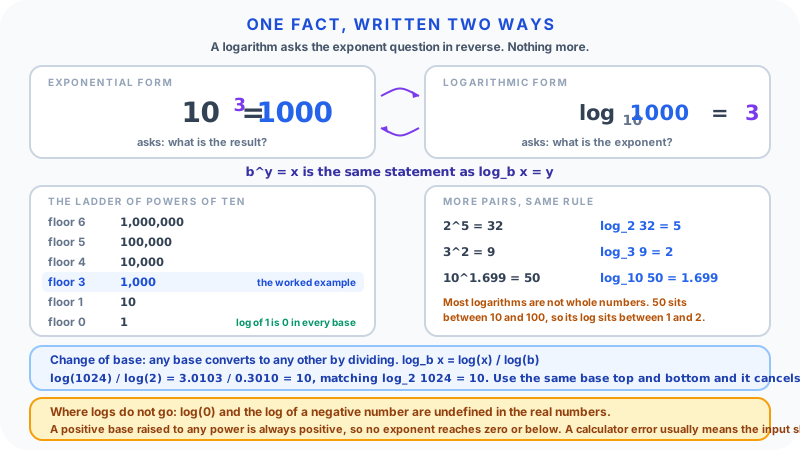
log base 10 of 1000 asks: how many times do you multiply by 10 to get 1000?
Count them: 10^1 = 10, 10^2 = 100, 10^3 = 1000. Three tens multiplied together give 1000, so the answer is 3.
That is the whole doorway. A logarithm answers an exponent question in reverse.
Use the Logarithm Calculator when you need the value. Use this guide to understand what the value is saying.
The elevator model
Imagine a building where each floor is ten times higher than the last.
Floor 0 is 1.
Floor 1 is 10.
Floor 2 is 100.
Floor 3 is 1,000.
Floor 6 is 1,000,000.
A base-10 logarithm tells you which floor you are on. It does not tell you the raw height. It tells you the exponent level.
That is why logs compress huge ranges. The jump from 1 to 1,000,000 becomes a move from floor 0 to floor 6. The numbers are still different by a factor of a million, but the log scale gives you a manageable map.
Notice that floor 0 is 1, not 0. That is a general rule: the log of 1 is 0 in every base, because multiplying by the base zero times leaves you at 1.
This is not just a math trick. It matches how many real systems behave.
Logs and exponents are inverse questions
Exponents ask:
10^3 = ?
Logarithms ask:
10^? = 1000
The first question gives the result. The second asks for the exponent.
Written formally, the two statements below say exactly the same thing, and being able to flip between them is most of what using logs requires:
b^y = x is the same statement as log base b of x = y
Here is the pairing in action:
| Exponential form | Logarithmic form |
|---|---|
2^5 = 32 | log base 2 of 32 = 5 |
10^4 = 10000 | log base 10 of 10000 = 4 |
3^2 = 9 | log base 3 of 9 = 2 |
Once you see the inverse relationship, logarithms stop being a separate mystery. They are the answer to "what power?"
The Exponent Calculator is helpful for checking the forward direction. The log calculator checks the reverse.
This inverse relationship is the reason logarithms show up whenever the unknown is time, number of doublings, number of halvings, or number of repeated percentage changes. If the unknown sits in the exponent, ordinary arithmetic will not isolate it cleanly. A logarithm pulls that exponent down into a number you can solve for.
Where logs simply do not go
The inverse relationship also explains the two restrictions people run into. Raising a positive base to any power always gives a positive result, so working in ordinary real numbers there is no exponent that produces zero or a negative number. That means log(0) and the log of any negative number are undefined, and a calculator will return an error rather than a value. The base itself must also be positive and not equal to 1, since 1 raised to any power is stubbornly still 1.
If a calculator throws an error on a log, checking whether the input went to zero or negative is usually the fastest diagnosis.
Why the base matters
The base tells you what multiplication step you are counting.
Base 10 counts powers of 10. This is common in scientific notation and many measurement scales.
Base 2 counts doublings. This appears naturally in computing, binary systems, algorithm analysis, and repeated halving or doubling problems.
Base e, called the natural logarithm, appears in continuous growth and decay. The number e is about 2.71828. It may look odd at first, but it emerges naturally when growth is happening continuously rather than in neat yearly or monthly steps.
The same number can have different logarithms depending on the base. That is not a contradiction. It is like measuring distance in miles or kilometers. The distance did not change. The unit did.
For example, log base 10 of 1000 is 3 because 10 needs three powers to reach 1000. But log base 2 of 1024 is 10 because 2 needs ten doublings to reach 1024. Both answers are clean because the numbers line up exactly with the base. Most logs are not whole numbers. log base 10 of 50 is about 1.699, sitting between 1 and 2 because 50 sits between 10 and 100.
That in-between answer is not a problem. It means the target is partway between two exact multiplication floors.
Changing between bases
If your calculator only offers log and ln, you are not stuck with base 10 and base e. Any base converts into any other by division:
log base b of x = log(x) / log(b)
The base you use on the right side does not matter, as long as you use the same one top and bottom. To check log base 2 of 1024 with a base-10 button: log(1024) / log(2) = 3.0103 / 0.3010 = 10. Same answer, different route.
This is why the doubling-time formulas later in this article use log(2) / log(1.06) without specifying a base. Either button gives the same result.
Why log scales exist
A normal scale handles ordinary ranges well. A log scale handles enormous ranges better.
Suppose you want to plot values from 1 to 1,000,000 on a chart. On a normal scale, the small values get crushed near zero. A change from 10 to 100 is visually tiny compared with a change from 900,000 to 1,000,000, even though 10 to 100 is a tenfold increase.
A logarithmic scale gives equal visual spacing to equal ratios. Moving from 10 to 100 takes the same space as moving from 100 to 1000 because both are times 10.
This makes log scales useful for:
- Earthquake magnitudes
- Sound intensity
- pH levels
- Population growth
- Financial charts over long periods
- Computer performance and data sizes
- Scientific measurements spanning many orders of magnitude
On a log scale, multiplication becomes distance.
That sentence is worth keeping.
The pH scale: small numbers, huge changes
pH measures how acidic or basic a solution is, and the scale is logarithmic by construction. The formal IUPAC definition is pH = -log10(a), where a is the activity of hydrogen ions rather than their raw concentration. In dilute solutions activity and concentration are close enough that most textbooks write pH = -log10[H+], and that version is fine for building intuition as long as you know the exact definition is slightly stricter.
The minus sign is there for convenience. Hydrogen ion concentrations in water are small numbers with many leading zeros, so the raw logarithms are negative. Flipping the sign turns an awkward figure like -3 into a readable pH of 3.
Because each whole step is one power of ten, a solution at pH 3 has ten times the hydrogen ion activity of one at pH 4, and a solution at pH 2 has 100 times that of pH 4. Two numbers that look adjacent describe chemistry that is not adjacent at all.
That is why lemon juice and stomach acid are not casually comparable just because their pH numbers are close. The logarithm compresses tiny chemical quantities into a scale humans can read. Without it, the raw numbers would be awkward strings of decimals.
Earthquakes: one step is not one unit of damage
Earthquake magnitude scales are logarithmic too, and here it is worth being precise, because two different quantities change at two different rates.
According to the US Geological Survey, each whole-number step up in magnitude corresponds to:
- ten times the amplitude of ground motion recorded on a seismogram
- about 32 times the energy released, because energy scales as
10^(1.5 × magnitude difference), and10^1.5is approximately 31.6
So a magnitude 6 is ten times larger than a magnitude 5 in shaking amplitude, but roughly thirty-two times larger in energy. Both statements are correct; they answer different questions. Compounded over a wider gap, the numbers get dramatic: USGS notes that a magnitude 8.7 has about 794 times the amplitude of a magnitude 5.8, and roughly 23,000 times the energy.
This is why magnitude language misleads in casual conversation. "Only one point higher" describes a major physical difference, and which multiple you should quote depends on whether you are talking about shaking or about released energy.
Logarithmic scales suit earthquakes because earthquakes vary enormously. A linear scale would either hide small earthquakes entirely or make large ones impossible to display.
Sound: decibels and human perception
Sound intensity also spans an enormous range, and the decibel scale compresses it logarithmically. For sound intensity the definition is:
L = 10 × log10(I / I0)
where I0 is a fixed reference intensity. The factor of 10 in front is what makes a tenfold increase in intensity come out as exactly 10 dB, which is why the CDC's hearing loss guidance can state plainly that a sound 10 dB louder than another is ten times more intense.
The practical consequence is that decibels add where intensities multiply. Going from 85 dB to 95 dB is not a modest step up; it is ten times the intensity. This is the reason occupational limits are written in decibels with time attached rather than as a single threshold: NIOSH sets its recommended exposure limit at 85 dBA averaged across an eight-hour workday, and safe exposure time falls sharply as the level rises.
Human loudness perception is a separate matter from intensity, and the two should not be conflated. Perceived loudness grows more slowly than measured intensity, which is part of why a sound ten times more intense does not feel ten times louder. What the log scale captures well is that our senses respond to ratios more readily than to absolute differences.
That pattern shows up outside acoustics too. A $5 increase on a $10 item feels large. A $5 increase on a $5,000 item barely registers. Logarithmic thinking helps whenever ratios matter more than differences.
Exponential growth becomes readable with logs
If something grows exponentially, a logarithm can straighten the story.
Imagine a population growing by 20% per year:
P = P0 x 1.2^t
The exponent t is time. The growth is multiplicative.
Take the log of both sides and the multiplication turns into addition:
log(P) = log(P0) + t x log(1.2)
That is the equation of a straight line, with log(1.2) as the slope. This is exactly why analysts use log plots: a curve that is hard to read by eye becomes a line whose steepness is the growth rate. A bend in that line means the growth rate itself changed, which is far easier to spot than a bend in an exponential curve.
In finance, logs help with compound returns. In biology, they help compare growth rates. In epidemiology, they reveal whether case counts are rising by a consistent factor. In computing, they describe how algorithms scale as input size grows.
Logs do not remove complexity. They change the viewpoint.
Data compression and information
Logarithms also appear in information theory and computing.
If you have 8 equally likely options, how many yes-or-no questions do you need to identify one option?
One yes-or-no question splits possibilities in half. Two questions can distinguish 4 possibilities. Three questions can distinguish 8. That is log base 2 of 8 = 3.
This is why base-2 logarithms appear when counting bits. A bit is a binary choice. Logs tell you how many binary choices are needed to represent or identify something.
Data compression, search algorithms, decision trees, entropy, and binary encoding all rely on this kind of thinking. The logarithm counts how many splits or doublings are involved.
Search is a friendly example. If a sorted list has 1,024 items and each question cuts the remaining possibilities in half, about 10 yes-or-no splits are enough to isolate one item, because log base 2 of 1024 = 10. That is not because 1,024 is small. It is because halving repeatedly is powerful. Double the list to 2,048 items and you need just one more question.
Common log, natural log, and base-2 log
You will see three bases often.
log usually means base 10 in school science and on most pocket calculators, though conventions vary: in pure mathematics log often means base e, and in computer science it often means base 2.
ln means natural log, base e.
log2 means base 2.
Base 10 is convenient for decimal scale and scientific notation. Natural log is convenient for continuous growth and decay. Base 2 is convenient for computing and binary choices.
If you are using a calculator, check the label. log and ln are not the same button.
The Scientific Calculator is useful when you want to compare log, ln, powers, and roots in one place.
If a problem does not state the base, check the convention before calculating. Where the answer is a ratio of two logs, as in a doubling-time calculation, the base cancels out and it genuinely does not matter.
A gentle example: how long until something doubles?
Suppose a quantity grows by 6% per year. How long until it doubles?
The equation is:
2 = 1.06^t
The unknown is in the exponent, so this is a logarithm problem.
Using logs:
t = log(2) / log(1.06)
Working it through: 0.30103 / 0.025306 = 11.90, so about 11.9 years.
You do not need to memorize this formula to understand the point. The logarithm is solving for the number of repeated 6% growth steps needed to reach double.
That is logs in plain language: how many growth steps?
A similar idea works backward for decay. Suppose a medication level falls by 20% each hour, so 80% remains after every hour. How long until only 25% remains?
The structure is:
0.25 = 0.8^t
The unknown is again the exponent. Logs solve for t:
t = log(0.25) / log(0.8)
That is -0.60206 / -0.09691 = 6.21, so about 6.2 hours. Two negative logs divide to give a sensible positive answer, which is what should happen: you are counting forwards in time even though the quantity is shrinking. The logarithm is counting repeated 20% reductions rather than repeated growth steps.
Misconceptions that cause trouble
One misconception is that logarithms make numbers smaller, so they must be losing information. They do compress scale, but the transformation is reversible: raise the base to the log and you get the original number back exactly.
Another is that logs only work for huge numbers. Logs are also useful for tiny numbers, repeated decay, probability, and continuous change. pH is the everyday proof.
A third misconception is that logarithmic scales are deceptive. They can mislead if unlabeled or used carelessly, but they are often the honest choice when values span orders of magnitude.
A fourth is treating the base as a technical footnote. The base defines the counting unit. Changing the base changes the log value, just as changing inches to centimeters changes the number.
A fifth is assuming every scale described as logarithmic behaves identically. pH steps by a factor of 10 per unit; earthquake energy steps by about 32 per unit; decibels step by 10 per ten units. The shared feature is that equal steps mean equal ratios. The size of the ratio is specific to each scale.
Reading a log-scale chart
When you see a log-scale chart, do not read vertical distance as ordinary addition. Read it as multiplication.
Equal steps mean equal ratios.
If the labels are 10, 100, 1000, and 10000, each step is times 10. A line that looks steady on a log chart may represent constant percentage growth, not constant addition.
This is why financial charts over decades often use log scales. A move from 100 to 200 and a move from 1000 to 2000 are both doublings. A linear chart makes the second look much larger. A log chart treats both as the same proportional gain.
The danger is that log charts can soften the visual shock of large absolute changes. A line may look calm while the raw numbers are enormous. That does not make the chart wrong. It means the reader has to know which question the chart is answering: absolute change or proportional change.
For public communication, labels matter. A log scale should be clearly marked so readers do not mistake equal visual spacing for equal addition.
FAQs
What is a logarithm in simple terms?
A logarithm tells you what exponent is needed. It counts how many times you multiply by a base to reach a number. log base 10 of 1000 is 3 because three tens multiplied together make 1000.
How are logarithms related to exponents?
They are inverse operations. b^y = x and log base b of x = y are two ways of writing the same fact. If 2^5 = 32, then log base 2 of 32 = 5.
Why do logarithmic scales exist?
They make huge or tiny ranges easier to read by turning equal ratios into equal spacing. This is useful when values differ by factors of 10, 100, or more, which would otherwise crush the small values against the axis.
What is the difference between log base 10 and natural log?
Log base 10 counts powers of 10 and suits decimal measurement scales. Natural log, written ln, uses base e (about 2.71828) and appears naturally in continuous growth and decay. You can convert between them by dividing: ln(x) = log(x) / log(e).
Why are pH, decibels, and earthquakes logarithmic?
All three describe quantities spanning enormous ranges, so a log scale compresses them into readable numbers while preserving multiplicative relationships. The specific ratio differs by scale: one pH unit is a factor of 10 in hydrogen ion activity, one earthquake magnitude unit is 10 times the amplitude and about 32 times the energy, and 10 decibels is 10 times the sound intensity.
When should I use a logarithm calculator?
Use one when the unknown is an exponent, when you need a log in a base your calculator lacks, when comparing values across huge ranges, or when working with log-scale systems such as pH, decibels, earthquakes, or compound growth.
Sources
- International Union of Pure and Applied Chemistry, IUPAC Compendium of Chemical Terminology: pH. Formal definition of pH in terms of hydrogen ion activity.
- US Geological Survey, How much bigger is a magnitude 8.7 earthquake than a magnitude 5.8?. Amplitude and energy relationships per magnitude unit, including the
10^1.5energy factor. - US Geological Survey, Moment magnitude, Richter scale: what are the different magnitude scales?. Background on magnitude scales and how they relate.
- Centers for Disease Control and Prevention, About Occupational Hearing Loss. The tenfold intensity meaning of a 10 dB increase and the NIOSH 85 dBA eight-hour recommended exposure limit.
Worked logarithm values in this article were computed directly and rounded for display.
The bottom line
Logarithms are not a secret advanced language. They are a way to count multiplications, compress scale, and read exponential change. Once you see logs as inverse exponents, the button on the calculator becomes less mysterious, and the world of pH, sound, earthquakes, growth, and data suddenly shares the same underlying grammar.