
Almost every mistake with percentage change comes from one question going unanswered: a percentage of what?
Get the base value right and increases, decreases, reversals and stacked changes all fall out of a single formula. Get it wrong and you produce numbers that look reasonable, pass a sanity check, and are wrong by a margin large enough to matter.
Key Takeaways
- Percentage change = (New − Original) / Original × 100. The original value is always the denominator.
- Increase and decrease are the same formula. A positive result is an increase, a negative one a decrease.
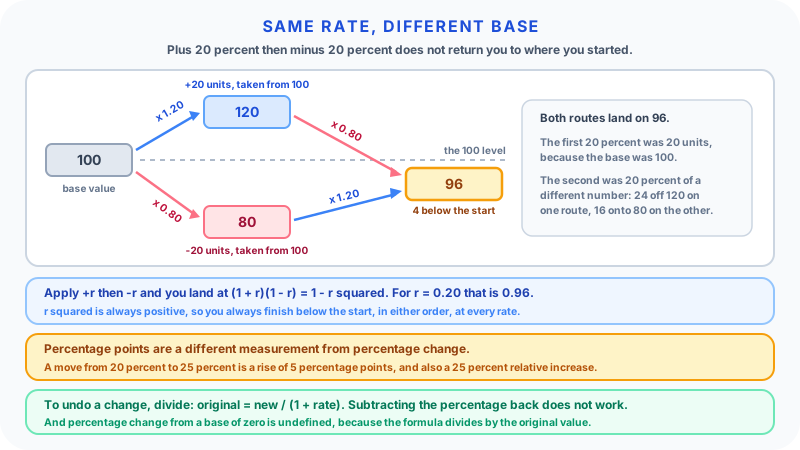
- +20% then −20% does not return to the start, because the two percentages are taken from different base values.
- To reverse a change, divide. Original = New ÷ (1 + rate). Subtracting the percentage back does not work.
- Percentage points are not percent. 20% to 25% is 5 percentage points and also a 25% relative increase.
- Percentage change from an original value of zero is undefined, because the formula divides by zero.
The One Formula
Percentage Change = (New Value − Original Value) / Original Value × 100
That single expression covers both directions. If the result is positive, the value increased. If it is negative, it decreased.
When people want the answer stated as a positive number in each direction, the two familiar forms are:
Percentage Increase = (New − Original) / Original × 100
Percentage Decrease = (Original − New) / Original × 100
They are the same calculation with the subtraction written in whichever order keeps the answer positive. There is no separate mathematics for going down.
Two worked examples:
- 80 rises to 100. (100 − 80) / 80 × 100 = +25%
- 100 falls to 80. (80 − 100) / 100 × 100 = −20%
Identical gap of 20 units, two different percentages, because the denominator changed. That single observation explains most of what follows.
Naming The Parts
| Term | What it means | In the formula |
|---|---|---|
| Original value | Where you started. Also called the base, the old value, or the reference value | The denominator |
| New value | Where you ended up | The first term in the numerator |
| Absolute change | New − Original, in the original units | The numerator |
| Percentage change | The absolute change expressed as a share of the original | The whole expression |
| Percentage point | The plain arithmetic gap between two percentages | Not this formula at all |
The base is the only part people get wrong, and it is wrong in a predictable way: dividing by the new value rather than the original. 80 to 100 divided by 100 gives 20%, which is a real number answering a different question ("the gap is 20% of where I ended up") and not the percentage increase.
Why +20% Then −20% Does Not Cancel
Work it through with 100:
- Start: 100
- Apply +20%: 100 × 1.20 = 120
- Apply −20%: 120 × 0.80 = 96
You end at 96, not 100. Nothing has gone wrong. The first 20% was 20% of 100, which is 20 units. The second 20% was 20% of 120, which is 24 units. Different bases, different amounts.
Reverse the order and the result is identical:
- 100 × 0.80 = 80
- 80 × 1.20 = 96
Multiplication is commutative, so the sequence does not matter. The shortfall does not come from the order; it comes from the fact that any percentage always refers to whatever it is applied to at that moment.
The general result: applying +r then −r leaves you at (1 + r)(1 − r) = 1 − r² of the original. For r = 0.20 that is 1 − 0.04 = 0.96, a 4% shortfall. Because r² is always positive for any non-zero r, you always end up below where you started, in both orders, for every rate.
| Rate applied both ways | You end up at | Shortfall |
|---|---|---|
| 5% | 99.75% | 0.25% |
| 10% | 99% | 1% |
| 20% | 96% | 4% |
| 30% | 91% | 9% |
| 50% | 75% | 25% |
Notice how fast the shortfall grows: it scales with the square of the rate, so doubling the percentage quadruples the gap.
Reverse Percentages: Undoing A Change
To get back to the original value from the new one, divide.
Original = New Value ÷ (1 + rate)
Use a negative rate for a decrease. A price that is now 120 after a 20% increase: 120 ÷ 1.20 = 100. A figure that is now 80 after a 20% decrease: 80 ÷ 0.80 = 100.
Subtracting the percentage back is the common error and it is always wrong. 120 minus 20% is 96, not 100, because that 20% is being taken from 120 instead of from the original 100.
The same divide-to-reverse rule answers the matching practical question: how large a gain undoes a given loss?
Recovery gain = loss / (1 − loss)
| Loss | Gain needed to get back |
|---|---|
| 10% | 11.1% |
| 20% | 25% |
| 25% | 33.3% |
| 33.3% | 50% |
| 50% | 100% |
| 75% | 300% |
A 50% fall needs a 100% rise to undo, because the rise is measured against the reduced value. This is arithmetic, not a claim about how any particular market behaves.
Percentage Change vs Percentage Points
These describe different things and are swapped constantly, usually in ways that make a change sound larger or smaller than it is.
A percentage point is the plain subtraction of one percentage from another. It has no base and needs none.
A percentage change is relative, and always has a base.
The standard example:
A rate moves from 20% to 25%.
That is an increase of 5 percentage points.
It is also a 25% relative increase, because 5 / 20 = 0.25.
Both statements are correct and they are not interchangeable. The UK Office for National Statistics states the distinction plainly in its editorial guidance: a percentage point is the difference between percentages, so a value of 10% falling by 1 percentage point becomes 9% (ONS).
More cases, to make the gap concrete:
| Moves from | To | Percentage points | Percentage change |
|---|---|---|---|
| 2% | 3% | +1 point | +50% |
| 20% | 25% | +5 points | +25% |
| 40% | 20% | −20 points | −50% |
| 95% | 99% | +4 points | +4.2% |
The 2% to 3% row is where reporting goes astray. "Up 50%" is true and, on a base that small, easily read as a crisis. "Up one percentage point" is equally true and reads very differently. Whenever the underlying quantity is itself a percentage, ask which of the two is being quoted.
Stacked Changes Multiply
Sequential percentage changes compound. They do not add.
Final = Original × (1 + r1) × (1 + r2) × ... × (1 + rn)
Negative rates for decreases.
A price of 40 rises 10%, then 5%: 40 × 1.10 × 1.05 = 46.20. The effective increase is 15.5%, not 15%. The extra 0.5 point is the second rise applied to the first rise.
Three years of salary increases of 5%, 3% and 4%: 1.05 × 1.03 × 1.04 = 1.1247, a total of 12.47%, not the 12% you get by adding.
Quarterly revenue falls 15% then recovers 18%: 0.85 × 1.18 = 1.003, so 0.3% above the starting point. The recovery sounds like it more than made up the fall; it barely did.
Adding percentages is a usable approximation only when the rates are small and few. At 5% and 5% the error is a quarter of a point; at 40% and 40% adding gives 80% when the true answer is 96%.
Zero, And Where The Formula Stops Working
Percentage change from an original value of zero is undefined. The formula divides by the original value, and division by zero has no result.
This matters more than it sounds, because software and spreadsheets will happily hand you something that looks like an answer. Sales going from 0 to 40 is not a 4,000% increase, or a 100% increase, or an infinite increase. It is an increase of 40 units from a base that cannot support a ratio. Report the absolute change and say the base was zero.
Two related cases worth naming:
A very small base. Going from 1 to 4 is a real +300%, but the percentage is doing almost no work: three extra units. Percentages on tiny bases are technically correct and practically misleading, which is why absolute figures belong alongside them.
A negative base. If the original value is negative, as with a loss on a profit line, the formula still computes but the sign becomes uninterpretable: a loss of 50 moving to a loss of 25 is a genuine improvement that the raw formula reports as +50%, and a loss moving to a profit produces a number with no sensible reading. Describe such moves in absolute terms, or as "from a loss of 50 to a loss of 25".
A bounded quantity. A decrease cannot exceed 100% for a quantity that cannot go below zero, because a 100% decrease is already everything. For quantities that genuinely can go negative, such as profit, a "more than 100% decrease" is arithmetically possible and is much clearer stated in units.
Worked Examples
A price rise. A subscription goes from £12 to £13.50. (13.50 − 12) / 12 × 100 = +12.5%. In points of nothing, just 12.5% of the original price.
A discount and its true depth. A £180 coat sells for £126. (126 − 180) / 180 × 100 = −30%. Checking forward: 180 × 0.70 = 126. Correct. How to Calculate Discounts covers stacked promotions in detail.
Revenue against a target. Revenue of 92,000 against a target of 80,000 is (92,000 − 80,000) / 80,000 × 100 = +15% of target. Note the base: the target, because that is what "against target" means. Using the actual figure as the base answers a different question.
A measurement. A component specified at 25.0 mm measures 25.4 mm. (25.4 − 25) / 25 × 100 = +1.6%. Whether 1.6% matters is a question about tolerance, not about arithmetic.
A conversion rate. A checkout converting at 3.2% now converts at 3.6%. That is +0.4 percentage points and +12.5% relative. Both are worth reporting; only one of them is worth putting in a headline without the other.
A real-terms pay change. A 4% rise against 5% inflation: (1.04 / 1.05) − 1 = −0.95%. Nominally up, in purchasing power slightly down. Dividing the factors, rather than subtracting the percentages, is what makes this exact.
Common Mistakes
Dividing by the new value. The original value is the denominator, always.
Adding sequential changes. They multiply. 10% then 10% is 21%, not 20%.
Assuming symmetry. A 30% fall needs a 42.9% rise to undo, not another 30%.
Subtracting to reverse. Divide by (1 + rate). Taking 20% off a figure that rose 20% lands 4% short.
Confusing points with percent. Especially when the quantity measured is itself a percentage.
Quoting a percentage on a base of zero or near zero. Undefined in the first case, misleading in the second.
Saying "200% larger" without saying of what. It most often means three times the original, but readers regularly take it as two times. Write the resulting figure.
Averaging percentage changes. The mean of +50% and −50% is not 0%. Applying both leaves you at 75% of the original. Compound the factors instead.
FAQ
What is the formula for percentage increase? (New − Original) / Original × 100. A rise from 80 to 100 is (100 − 80) / 80 × 100 = 25%.
What is the formula for percentage decrease? (Original − New) / Original × 100, which is the same formula written to give a positive answer. A fall from 100 to 80 is (100 − 80) / 100 × 100 = 20%.
Why do a 20% increase and a 20% decrease not cancel out? Because they are taken from different base values. The +20% is 20% of the starting figure; the −20% is 20% of the larger figure that resulted. You end at 96% of where you began, in either order.
How do I reverse a percentage change? Divide. Original = New ÷ (1 + rate), using a negative rate for a decrease. A figure of 120 after a 20% rise came from 120 ÷ 1.20 = 100.
What gain do I need to recover a loss? Gain = loss / (1 − loss). A 20% loss needs 25%; a 50% loss needs 100%.
What is the difference between percent and percentage points? A percentage point is the arithmetic difference between two percentages. A percent change is relative to a base. Moving from 20% to 25% is 5 percentage points and a 25% increase.
What is the percentage increase from zero? It is undefined, because the formula divides by the original value. Report the absolute change and state that the base was zero.
Can a percentage decrease be more than 100%? Not for a quantity that cannot go below zero, since a 100% decrease has already reached zero. For quantities that can go negative, such as profit, it is possible but far clearer expressed in units.
How do I combine several percentage changes? Multiply the factors: (1 + r1) × (1 + r2) and so on. Do not add the rates.
Related Tools
The Percentage Increase Calculator works out the change between two values and applies a rate in either direction. The Percentage Calculator handles the general forms, including finding a part, a whole or a rate. For sale prices and stacked promotions specifically, use the Discount Calculator.
Related Articles
Sources
- Office for National Statistics, Percentages and percentage points, Content style guide - the editorial rule that a percentage point is the difference between percentages, so 10% falling by 1 percentage point becomes 9%.
Every figure in this article was calculated directly from the formulas shown and rounded where stated.
Final Thoughts
Percentage change has one formula and one failure mode. The formula is (New − Original) / Original. The failure mode is losing track of which number is the original.
Two habits remove nearly all of it. Write the multiplier rather than the percentage, so +20% becomes 1.20 and −20% becomes 0.80, which makes it obvious that they multiply to 0.96 rather than to 1. And whenever you report a percentage, put the two underlying figures next to it. A change that survives being written out in units is a change you have understood.