
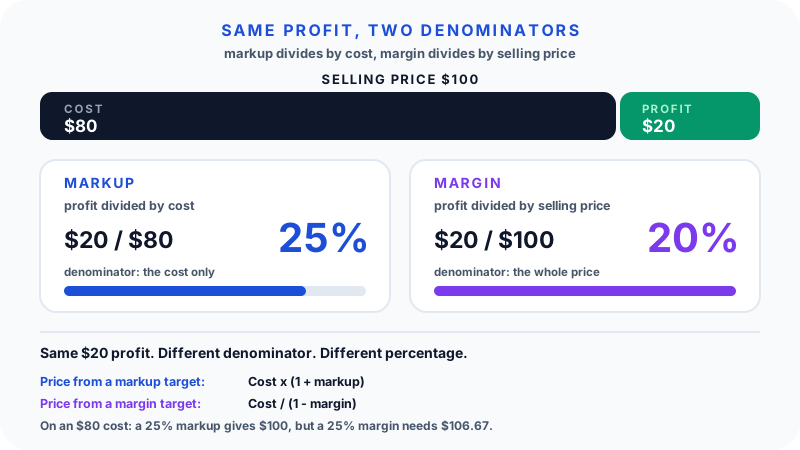
The short answer: markup is measured against cost. Margin is measured against selling price. Both describe the same dollars of profit. Because the denominator changes, the percentages never match, and treating them as interchangeable is one of the most common ways a business quietly underprices everything it sells.
Markup % = (Selling price - Cost) / Cost x 100
Margin % = (Selling price - Cost) / Selling price x 100
One Example, Two Percentages
Take a single product and run both formulas on it.
| Cost | $80 |
| Selling price | $100 |
| Gross profit | $20 |
| Markup | 20 / 80 = 25% |
| Margin | 20 / 100 = 20% |
Nothing changed except what you divided by. The same $20 of profit is a 25% markup and a 20% margin at the same time.
This is the mistake to internalise: a 25% markup does not produce a 25% margin. It produces a 20% margin. If your plan assumed 25% of revenue would survive as gross profit, you are five percentage points short before a single expense is paid.
Markup is always the larger of the two numbers, because cost is always smaller than selling price on a profitable sale.
Converting Between the Two
The conversions are exact, not approximations:
Markup to margin: Margin = Markup / (1 + Markup) Margin to markup: Markup = Margin / (1 - Margin)
Use decimals inside the formula. A 40% markup is 0.40 / 1.40 = 0.2857, so 28.57% margin.
| Markup | Margin |
|---|---|
| 10% | 9.09% |
| 20% | 16.67% |
| 25% | 20.00% |
| 30% | 23.08% |
| 33.33% | 25.00% |
| 40% | 28.57% |
| 50% | 33.33% |
| 75% | 42.86% |
| 100% | 50.00% |
| 150% | 60.00% |
| 200% | 66.67% |
Markup has no ceiling. A $10 item sold for $30 carries a 200% markup. Margin does have a ceiling: profit can never exceed the selling price, so margin always stays below 100%.
Building a Price From Either Metric
Both directions are one line of arithmetic, and they give different answers from the same inputs.
From a target markup: Selling price = Cost x (1 + markup as a decimal) From a target margin: Selling price = Cost / (1 - margin as a decimal)
On an $80 cost:
- Target 25% markup: 80 x 1.25 = $100
- Target 25% margin: 80 / 0.75 = $106.67
That $6.67 gap per unit is the entire subject of this article. Decide which metric your business reports in, then always price with the matching formula.
Gross Profit, Gross Margin, Markup, Net Profit Margin
Four terms get used loosely and mean four different things.
- Gross profit is a currency amount: selling price minus the direct cost of the goods or service. On the example above, $20.
- Gross margin is that gross profit as a percentage of revenue. Here, 20%.
- Markup is the same gross profit as a percentage of cost. Here, 25%. It is a pricing lever, not a reporting figure.
- Net profit margin is what is left after everything else: overhead, payroll, marketing, rent, interest, tax, divided by revenue.
Gross margin is not profit. It is the budget out of which every other cost in the business must be paid. A product line running a 40% gross margin can still land a business at a 3% net margin once the rest of the cost base is applied, which is why gross margin discipline matters more than it looks: it is the only cushion between revenue and everything else.
Operating margin sits between the two, subtracting operating expenses but not interest and tax.
Where This Bites in Practice
Retail pricing
The classic "keystone" convention is a 100% markup, which is exactly a 50% margin. Retail conventions are expressed in markup because cost is the known input at the buying desk, and because markup builds cushion for shrinkage, returns and end-of-season discounting. Trouble starts when the same figure is repeated to a lender or an accountant, who will read it as margin.
Freelance and product pricing
A freelancer costs out a project at $800 of direct time and materials and wants 30% of the fee to remain as gross profit. That is a margin target, so the price is 800 / 0.70 = $1,142.86, not 800 x 1.30 = $1,040. Pricing at $1,040 delivers a 23.08% margin, not 30%.
Wholesale and resale
A wholesale line sheet usually quotes cost and a recommended retail price, and expects the retailer to think in markup. A retailer buying at $12 and selling at $24 has a 100% markup and a 50% margin. If the same retailer needs a 55% margin to cover store overhead, the price has to be 12 / 0.45 = $26.67, not $24. Small differences at the buying desk compound across an entire season of stock.
Discounting
Discounts hit margin far harder than the headline suggests, because cost does not move.
An item costs $60 and sells for $100. Margin is 40%. Run 30% off:
- New price: $70
- New gross profit: $10
- New margin: 10 / 70 = 14.29%
A 30% discount removed roughly 64% of the gross profit on that sale. Before agreeing to a promotion, calculate the margin at the discounted price, not the discount percentage.
Supplier negotiation
A product costs $50 and sells for $80: $30 gross profit, 37.5% margin. A 10% cost reduction takes cost to $45 and gross profit to $35, lifting margin to 43.75%. That is a 16.7% increase in gross profit per unit with no change to the price tag. Cost negotiation is usually more leveraged than an equivalent price increase, and it is invisible to the customer.
A Worked Failure
A bakery owner sources ingredients for $4 a loaf and wants "40% profit". She marks up 40% and prices at $4 x 1.40 = $5.60.
Her real margin is 1.60 / 5.60 = 28.57%, not 40%.
At 5,000 loaves a month, the 11.43 percentage points of the selling price she thought she was keeping and is not amount to about $3,200 of gross profit a month that her plan assumed and her till never sees.
The corrected price is 4 / 0.60 = $6.67, which locks in a true 40% margin. A $1.07 difference per loaf is the difference between a plan that works and one that does not.
Pricing Checklist
- Build a true unit cost. Materials, direct labour, packaging, inbound freight, payment processing, and a reserve for returns and shrinkage.
- Set the target as a margin. Margin is the number your accounts, your lender and your board will read.
- Price with Selling price = Cost / (1 - margin).
- Sanity-check against the market. If the price is uncompetitive, attack cost before cutting price.
- Model the discount before you run it. Check the margin at the promotional price.
- Keep both numbers, labelled. Markup for the buying conversation, margin for reporting. Never let one wear the other's name.
Margin and the Break-Even Point
Break-even volume depends on contribution per unit, which comes from selling price and variable cost, so it is driven by margin rather than markup.
Break-even units = Fixed costs / (Selling price - Variable cost per unit)
With $20,000 of monthly fixed costs, a $50 selling price and a $30 variable cost, contribution is $20 a unit and break-even is 1,000 units. Widen the margin, by cutting cost or raising price, and the break-even volume falls immediately.
Common Mistakes
- Writing "40% margin" when you mean 40% markup. The financial model will not survive scrutiny.
- Feeding a markup figure into a margin calculator. The output is internally consistent and externally wrong.
- Discounting against the sticker instead of the margin. Cost stays put while the price falls.
- Reading gross margin as profit. It is the budget for everything that comes after.
- Comparing margins across industries. A 5% net margin is strong in grocery and weak in software. Benchmark inside your own sector.
FAQ
Is a 30% markup the same as a 30% margin? No. A 30% markup produces a 23.08% margin, because 0.30 / 1.30 = 0.2308. To reach a 30% margin you need a 42.86% markup.
How do I convert markup to margin? Divide the markup by one plus the markup, both as decimals. A 50% markup is 0.50 / 1.50 = 0.3333, so a 33.33% margin. Going the other way, margin to markup is margin / (1 - margin).
How do I calculate selling price from a target margin? Selling price = Cost / (1 - target margin as a decimal). A $30 cost at a 35% target margin gives 30 / 0.65 = $46.15.
Can a business have a high markup but a low net profit? Yes, routinely. Markup and gross margin only cover the direct cost of goods. Rent, payroll, marketing, interest and tax all come out afterwards, so a business with a 300% markup on food can still finish the year with a low single-digit net profit margin.
Are margin and markup the same thing? No. They describe the same gross profit against different denominators: margin against selling price, markup against cost. A $40 profit on a $100 sale is a 40% margin and a 66.67% markup.
Can margin ever be higher than 100%? No. Gross margin is profit divided by selling price, and profit cannot exceed the price, so it stays below 100%. Markup has no upper limit.
How does margin affect the break-even point? Break-even volume is fixed costs divided by contribution per unit. A wider margin means more contribution per unit, so fewer units are needed to cover fixed costs.
Related Tools and Reading
Keep the Margin Calculator open while pricing: it works gross profit, margin percentage and markup from the same cost and price. The Break-Even Calculator turns a chosen margin into the monthly volume the business actually needs, the Discount Calculator shows what a promotion does to the sale price before you commit to it, and the Percentage Calculator handles the quick conversions in between.
For the wider picture, read Gross Profit vs Net Profit, What Is a Healthy Profit Margin? and How to Calculate Discounts.
Conclusion
Margin and markup are not rivals. They answer different questions: markup builds a price up from a cost you know, margin tells you how much of each pound or dollar of revenue is still yours before the rest of the business takes its share. The discipline is to name them correctly, price with the formula that matches the target, and check the conversion table any time the two appear in the same sentence.
Get that right and pricing stops leaking. Get it wrong and every transaction gives away a few percentage points, quietly, all year.