
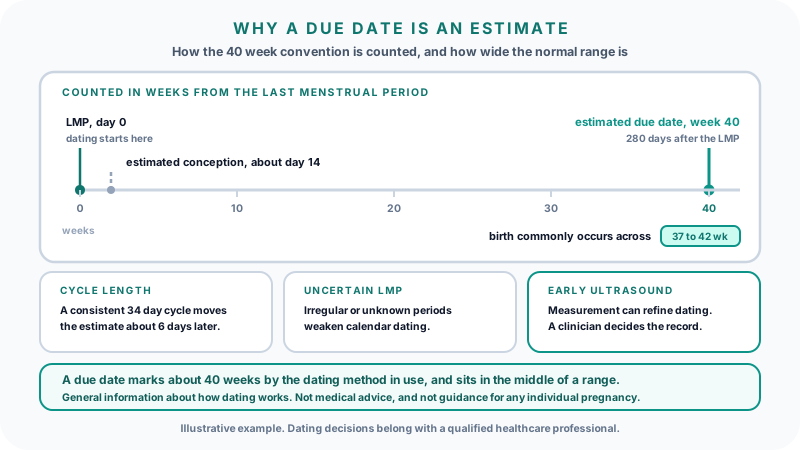
A due date is given as a single day, so it reads like an appointment. It is better understood as the centre of a window.
The NHS puts the range plainly: pregnancy usually lasts between 37 and 42 weeks, and it is common to give birth before or after the due date. That is a spread of about five weeks around a date printed as one square on a calendar.
None of that makes the date pointless. It is the reference point for gestational age, and gestational age is what schedules scans, screening windows, and checks. It just does a different job than people expect: it organizes care, rather than predicting an arrival.
BlinkCalc's Due Date Calculator applies the standard arithmetic. This article explains what that arithmetic assumes, so you can read the result for what it is.
The 40-week convention, and why the clock starts early
Pregnancy is conventionally dated from the first day of the last menstrual period, usually written LMP, and a full term is described as about 40 weeks from that day.
This is the part that confuses almost everyone at first: in a typical cycle, conception happens roughly two weeks after the LMP. So the first two counted weeks of a pregnancy occur before there is a pregnancy.
That is not a mistake in the system. It is a deliberate trade. The LMP is a date many people can identify with reasonable confidence. Ovulation and fertilization are events with no obvious outward marker and are often unknown even to someone tracking carefully. Dating from an observable date beats dating from an unobservable one, and the convention simply absorbs the offset.
The practical consequence is the one that surprises people: a positive test taken around a missed period usually corresponds to about four weeks pregnant by LMP dating, even though conception was likely around two weeks earlier. "Weeks pregnant" is a calendar count from the dating start point, not a count since fertilization.
The LMP method
The standard calculation adds 280 days, or 40 weeks, to the first day of the last menstrual period. This is sometimes referred to as Naegele's rule.
Underneath it sits an assumption: a 28-day cycle with ovulation around day 14. That assumption is what makes the plain 280-day sum work, and it is also its main limitation.
The BlinkCalc calculator adjusts for this. Enter a cycle length and it shifts the estimate by the difference from 28 days, so a 34-day cycle moves the date six days later and a 24-day cycle moves it four days earlier. It accepts cycle lengths from 21 to 45 days. It also shows an estimated conception date, placed 14 days after the LMP with the same cycle adjustment applied.
That adjustment handles a consistently longer or shorter cycle. It cannot do anything about a cycle that varies from month to month, because there is no single number to adjust by.
A worked example
Suppose the last menstrual period began on 8 March 2026, with a typical 28-day cycle.
8 March 2026 + 280 days = 13 December 2026The estimated due date is 13 December 2026, and the estimated conception date is around 22 March 2026, fourteen days after the LMP.
Now change one input. With a consistent 34-day cycle, ovulation is assumed to occur later, so the calculator adds six days:
8 March 2026 + 280 + 6 days = 19 December 2026A six-day shift from one input, and cycle length is only one of the assumptions involved.
It is worth placing the usual 37 to 42 week range around that first estimate. Measured from the same LMP, 37 weeks falls on 22 November 2026 and 42 weeks on 27 December 2026. The estimated due date of 13 December sits inside a window roughly five weeks wide. Both dates the calculator produced sit comfortably within it, which is the real lesson of the example: a difference of a few days between two dating methods is small compared with normal variation in when birth actually happens.
Conception-based dating
If a conception date is known with confidence, the calculator can work from it directly, adding 266 days, which is 280 minus the standard two-week offset.
The catch is in the words "known with confidence". Conception timing is less precise than it sounds, for reasons that are biological rather than arithmetical. Ovulation does not always occur on the expected cycle day. Sperm can survive in the reproductive tract for several days, so intercourse and fertilization can be separated by a meaningful interval. Fertilization and implantation are also distinct events.
Intercourse date, ovulation date, fertilization date, and implantation date are related but not interchangeable. Entering an assumed conception date produces a confident-looking result built on an uncertain input, which can be less reliable than the LMP method rather than more.
The Ovulation Calculator illustrates how cycle timing shifts the fertile window, and the same caveat applies there: it models a typical pattern, not a specific cycle.
Dating after fertility treatment
Pregnancies conceived through IVF often have more precise timing, because the transfer date and the embryo's age at transfer are recorded rather than estimated.
The calculator reflects this by subtracting the embryo age from the 266-day conception figure. A 5-day embryo transfer is therefore dated at 261 days from transfer, and a 3-day transfer at 263 days.
Even here, the result is still an estimated due date rather than a scheduled arrival. And if treatment was involved, the dating method your care team uses is the one that should be recorded, since clinical protocols may account for details a general calculator does not.
Ultrasound dating and why an estimate can change
Ultrasound measures the pregnancy rather than inferring it from a calendar, which is why it can refine or replace a calendar-based estimate.
Early ultrasound is generally the more useful for dating. Early in pregnancy, growth follows a relatively consistent pattern, so a measurement maps onto gestational age fairly tightly. Later in pregnancy that relationship loosens, because healthy babies vary more in size as they grow, which is why later scans focus on growth and anatomy rather than on establishing dates. The NHS notes that the 12-week scan can more accurately estimate how many weeks pregnant someone is.
ACOG's guidance describes determining gestational age and the estimated due date as soon as data from the last menstrual period, the first accurate ultrasound examination, or both are available. In practice a clinician compares the two, and professional guidance sets out when the ultrasound-based estimate should be adopted. Whether to revise a particular due date is a clinical judgement, made with the full picture.
A revised due date is usually a sign that better dating information became available, not that something is wrong. If your date changes and you want to understand why, asking which measurement or which date the new estimate came from is a reasonable question to bring to an appointment.
Where calculators fit, and where they do not
A due date calculator does calendar arithmetic on the inputs you give it. It has no access to your scan measurements, your cycle history, your medical record, or anything a clinician would weigh.
That makes it useful for a narrow set of things: understanding how the dating conventions work, seeing how sensitive the estimate is to cycle length, and converting between dates and pregnancy weeks. The Pregnancy Calculator covers the weeks-and-milestones side, and the Date Difference Calculator handles ordinary interval questions such as how many days until a particular appointment. Because pregnancy is described in weeks while calendars count days, the Days to Weeks Converter restates a day count in the units the rest of the pregnancy is measured in.
It is not a substitute for prenatal care, and it cannot assess anything about how a pregnancy is going. Where a calculator result and a clinician's date differ, the clinical record is the one that care is planned around. If you are unsure which date is official, it is worth asking rather than assuming, since personal apps and clinic records can drift apart when only one is updated.
A practical habit: alongside any date you write down, note the method it came from, whether that is LMP, a cycle-adjusted estimate, a conception date, an IVF transfer, or a scan. The same date can come from different assumptions, and knowing which one produced yours makes any later change much easier to follow.
Planning around a window
Because the range is genuinely wide, plans built on a single day tend to need rearranging.
Thinking in windows helps. Having essentials ready earlier than the final week, treating the due date as the middle of a period rather than its endpoint, and giving work and family a general timeframe rather than an exact day all reduce the number of arrangements that depend on one square of the calendar.
Sharing a due month rather than a due date is a common way to avoid a daily countdown from well-meaning people, though that is entirely a personal preference.
For anything with a formal timing requirement, such as leave entitlements or notice periods, confirm the details with the relevant employer or benefits provider, since these depend on local rules rather than on the arithmetic here.
Common mistakes
Treating the date as a deadline. It marks about 40 weeks by the dating method in use. Birth commonly occurs before or after it.
Assuming LMP dating fits every cycle. It is built on a 28-day assumption. Cycle-length adjustment helps for a consistently different cycle, and helps less for an irregular one.
Confusing intercourse date with conception date. Sperm survival and variable ovulation timing mean these can be days apart.
Reading a changed date as bad news. It usually reflects better dating information. The reason is a fair thing to ask about.
Keeping several unlabelled dates at once. An app, a family calendar, and a clinic record can each hold a different estimate. Record which date is the clinical one and which method produced it.
Using a calculator to settle a clinical question. Dating conventions are arithmetic. Whether a date should change, and what any of it means for a particular pregnancy, is not.
FAQ
How is a pregnancy due date calculated?
The common method adds 280 days, about 40 weeks, to the first day of the last menstrual period. Some calculators, including BlinkCalc's, adjust that by the difference between your cycle length and 28 days. Conception-based dating adds 266 days instead.
Why can due dates change?
New information can produce a better estimate, most often an early ultrasound measurement, and sometimes clearer cycle history or fertility treatment dates. A clinician decides whether the recorded date should be revised.
Is conception date more accurate than LMP?
Only when the conception date is genuinely known, as it can be after IVF. For most pregnancies it is uncertain, because ovulation timing varies and sperm can survive for several days, so an assumed conception date can be less reliable than the LMP.
What are pregnancy weeks?
They count from the dating start point, usually the first day of the last menstrual period. Because that point precedes conception by roughly two weeks in a typical cycle, someone is described as about four weeks pregnant around the time a period is missed.
Can ultrasound adjust a due date?
Yes. Early ultrasound in particular can give more precise dating than a calendar calculation, and the NHS notes that the 12-week scan can more accurately estimate how many weeks pregnant you are. Whether the recorded date changes is a clinical decision.
Do most babies arrive on the due date?
No. Pregnancy usually lasts between 37 and 42 weeks, and it is common to give birth before or after the estimated date. The date is best treated as the centre of a range.
Sources
- NHS, Pregnancy due date calculator
- NHS, Overdue: have you gone past your due date?
- American College of Obstetricians and Gynecologists, Methods for Estimating the Due Date (Committee Opinion No. 700)
Related guides
Final thoughts
The arithmetic behind a due date is straightforward: a start date, a convention of 280 days, and an adjustment for cycle length. What the result means is the part worth holding onto. It is a well-chosen midpoint of a range that is naturally several weeks wide, useful for organizing care and preparation, and not a prediction of a particular day.
Knowing which method produced your date, and that a revision usually means better information rather than a problem, tends to make the whole timeline easier to follow.
Educational only. Not medical advice. Due dates and pregnancy care should be discussed with a qualified healthcare professional.