
BMI, or body mass index, is a simple way to compare body weight with height. It turns height and weight into one number that is used to screen whether an adult is underweight, in the healthy weight range, overweight, or in an obesity category.
The calculation is straightforward, but mistakes are common. People forget to square height, mix centimetres with metres, use pounds in the metric formula, or read the category as a diagnosis. BMI is useful only when you understand what it measures and what it leaves out.
BMI does not measure body fat directly. It cannot tell you how fit you are, where fat is stored, or whether a weight is healthy for your personal medical situation. The World Health Organization describes it as "a surrogate marker of fatness" and notes that additional measurements such as waist circumference help. It is a screening tool, not a diagnosis.
What BMI Is, and Where It Came From
BMI is an index based on weight relative to height. Taller people naturally tend to weigh more, so BMI adjusts weight by height squared rather than comparing weight alone.
The ratio is older than the name. The Belgian statistician Adolphe Quetelet described weight divided by height squared in the 1830s while studying the distribution of measurements across populations, not while assessing individual patients. It picked up its modern name in 1972, when Ancel Keys and colleagues compared several weight-for-height indices and concluded that Quetelet's was the best of a limited set for population studies. That origin matters: BMI was built to describe groups, and it has been carrying the weight of individual judgements ever since.
For adults, the result is usually grouped into categories:
- Underweight
- Healthy weight
- Overweight
- Obesity class 1, 2, or 3
The reason BMI is widely used is practical. It is quick, cheap, and easy to calculate. It can be used in clinics, studies, public health reports, and personal tracking without special equipment.
That convenience is also its weakness. A simple index cannot capture the full complexity of human bodies. BMI should be understood as a rough screening measure that may prompt a closer look.
The Metric BMI Formula
The metric formula is:
BMI = weight in kg / height in metres squared
Written another way:
BMI = kg / m squared
The phrase "height in metres squared" means you multiply height by itself first, then divide weight by that result.
If your height is 1.75 m, height squared is:
1.75 x 1.75 = 3.0625
If your weight is 70 kg:
70 / 3.0625 = 22.9
So the BMI is 22.9.
Metric example step by step
Example person:
- Weight: 82 kg
- Height: 1.78 m
Step 1: Square the height.
1.78 x 1.78 = 3.1684
Step 2: Divide weight by height squared.
82 / 3.1684 = 25.88
Step 3: Round sensibly.
BMI is usually shown to one decimal place:
25.9
Step 4: Compare with adult categories.
A BMI of 25.9 falls in the overweight category.
The Imperial BMI Formula
The imperial formula is:
BMI = 703 x weight in pounds / height in inches squared
The number 703 is a conversion factor that makes pounds and inches produce the same kind of BMI result as kilograms and metres. It comes straight from the unit conversion: 1 kg is about 2.2046 lb and 1 m is 39.3701 inches, and 39.3701 squared divided by 2.2046 is about 703.
If your height is 5 ft 9 in, first convert it to inches:
5 x 12 + 9 = 69 inches
If your weight is 165 lb:
BMI = 703 x 165 / (69 x 69)
BMI = 115,995 / 4,761 = 24.4
Imperial example step by step
Example person:
- Weight: 190 lb
- Height: 6 ft 0 in
Step 1: Convert height to total inches.
6 x 12 = 72 inches
Step 2: Square the height.
72 x 72 = 5,184
Step 3: Multiply weight by 703.
190 x 703 = 133,570
Step 4: Divide by height squared.
133,570 / 5,184 = 25.8
The BMI is 25.8, which falls in the overweight category for adults.
Standard Adult BMI Categories
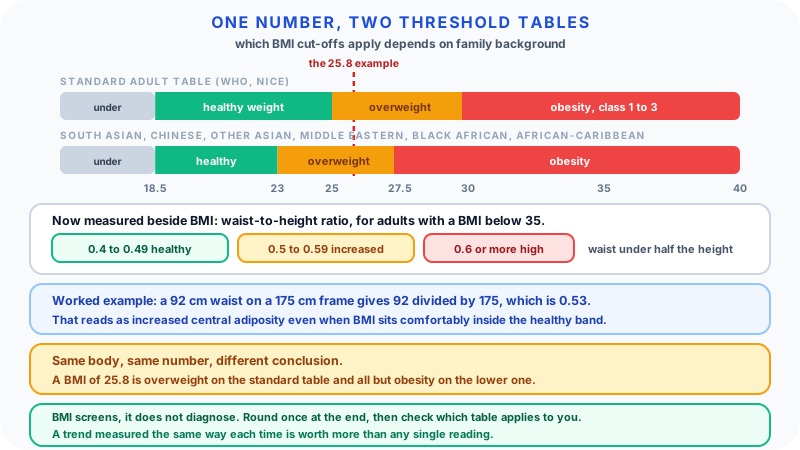
The standard adult categories, as set out in current NICE guidance and matching the WHO classification, are:
| BMI | Category |
|---|---|
| Below 18.5 | Underweight |
| 18.5 to 24.9 | Healthy weight |
| 25.0 to 29.9 | Overweight |
| 30.0 to 34.9 | Obesity class 1 |
| 35.0 to 39.9 | Obesity class 2 |
| 40.0 or above | Obesity class 3 |
A small technical note that trips up calculator builders: the tabled ranges stop at one decimal place, so a BMI of exactly 24.95 appears to fall in a gap. The boundaries are really "less than 25" and "25 or more". Round the final BMI once, at the end, and read it against those thresholds.
These categories apply to adults. They are not designed for children and teenagers, who are assessed using age and sex adjusted centiles.
The category boundaries are useful, but they are not sharp biological lines. A BMI of 24.9 and a BMI of 25.0 are almost identical in practical terms. Health risk tends to change gradually as weight, waist size, body composition, and other markers change.
Lower thresholds for some ethnic groups
This is the part most BMI explainers leave out, and it changes the reading for a large share of the population.
Health risks linked to body fat appear at lower BMI values in some groups. NICE and the NHS both advise using lower cut-offs for adults with South Asian, Chinese, other Asian, Middle Eastern, Black African, or African-Caribbean family backgrounds:
| BMI | Category for these groups |
|---|---|
| 23.0 to 27.4 | Overweight |
| 27.5 or above | Obesity |
The imperial worked example above returns 25.8. Against the standard table that reads as overweight. For someone in one of these groups it sits close to the obesity threshold instead. Same body, same number, different screening conclusion, because the risk relationship behind the number differs.
Beyond BMI: Waist and Central Adiposity
BMI says nothing about where weight sits, and fat carried around the abdomen carries more metabolic risk than fat elsewhere. Current NICE guidance therefore recommends using waist-to-height ratio alongside BMI for adults with a BMI below 35.
The measurement is simple. Measure your waist at the midpoint between the lowest rib and the top of the hip bone, against skin or light clothing, at the end of a normal breath out. Then divide it by your height in the same units.
| Waist-to-height ratio | Reading |
|---|---|
| 0.4 to 0.49 | Healthy central adiposity |
| 0.5 to 0.59 | Increased central adiposity |
| 0.6 or more | High central adiposity |
The rule of thumb NICE gives is easy to remember: keep your waist to less than half your height.
Worked example. Someone 175 cm tall with a 92 cm waist:
92 / 175 = 0.53
That falls in the 0.5 to 0.59 band, so it reads as increased central adiposity. Half their height would be 87.5 cm, so the waist is about 4.5 cm above the rule of thumb. Their BMI might be comfortably in the healthy range, and the waist measurement would still be worth raising with a clinician. This is exactly the case BMI alone misses.
Above a BMI of 35, waist measurement adds little, because central adiposity can be assumed.
What Changed Recently in How Clinicians Read BMI
In January 2025, a Commission published in The Lancet Diabetes and Endocrinology, backed by more than seventy medical organisations, proposed a substantial reframing. Its central argument is that BMI on its own should not diagnose obesity. Under the proposal, excess body fat should be confirmed either by a second measure such as waist circumference, waist-to-hip ratio, or waist-to-height ratio, or by direct measurement such as a DEXA scan.
The Commission then splits the result in two:
- Preclinical obesity: excess body fat is confirmed, but there are no signs or symptoms of reduced organ or tissue function, and the person can carry out normal daily activities. This is treated as a risk state.
- Clinical obesity: excess body fat is accompanied by organ or tissue dysfunction, or an inability to carry out day-to-day activities. This is treated as a disease in its own right.
This is a proposal rather than a settled international standard, and BMI categories remain in everyday clinical and public health use. But it explains a shift you may notice: a clinician who takes your waist measurement rather than reading a BMI number back to you is following where the guidance is heading, not dismissing the number.
Worked Example: Finding a Healthy Weight Range
BMI can be rearranged to estimate a weight range for a height. This helps when someone asks what weight corresponds to the healthy BMI category.
The formula is:
Weight = BMI x height squared
Suppose someone is 1.65 m tall.
Step 1: Square the height.
1.65 x 1.65 = 2.7225
Step 2: Calculate the lower end using BMI 18.5.
18.5 x 2.7225 = 50.4 kg
Step 3: Calculate the upper end using BMI 25, the point at which the overweight category starts.
25 x 2.7225 = 68.1 kg
For a 1.65 m adult, the standard healthy BMI range corresponds to roughly 50 kg up to just under 68 kg.
Using the lower thresholds described above, the upper end for someone from one of those ethnic groups would be BMI 23 instead:
23 x 2.7225 = 62.6 kg
This is a broad screening range in both cases. It is not a personal target and should not override medical advice, pregnancy guidance, athletic context, disability, age-related changes, or eating disorder care.
Another Example: Checking a Result That Seems Off
Suppose someone is 180 cm tall and weighs 74 kg. They enter 180 as the height in the metric formula and get a tiny number. The problem is the unit. Height must be in metres, so 180 cm should be entered as 1.80 m.
Correct calculation:
1.80 x 1.80 = 3.24
74 / 3.24 = 22.8
The correct BMI is 22.8, not a number close to zero.
Now suppose the same person uses an imperial calculator and enters 5.11 for a height of 5 ft 11 in. That is another common error. Feet and inches are not decimals in the usual sense. Five feet eleven inches means:
5 x 12 + 11 = 71 inches
Small unit errors can move the result into the wrong category, so it is worth checking the input before interpreting the answer.
Common BMI Calculation Mistakes
Using centimetres instead of metres
The metric formula needs height in metres. If you are 170 cm tall, use 1.70 m, not 170.
Wrong:
70 / (170 x 170) = 0.0024
Correct:
70 / (1.70 x 1.70) = 24.2
Forgetting to square height
BMI divides by height squared, not height. If you divide 70 by 1.75, you get 40, which is not the correct BMI.
Mixing metric and imperial units
Do not use pounds in the metric formula or kilograms in the imperial formula. If using pounds and inches, include the 703 conversion factor.
Rounding too early
If you round height squared too aggressively, the final BMI may shift slightly. Keep a few decimal places during the calculation, then round the final BMI to one decimal place.
Reading BMI as body fat percentage
A BMI of 27 does not mean 27% body fat. BMI has no percentage unit. It is a weight-for-height index. For how body fat itself is estimated, see the body fat estimate guide.
Using adult categories for children
Children's BMI is interpreted differently because growth changes body composition and proportions. Use paediatric centile charts and professional guidance for children.
Using the standard table for everyone
If the lower thresholds apply to you, a BMI of 26 is not a mild reading. Check which table you should be reading against before drawing a conclusion.
What BMI Can Tell You
BMI can give a quick indication of whether your weight is low, typical, or high for your height according to adult population categories. It can be useful for:
- Tracking broad weight changes over time
- Estimating whether weight may be outside the common healthy range
- Starting a conversation with a health professional
- Public health research
- Comparing weight categories across groups
It is most useful when it is part of a bigger picture. If your BMI changes from 23 to 29 over a few years, that trend is worth noticing. If your BMI is 31 and your waist measurement and blood pressure have also increased, that combination is more meaningful than the BMI alone.
What BMI Cannot Tell You
BMI cannot tell you:
- Your body fat percentage
- Your muscle mass
- Your bone density
- Your waist size
- Your cardiovascular fitness
- Your diet quality
- Your blood pressure
- Your cholesterol or blood sugar
- Whether you have a medical condition
It also cannot tell where body fat is carried, which is why the waist-to-height ratio described above is now recommended alongside it.
Limitations of BMI
BMI is less reliable for some people and situations.
Athletes and strength-trained people
Muscle adds weight. A muscular person may have a high BMI without having a high level of body fat. The waist measurement usually settles the question quickly.
Older adults
Older adults may lose muscle while maintaining weight, which can make BMI look more reassuring than it should. Strength, mobility, nutrition, and medical history matter.
Pregnancy
BMI categories are not interpreted the same way during pregnancy. Pre-pregnancy BMI may be used in care planning, but pregnancy weight changes need specific guidance.
Children and teenagers
Adult BMI categories do not apply. Children need age and sex adjusted centiles.
Differences between populations
As set out above, health risk appears at different BMI levels across populations, which is why NICE and the NHS publish a second set of thresholds rather than a single universal table.
Use the BlinkCalc BMI Calculator
The BMI Calculator can calculate BMI for you using metric or imperial inputs. It is useful if you want to avoid unit mistakes or quickly compare results.
To use it well:
- Enter your current height and weight accurately.
- Check that the units are correct.
- Read the BMI and category.
- Check which threshold table applies to you.
- Measure your waist and divide it by your height.
- Treat the result as screening information and watch the trend over time.
The calculator is for educational use and does not diagnose health conditions.
Practical Uses for BMI
BMI is useful when you need a quick baseline. Someone starting a fitness plan may record BMI alongside waist measurement, resting heart rate, and strength markers. Over time, the trend shows whether things are moving in the intended direction, and the waist number often moves before the BMI does.
It can also help someone understand a health form or insurance document that asks for BMI. Rather than guessing, they can calculate it directly.
Clinicians may use BMI as one input during routine checks, but they do not have to rely on it alone. A sensible interpretation considers symptoms, history, exam findings, and other measurements.
FAQ
What is BMI?
BMI is body mass index, a number that compares weight with height. It is used as an adult weight category screening tool, not as a diagnosis.
How do you calculate BMI in metric units?
Divide weight in kilograms by height in metres squared. For example, 70 kg and 1.75 m gives 70 / 3.0625 = 22.9.
How do you calculate BMI in imperial units?
Use 703 x weight in pounds divided by height in inches squared. For example, 165 lb and 69 inches gives a BMI of 24.4.
What are the standard BMI categories?
Below 18.5 is underweight, 18.5 to 24.9 is healthy weight, 25.0 to 29.9 is overweight, and 30.0 or above is grouped into obesity classes 1, 2, and 3. Adults from South Asian, Chinese, other Asian, Middle Eastern, Black African, or African-Caribbean backgrounds are advised to use 23.0 for overweight and 27.5 for obesity instead.
Why can BMI be inaccurate?
BMI does not distinguish muscle from fat, does not show where fat is stored, and does not account for age, pregnancy, ethnicity, or individual health history. That is why current guidance pairs it with a waist measurement.
Is BMI the same as body fat percentage?
No. BMI is not a percentage and does not measure body fat directly.
Should I worry about a BMI just over 25?
Not automatically. A BMI just over 25 should be interpreted with waist size, body composition, health markers, and personal context. A waist-to-height ratio under 0.5 alongside it is reassuring.
Can BMI be too low?
Yes. A BMI below 18.5 is classed as underweight for adults and may warrant further review, especially if it is unexpected or linked with symptoms.
Related guides
Sources
- Obesity and overweight fact sheet - World Health Organization, updated 8 December 2025. Source for the adult definitions of overweight as a BMI of 25 or more and obesity as 30 or more, and for the description of BMI as a surrogate marker of fatness.
- Overweight and obesity management (NG246) - National Institute for Health and Care Excellence, published 14 January 2025. Source for the adult BMI classification table, the lower thresholds of 23.0 and 27.5 for the ethnic groups listed, the waist-to-height ratio bands of 0.4 to 0.49, 0.5 to 0.59 and 0.6 or more, the advice to keep the waist to less than half the height, and the advice that this applies to adults with a BMI below 35.
- Obesity - NHS. Source confirming the same lower BMI thresholds in patient-facing guidance.
- Definition and diagnostic criteria of clinical obesity00316-4/fulltext) - Rubino and colleagues, The Lancet Diabetes and Endocrinology Commission, January 2025. Source for the proposal that BMI alone should not diagnose obesity and for the definitions of preclinical and clinical obesity.
Guidance was checked in September 2026. Clinical thresholds are revised from time to time, so check the current NICE and WHO pages before relying on any figure here. All worked examples are BlinkCalc illustrations and are not measurements of any real person.
Conclusion
BMI is simple: weight divided by height squared, with a conversion factor for pounds and inches. Its simplicity is the reason it is useful and the reason it has limits.
Calculate it correctly, check which threshold table applies to you, measure your waist and compare it with half your height, and read the result as one screening signal among several. Where the number and the context disagree, the context usually deserves more weight than the number.